
Point-of-Care Diagnostic Device Manufacturing Automation, Station by Station
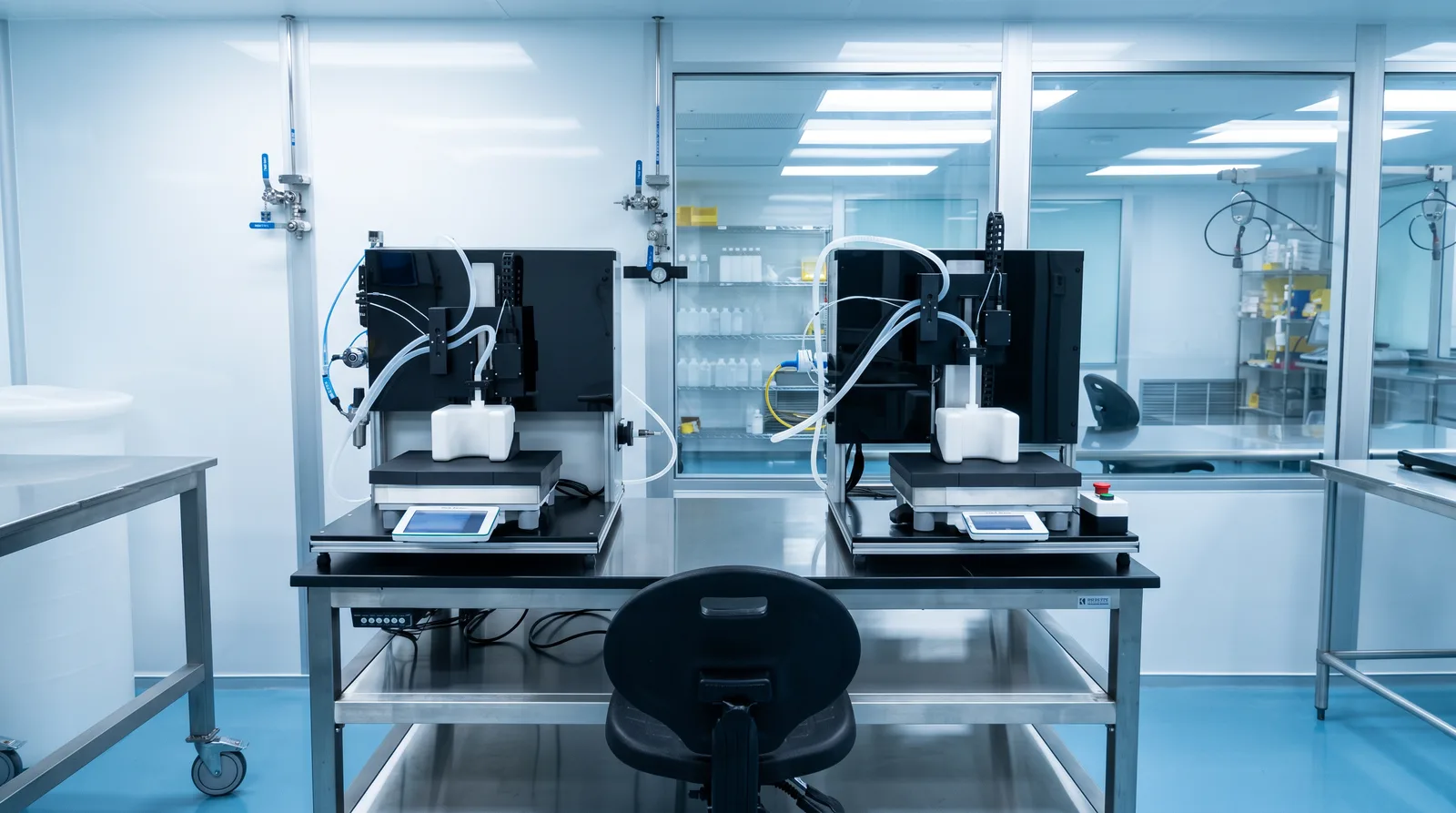
Point-of-care diagnostic device manufacturing automation chains strip preparation, reagent dispensing, cassette assembly, labeling, inline inspection, and packaging. The slowest station sets the line rate, and uptime and yield set the real output.
- A point-of-care test line is a chain of stations, and the slowest one sets the rate.
- Strip cutting, reagent dispensing, cassette assembly, labeling, or inline test each have their own limits.
- Do the rate math at yield and uptime, not nameplate speed.
- Then decide where semi-automation earns its keep and where full automation pays.
Point-of-care diagnostics keeps growing, though analysts can’t agree on how big it is. MarketsandMarkets puts 2026 at $20.63 billion. Knowledge Sourcing says $38.94 billion. Both forecast growth. For you, the useful question is smaller. What does the line look like, and what will it really produce?
I work as a fractional automation engineer for makers of consumable diagnostics and IVDs. When a team asks me for a point-of-care line, the first thing I do is draw the stations and find the slow one. Everything else follows from that.
This post walks the stations, does the rate math, and covers the two decisions that cause the most pain. Labeling, and how much to automate.
Lay out the line before you pick machines
Most lines share the same backbone, though the details change by product. Strips get made and cut, reagents go on, a cassette gets assembled, the unit gets labeled and tested, and then it’s packed.
| Station | What it does | What sets the limit |
|---|---|---|
| Lamination and cutting | Joins membranes to a backing web, cuts cards or strips | One continuous lamination system lists 1,200 cards per hour, and a web-fed system has assembled 120 test strips per minute |
| Reagent dispensing | Deposits and dries reagents on strips or in cartridges | One dispensing vendor says a single work cell supports up to a million tests per week |
| Cassette assembly | Places strips, closes housings | One platform equips a cassette with up to three strips in as little as 750 ms |
| Labeling and marking | Prints lot, expiry, and UDI, then verifies | OCR read time and label material |
| Inline test | Vision, leak, and seal checks | Some seal methods may need 100% testing in production |
| Packaging | Pouches, desiccant, cartons | Dry-room vs. dry-box space and changeover |
Those figures are vendor claims, each tied to one product and one setup. Use them to understand the range, not as your spec.
One more point on complexity. Cassette lines are one thing and molecular cartridges are another. A strip device has a few assembly processes, while a molecular device has many, because of the reagents and materials involved. Cartridges also need planning for the processes that carry quality risk. Welding, reagent deposition, drying, and sealing top that list. Invetech advises identifying those early.
Do the rate math at yield, not nameplate
Output equals line rate times available time times yield. Nameplate speed ignores two of the three.
A standard capacity calculation assumes seven hours per shift, per Invetech. The same guidance warns that teams forget setup before production, line clearance, cleaning, and independent verification after each batch. So your seven hours shrinks again.
Here’s the arithmetic, run on a rate I’ve seen in practice. I’ve run 80 PPM assembly lines at 95% uptime, 24/7. It took quick consumable change-outs and a design built to be maintained.
- 80 parts per minute over a 24-hour day gives 115,200 parts gross.
- At 95% uptime, that’s 109,440 parts a day.
- On one seven-hour shift, 80 PPM gives 33,600 gross, or 31,920 at 95%.
Now drop yield on top. Say your first weeks run below target, as Invetech says is normal. The shift number falls again. Write the yield ramp into your plan, not your hopes.
Treat labeling as a station, not an afterthought
At 200 PPM, you get 300 milliseconds per part. That’s the budget for printing, reading, and deciding.
Vision Systems reports that OCR processing can take anywhere from 30 ms to 1000 ms for a two-line, 30-character image, and that rates above 600 parts per minute typically need PC-based hardware. Smart cameras don’t keep up.
On one fill line, labeling was harder than the fill. We had to print lot and UDI data onto partially printed labels, inspect with OCR and OCV, and handle several label colors. Static on plastic-backed labels added its own trouble, and tandem roll replacement kept the line moving. Put labeling in the URS. If it first shows up at FAT or validation, you’re explaining a change order to management.

Semi-automated or fully automated
Volume and complexity decide it. Hahn Automation maps low volume and high complexity to manual, medium to semi-automated, and high volume with low complexity to full automation. Assembly Magazine says a company producing millions of assemblies annually has little choice but full automation. A medical-device design article puts the automated threshold at volumes above a million devices per year.
| Level | Best for | Watch for |
|---|---|---|
| Semi-automated | Rising volume, formats still changing | Operator variation at manual steps |
| Fully automated | High, stable volume on a locked design | Cost of change when the design moves |
I’d add a point from the transfer side. Products coming out of R&D often aren’t built for production. Get manufacturing engineering and R&D working together early so the process arrives automation-ready. Changing the process afterward can trigger a new regulatory submission, and FDA publishes guidance on when a change to a cleared device needs a new 510(k). And don’t automate until the sales numbers support it.
Best for teams moving a point-of-care product from pilot builds into production.
- Scenario one. You have a strip product at moderate volume. Semi-automate dispensing and cutting first.
- Scenario two. You have a molecular cartridge. Budget for process characterization and a longer yield ramp.
- Scenario three. Labeling has UDI and several label stocks. Specify it before quotes go out.
Next steps
Draw the stations. Find the slow one. Run the math at yield and uptime, and put labeling in the URS. Then the semi-versus-full call becomes arithmetic. For the URS itself, start with the consumable diagnostics URS guide. I also covered the semi vs. full decision in another post.
If you want help working through your line, book a Manufacturing Automation Assessment. It’s 30 minutes, and we start with your volume.
Questions teams ask about point-of-care lines
What does a point-of-care manufacturing line include?
Strip or cartridge preparation, reagent dispensing, cassette assembly, labeling, inline inspection, and packaging. Molecular cartridges add welding, sealing, and heavier inspection.
Do rapid test lines need a clean room?
Usually a dry or a controlled room. One vendor says its rapid-test line runs in a dry environment without a clean room, but your product risk analysis decides.
How do I calculate real line output?
Multiply rate by available time and yield. Then subtract setup, line clearance, cleaning, and verification time.
Can I start semi-automated?
Yes, and it’s often wise. Automate the critical steps first and expand when volume holds.
How fast can labeling run?
OCR read time ranges from 30 ms to 1000 ms per image, so speed depends on the system. Above 600 PPM, plan on PC-based vision.
The Bottom Line
Find the slow station, run the math at yield and uptime, and put labeling in the URS before quotes go out.
Reza Bashar at MEPSCo GAMP provides fractional automation engineering for medical diagnostic manufacturers, from URS development through IQ/OQ/PQ. If you are planning a point-of-care line, we start with your volume.