
R&D to Production Transfer for IVD and Diagnostic Manufacturers
R&D to production transfer for IVD manufacturers requires resolving partially defined process parameters before equipment can be specified — not after. Writing the URS before that gap is closed generates change orders. MEPSCo’s fractional automation engineering bridges the gap using Proof of Process work before procurement starts.
When your process parameters aren’t fully defined yet, equipment procurement can’t wait — and a wrong URS means change orders you never budgeted for. 96+ equipment installations.
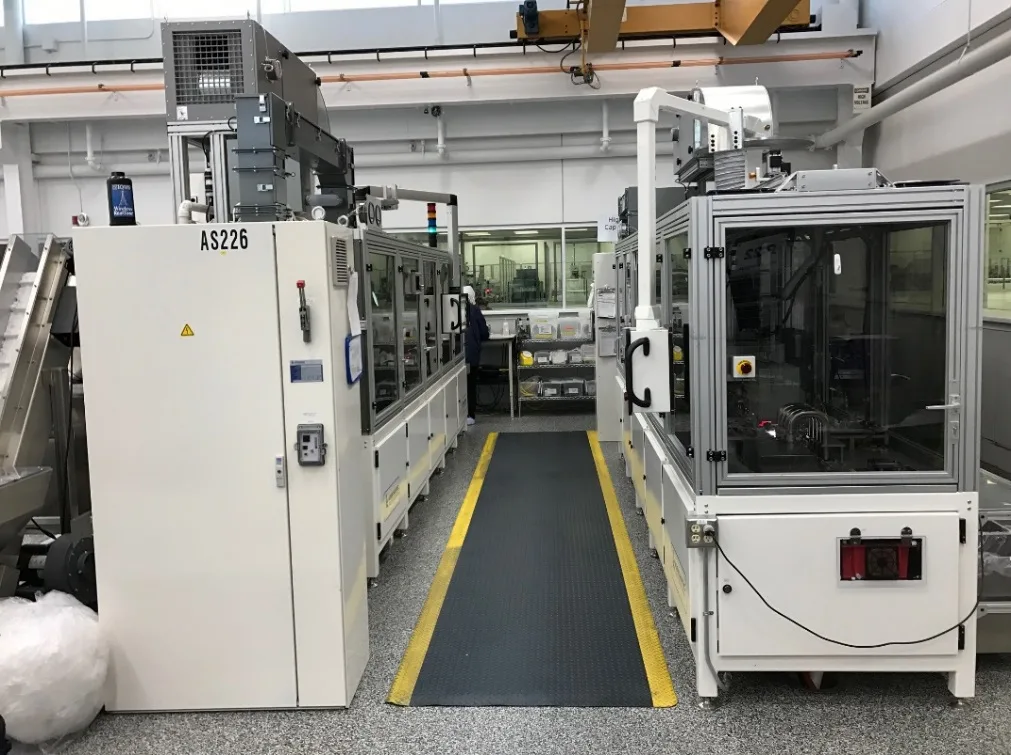
Most IVD manufacturers reach a transfer moment the regulatory frameworks don’t prepare them for.
The assay is validated. The bench process works. R&D is done by every internal definition of “done.” And then manufacturing asks the question that stops everything: “What are the process parameters we need to hold to run this at scale?”
Sometimes the answer is clear. Usually it isn’t. What R&D validates is that the biology works. What manufacturing needs is a process it can reproduce 5,000 times per shift without variability that kills the assay.
The gap between those two things is where equipment procurement gets expensive.
If you’re looking for a general overview of how IVD automation procurement works, that’s covered separately. What this page is about is the specific engineering problem of getting from a working bench process to a qualified production line — and why the sequence matters more than most manufacturers expect.
The R&D to Production Gap Is an Equipment Specification Problem
Every design transfer framework tells you to involve manufacturing early. Greenlight Guru’s design transfer guide makes the same point: proving a design on a few prototype units says little about whether it can run at full-scale production. ISO 13485 Clause 7.3.7 (incorporated directly into the FDA’s QMSR, effective February 2026) requires documented verification that designs are actually manufacturable before production specifications are finalized.
None of that is wrong. All of it misses the equipment engineering reality.
When an IVD assay is ready to transfer, it’s often ready in a biological sense. The reagents work. The detection mechanism is validated. What frequently isn’t defined yet is the mechanical process that will deliver consistent results at throughput. Dispense volumes may be characterized but not at automation-scale pump rates. Mixing parameters may be understood for a 2-liter bench vessel but not for a 200-liter production tank. Fill tolerances may be established for manual pipetting but not for a 4-channel rotary pump that needs to run 16 hours a day.
You can’t write a sound URS for equipment you don’t understand yet. Trying to do it anyway is how change orders get generated.
What POP/POC Does That Documentation Can’t
Proof of Process (POP) and Proof of Concept (POC) work is the step between “R&D done” and “ready to write the URS.” It’s where you take the bench process into the actual production environment — or as close to it as you can get — and establish the mechanical parameters that will govern equipment specification.
This isn’t pilot manufacturing. It’s engineering work. The goal is to answer specific questions: At what flow rates does this reagent behave predictably? What mixing energy keeps this suspension homogeneous at the volume we need? What dispense tolerance does this assay actually require at production speed?
Once those questions have answers, the URS can be written to hold those parameters. And when the URS holds the right parameters, the equipment you procure actually qualifies on first attempt.
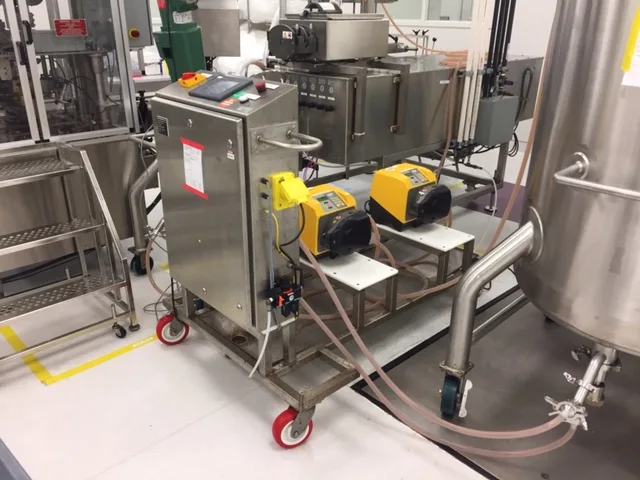
Case: Penetrable Cap Manufacturing Transfer
A medical device company needed to transfer a penetrable cap product from R&D into production. The process was being run manually — 6 operators across 3 shifts producing 1,000 caps per shift at variable quality. The process parameters and quality specifications at the point of transfer were only partially defined, and nothing yet existed that could drive an equipment specification for an automated machine.
Reza ran the POP/POC work first. It improved both welds, produced a better method for cutting and placing the wiping material, and put improved manual production equipment into the process. Output went from 1,000 to 5,000 caps per shift — 5x, with the same operators — before a single automated machine was ordered.
From the parameters that work established, Reza wrote the URS for a 40 PPM automated assembly machine, then managed its procurement and qualification. When demand grew, a new URS for an 80 PPM machine used a Kepner-Tregoe (KT) analysis to select the vendor. The 80 PPM machines were installed at multiple CMO sites and ran 24/7 at 95% uptime. Read the full case study.
That sequence (POP/POC, then URS, then procurement, then qualification) is what protects you from change orders. A URS written before the parameters are established is a guess. A guess generates change orders when the equipment arrives and the process doesn’t behave as the spec assumed.
Equipment Procurement on the Manufacturer’s Side
Most IVD manufacturers, when they reach the procurement phase, are talking primarily to equipment vendors. That’s where the expertise is concentrated, and vendors are usually helpful — they want to sell equipment. What they’re not doing is representing the manufacturer’s interest in the selection.
MEPSCo works exclusively on the manufacturer’s side. Vendor-neutral means the equipment spec is written to what the process needs, not to what’s convenient for any particular supplier’s product line. The URS goes out to multiple vendors. Quotes come back. When the technical differences are subtle enough that a KT analysis is warranted, that analysis is run — weighting the variables that actually matter to this manufacturer’s process, not to the vendor’s feature set.
ISO 13485 Clause 7.3.7, as incorporated into the QMSR that took effect in February 2026, requires that design transfer be documented, controlled, and verifiable — and that design outputs be confirmed as suitable for manufacturing before production specifications are finalized. That verification happens through the equipment qualification that follows procurement, but it can only produce clean results if the procurement was grounded in a URS that reflected reality.
A clean IQ/OQ/PQ package doesn’t fix an underspecified URS. The qualification tests against what the URS says. If the URS was written against assumed parameters rather than established ones, the qualification documents a process that doesn’t represent how production will actually run.
IVD Scale-Up Realities the Spec Sheets Don’t Cover
IVD processes have specific mechanical characteristics that standard pharmaceutical or medical device equipment wasn’t designed to handle. Getting the URS right means understanding those characteristics before procurement — not discovering them during qualification.
Magnetic particle suspensions
Magnetic particle suspensions settle. They settle at different rates depending on particle size, bead coating, and carrier fluid viscosity. A fill process that works at bench scale with a technician swirling the container every few minutes needs a continuous mixing and recirculation system at production scale. The pump type, the mixing energy, the recirculation rate, and the reservoir geometry all matter. Under-spec any of them and you get fill-to-fill variability that destroys assay performance.
When Reza worked on a magnetic particle suspension fill process, the solution wasn’t to find a standard fill-dispense platform and adapt it. It was to design a custom continuous suspension system — pump and valve skid, tanks, mixer, flow-through reservoir — that kept the suspension moving and eliminated the settling problem. The result was a reduction in sampling of over 95%. The thinking that got there came from Reza’s Walt Disney Imagineering background designing water effects, which is not something a standard equipment vendor catalog covers. Read the full case study.
Lyophilized bead manufacturing
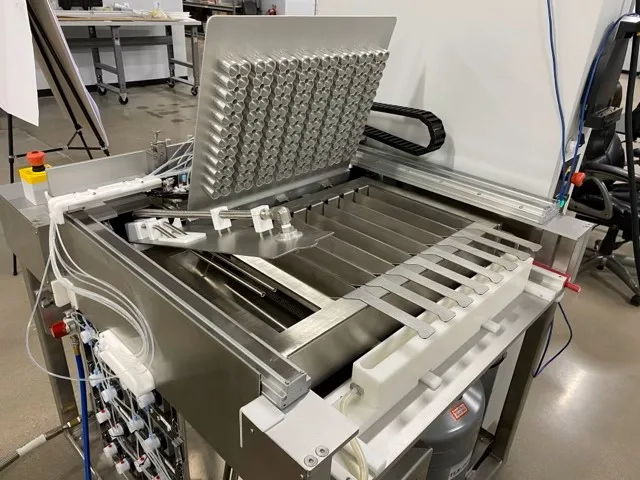
Lyophilized bead manufacturing compounds every R&D-to-production challenge simultaneously. The process is cryogenic. The product is fragile. The geometry is non-standard. And the reagent has to be dispensed in liquid form and then frozen into a bead without deforming, cracking, or losing biological activity.
One project Reza led started with R&D scientists using a pipette to drop reagent into a bead sieve in a liquid nitrogen bath. That process validated the biology. It wasn’t scalable. The transfer moved through a positive displacement pump, a 4-channel rotary unit, a full manufacturing suite including a dry room, and finally an 8-channel high-throughput system with an automatic LN2 tank transfer system designed with a cryo-vendor. Two patents came out of the process development work. The key insight at each stage was the same: write the URS to what the biology and process physics actually require, not to what equipment already exists. Read the full case study.
Foamy and viscous reagents
Foamy and viscous reagents fail dispense systems that are spec’d to water-like fluids. Foam knockdown, backpressure management, and purge cycle timing all need to be characterized in POP/POC work before they land in a URS. These are the parameters that vendors often omit from standard equipment proposals because they’re not visible until the actual process fluid runs through the system. See when standard fill equipment won’t work for non-standard IVD reagents.
How MEPSCo Runs a Transfer Engagement
MEPSCo’s GAMP process is the same 8-step framework regardless of whether a manufacturer is starting from scratch or bridging an R&D-to-production transfer. The difference is where the engagement starts. See what the documentation package includes and what it costs.
Step 1: Conceptual Requirements Document (CRD)
Captures what the process needs to accomplish, what constraints exist, and what’s known vs. unknown about parameters at the current stage of transfer.
Step 2: Budgetary URS and Vendor Quotes
An early-stage URS scoped to what’s actually defined, with vendor quotes requested to establish budget boundaries. This isn’t the final spec — it’s a realistic budget anchor.
Step 3: Project Management
Transfer engagements have milestones that aren’t just documentation milestones. POP/POC completion, parameter establishment, and URS finalization all have to sequence correctly before procurement moves forward.
Step 4: Final URS
Written after POP/POC work is complete and process parameters are established. This is the document that drives everything downstream. When it’s written correctly, change orders don’t happen.
Step 5: FRS/FDS/Trace Matrix
Functional Requirements Specification, Functional Design Specification, and the trace matrix connecting requirements to design elements. These documents are how you verify that the equipment being built or configured will actually hold the parameters the URS requires.
Step 6: FAT/SAT/IQ/OQ/Trace Matrix
Factory Acceptance Testing, Site Acceptance Testing, and full installation/operational qualification — conducted against the requirements established in the URS, not the vendor’s default test scripts.
Step 7: SOPs, Quality Systems, Transfer Documentation
The production process doesn’t exist until it’s documented to the standard production staff can follow it without the engineer in the room.
Step 8: Sustaining Activity Support
After transfer is complete, the process needs to keep running. Sustaining support is available for process upsets, equipment changes, or production volume changes that require URS revision.
Transfer With a Defined URS vs. Transfer Without One
| Without Defined URS at Procurement | With URS Grounded in POP/POC | |
|---|---|---|
| Equipment spec | Based on assumed parameters | Based on established parameters |
| Vendor selection | First available quote | Vendor-neutral with defined criteria |
| Change orders | Frequent — parameters shift during qualification | Rare — URS reflects actual process needs |
| Qualification outcome | Repeated cycles to close gaps | First-pass qualification against correct spec |
| Time to qualified production | 18–24 months typical | Compresses when URS is right from the start |
| Documentation defensibility | Qualification tests against a guess | Audit-ready trace from URS to qualification |
Who This Service Is For
MEPSCo’s R&D to production transfer work is built for:
- IVD and consumable diagnostic manufacturers transferring an assay from development to production scale for the first time
- Companies whose current production process started as an R&D process and has never been properly validated at production parameters
- CDMOs taking on a product transfer from a client and needing an equipment engineer on the manufacturer’s side to evaluate and qualify the incoming process
- Manufacturers mid-transfer who hit a change order problem and need an engineer to diagnose where the URS went wrong
It’s not the right fit for:
- Device-as-a-component manufacturers or implantable device companies (that’s a different engineering domain)
- Companies looking for a vendor representative to recommend specific equipment brands
- Projects where a full internal engineering team already covers automation procurement and qualification
What Manufacturers Ask Before Transfer Starts
What’s the difference between design transfer and process validation?
Design transfer is the documented handoff of design outputs from development to production — verifying that what was designed can actually be manufactured. Process validation confirms that the production process consistently produces a product meeting specifications. Design transfer has to come first. You can’t validate a process that hasn’t been transferred correctly.
When is it too early to start equipment procurement during R&D to production transfer?
Equipment procurement should start after POP/POC work has established the process parameters that will govern equipment specification — not before. Starting procurement before parameters are established means writing a URS against assumptions, which generates change orders when equipment arrives. The investment in POP/POC work almost always costs less than the first change order it prevents.
What happens when process parameters change after equipment is already ordered?
Change orders. The equipment was specified to parameters that no longer apply. Depending on how far the order has progressed, the fix ranges from a design change fee to a full procurement restart. MEPSCo’s POP/POC-first approach is specifically designed to prevent this scenario. Rebuilding equipment specifications twice in 18 months because the URS was written too early can cost more than the entire original equipment budget.
Does R&D to production transfer apply the same way at a CDMO as it does in-house?
The regulatory requirements are the same under ISO 13485 and the QMSR. At a CDMO, the transfer includes handing off documentation that allows production staff who didn’t develop the process to run it reproducibly — SOPs, training documentation, and a qualification package built to be handed off. Reza has deployed processes across multiple CMO sites and built documentation sets to support multi-site transfer.
What does a URS need to contain for an IVD scale-up to go smoothly?
A URS for an IVD scale-up needs process parameters at production conditions (not bench conditions), throughput requirements and their time horizon, reagent-specific equipment requirements (mixing, temperature, foam handling, fill tolerance), facility constraints (cleanroom class, utilities, footprint), and the regulatory requirements the qualification will test against. Missing any of these produces a gap that shows up as a change order or a failed qualification.
The Window Doesn’t Wait
IVD manufacturing is getting more competitive. The global IVD contract manufacturing market is forecast to grow at a 10.44% CAGR to $62.99 billion by 2035. Companies that compress the R&D-to-production timeline get to market first. Companies that burn 18–24 months on change orders and qualification cycles get there second.
The FDA’s January 2026 warning letter to Abbott Diabetes Care cited design transfer failures, including transfer of performance specifications to third-party manufacturers. It’s a reminder of what’s on the line when transfer is treated as a documentation exercise rather than an engineering one.
A missed transfer doesn’t just delay revenue. It generates 483s and warning letters at the worst possible moment in a product’s commercial life.
MEPSCo brings 96+ equipment installations, a GAMP documentation process that covers what a qualification package costs and what it includes, and a track record on exactly the kinds of IVD processes — magnetic particle suspensions, lyophilized bead manufacturing, non-standard fill systems — that create the most complicated transfer challenges.
MEPSCo GAMP works exclusively on the manufacturer’s side. We don’t represent equipment vendors, and our recommendations are driven by what the process requires — not by what any particular supplier sells. We serve IVD manufacturers, consumable diagnostic companies, and medical diagnostic CDMOs. We don’t serve catheter manufacturers, implantable device companies, or device-as-a-component manufacturers.
Related PagesLast updated: October 26, 2026
Tell Us Where Your Transfer Stands
Every week a product sits between R&D and production is a week the market window doesn’t wait.
If your product is anywhere in the R&D-to-production pipeline — or stuck in it — we’ll tell you what can be scoped right now and what needs POP/POC work first.