
Non-Standard Fills in IVD Manufacturing: Why Off-the-Shelf Automation Falls Short
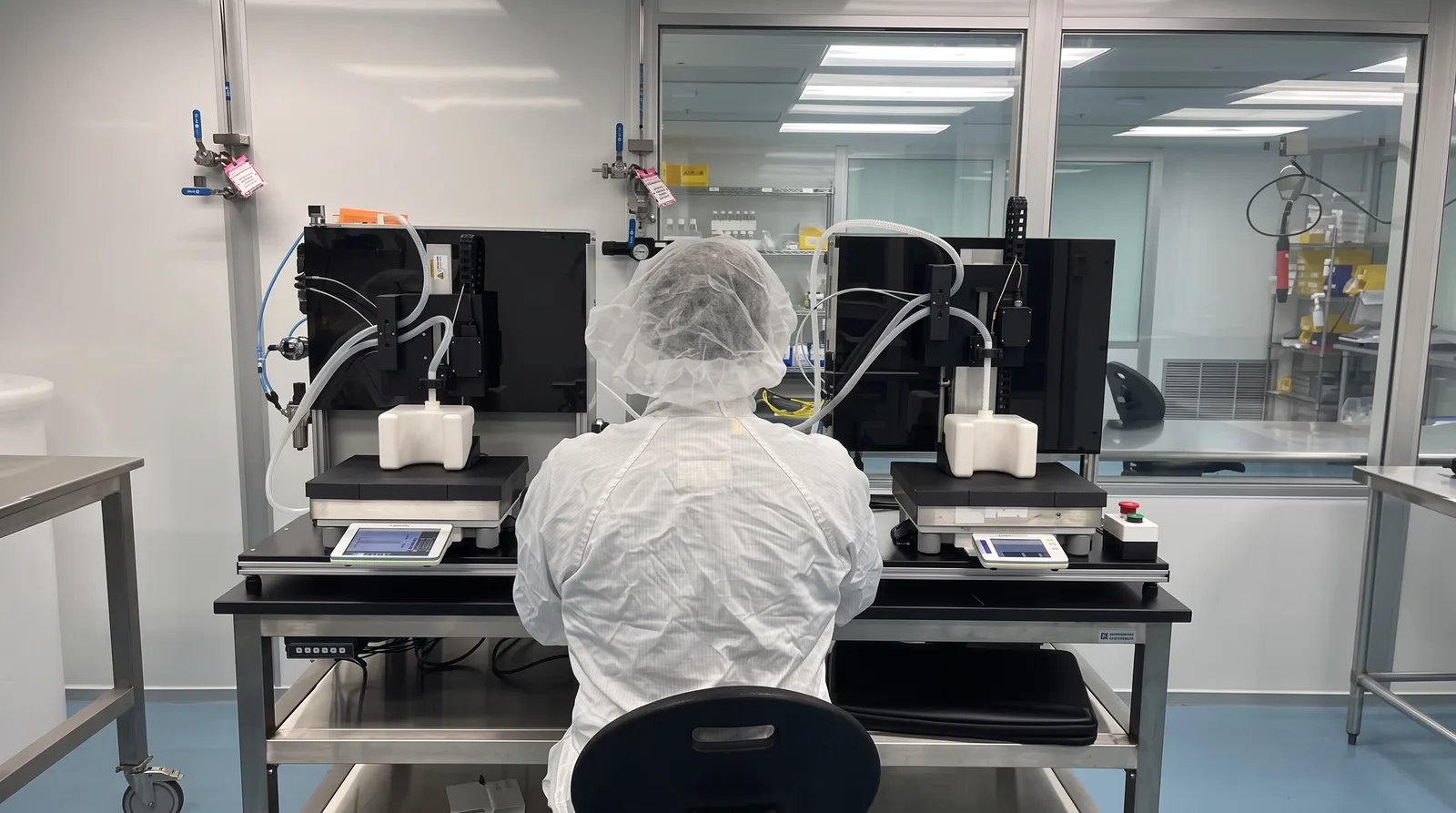
IVD reagent fills require custom automation because substrate shapes, fluid properties, and sealing methods vary too widely for standard pharmaceutical filling equipment to handle accurately or pass validation.
- Pharma fillers assume standard vials and predictable liquids; IVD reagents foam, suspend particles, or arrive as lyophilized beads, so off-the-shelf equipment rarely fits.
- Buying cheap and retrofitting later cost more than a purpose-built system in the project described here, and the timeline doubled.
- Start with the reagent’s physical properties and work backward to the nozzle, pump, and materials, not the other way around.
- Custom equipment keeps the validation chain from URS to PQ clean, and Quality has to be in the room before the purchase order is signed.
If you manufacture diagnostic reagents, you’ve already figured out that buying a standard filler doesn’t work the way the equipment vendor promised. I’ve worked on 96+ automation projects for IVD and medical diagnostic manufacturers over 25 years. The pattern repeats itself. A company searches for an IVD automation procurement partner to source fill equipment, finds options designed for pharmaceutical vials or syringes, and assumes the technology will transfer.
It won’t.
Standard off-the-shelf filling equipment was really built for pharma. Vial filling. Syringe filling. Clean, predictable, high-volume runs with standardized containers. Diagnostics filling? That’s a different discipline entirely. Your substrates aren’t standard. Your reagents aren’t standard. Your cap types, your sealing methods, your leak detection requirements, your light sensitivity protocols. None of it maps to what a pharma filler was engineered to do.
I’m Reza Bashar, a fractional automation engineer at MEPSCo GAMP, and this is the reality I see on every IVD project that walks through my door.
What Makes IVD Fills "Non-Standard" Compared to Pharmaceutical Filling?
IVD fills are non-standard because diagnostic manufacturers use unique substrates, proprietary bottle shapes, specialized caps, and reagents with unpredictable physical properties that no single off-the-shelf system was designed to accommodate.
Pharmaceutical filling operates within well-defined parameters. The vial is a vial. The syringe is a syringe. Container dimensions, closure systems, and fill volumes follow established industry standards. IVD manufacturing doesn’t have that luxury. Every diagnostic product introduces variables that require purpose-built equipment.
Think about what actually varies across IVD product lines. Substrate types alone cover an enormous range. Blister packs, pouches, custom-molded trays, odd-shaped bottles, cassettes, cartridges. Then layer on cap types. Snap caps, screw caps, heat-sealed foils, press-fit closures. Each one needs a different sealing mechanism and a different leak detection method.
Now add the reagent itself. Some reagents foam when dispensed at standard speeds. Others contain magnetic particles that settle out of suspension within minutes. Some are light-sensitive and can’t be exposed during filling. Others are lyophilized beads that require liquid nitrogen baths and positive displacement pumps instead of peristaltic systems.
Huge range. No two products the same.
The reagent filling systems market hit $10.25 billion in 2024 and it’s growing at 5.9% annually through 2034. That growth is happening precisely because off-the-shelf doesn’t cover the variety IVD demands.
Why Does Off-the-Shelf Fill Equipment Fail in Diagnostics Manufacturing?
Off-the-shelf fill equipment fails in diagnostics because it was engineered for pharma’s standardized containers and predictable fluid behaviors, not for the substrate variety, reagent complexity, and tolerance requirements unique to IVD products.
A standard pharmaceutical filler assumes your bottle fits a known specification, your liquid flows predictably, and your fill tolerance sits within a range the machine was calibrated for at the factory. Remove any of those assumptions and the machine can’t deliver. IVD manufacturing removes all 3.
I’ve seen this play out dozens of times. A manufacturer buys a standard industrial filler because the price looks right and the lead time is short. Within weeks, they discover the nozzle geometry doesn’t match their bottle opening. The pump can’t handle their foamy reagent without introducing air bubbles. The fill accuracy drifts outside their required tolerance at the speeds they need.
And here’s where things get expensive.
Quality can’t validate it. Under ISO 13485 clause 7.5.6 (which the QMSR incorporated in place of the old 21 CFR 820.70(i)), software that runs an automated production process has to be validated for its intended use. If the equipment wasn’t designed for your intended use, you can’t write a User Requirement Specification that matches what the machine actually does. Your IQ/OQ/PQ documentation falls apart before you even start. That’s not a theoretical risk. I’ve cleaned up that mess on multiple projects.
A packaging defect on a diagnostic consumable is a failed test result. Not a cosmetic issue. A clinical one. The stakes for fill accuracy in IVD aren’t the same as filling shampoo bottles.
What Happens When You Buy Standard Equipment and Try to Retrofit It?
Here’s a real example from my project files.
An engineer at a diagnostics company bought a cheap industrial filler for their medical device production line. The price was attractive. The machine looked capable. And the vendor said it would work.
It didn’t.
When Quality reviewed the equipment, they couldn’t answer 5 basic validation questions about how the machine operated. The documentation didn’t support GAMP requirements. The control system wasn’t designed for the precision their process needed. Dead end.
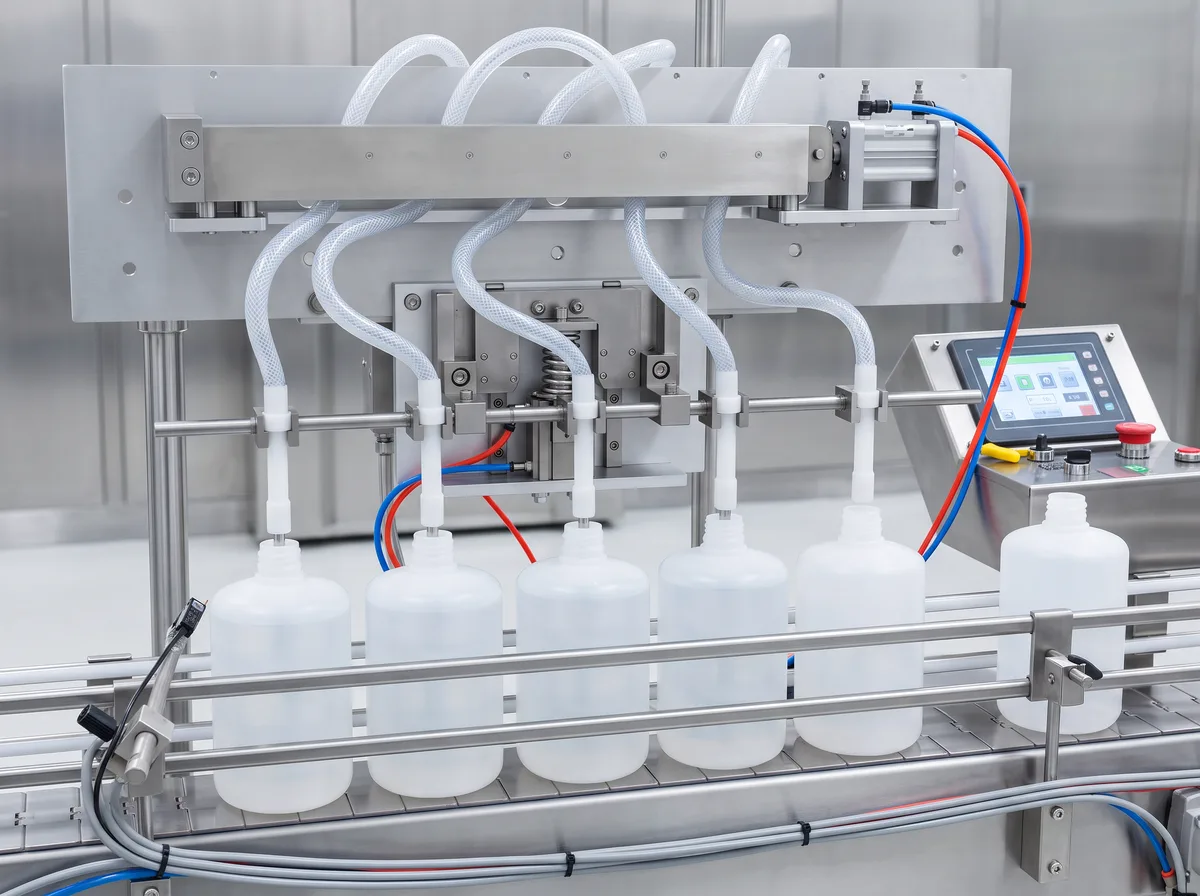
We ended up retrofitting the entire machine. Custom 5-channel pinch valve system. Complete HMI reprogramming. New control logic from scratch. By the time the retrofit was finished, the company had spent more than a purpose-built system would have cost. And the project timeline? Doubled.
No shortcuts.
The lesson isn’t complicated. There aren’t shortcuts in equipment procurement for validated manufacturing. Buying cheap up front and retrofitting later costs more in dollars, more in time, and more in risk to your quality system. Every single time.
Consider this. IVDs influence roughly 2 out of every 3 clinical decisions while accounting for only about 2% of healthcare spending. The equipment that manufactures these products can’t be an afterthought.
How Do You Build a Fill System That Actually Works for Your Reagent?
You start with the reagent’s physical properties and work backward to the equipment. Not the other way around. Custom nozzle design, pump selection, and material compatibility come before anything else.
Every custom IVD fill system I’ve built starts with understanding the liquid. Viscosity, surface tension, foaming tendency, particle content, light sensitivity, temperature requirements. The reagent tells you what pump type works, what nozzle geometry you need, what fill speed is achievable, and what materials can contact the fluid without compromising assay performance.
A CMO in Carlsbad came to me with an odd-shaped bottle and a foamy reagent. Standard fillers introduced air bubbles at any useful speed. Nobody could solve it with off-the-shelf nozzles. We designed a custom nozzle from scratch, built 2 complete fill units, and had them operational in under 2 months. The system filled over 1 liter per unit in under 60 minutes and exceeded their performance targets. That project went from "we don’t know how to fill this" to full production in 8 weeks.
Different challenge entirely. A diagnostic manufacturer needed to fill a magnetic particle suspension. The particles settled out of suspension so quickly that pre-weighing batches and then filling created unacceptable variation in the final product. Not a small problem. A product-killing one.
We built a custom pump and valve skid with integrated tanks, a mixer, and a flow-through reservoir that kept particles in suspension continuously during the fill cycle. The system eliminated the pre-weighing step entirely and reduced their sampling requirements by 95%.
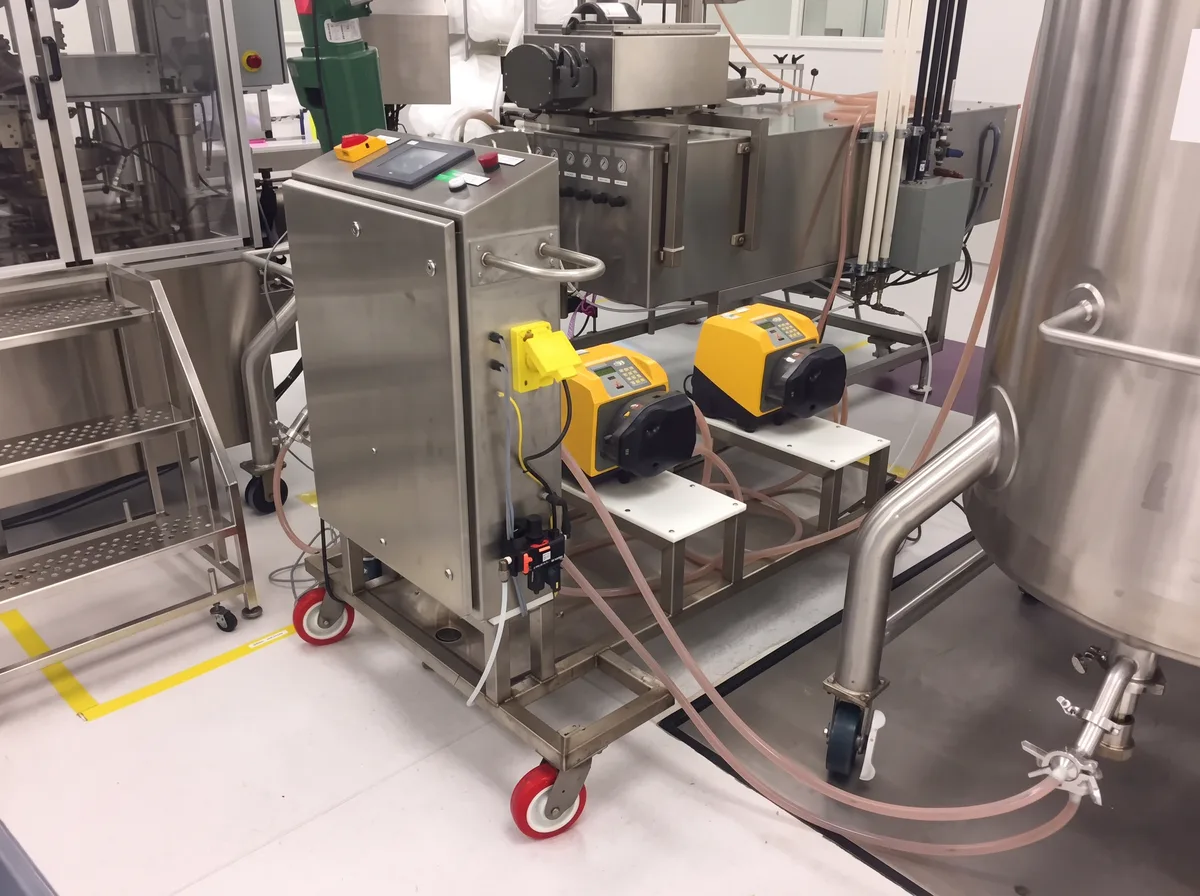
Two completely different reagents. Two completely different fill challenges. Both required custom builds because no off-the-shelf system could have handled either one. That’s the pattern in IVD.
What Does Validation Look Like for Custom IVD Fill Equipment?
Validation for custom IVD fill equipment follows the same IQ/OQ/PQ framework as any validated system, but the User Requirement Specification is written around your specific reagent and process. Not a generic machine capability.
That’s the real advantage of custom. When the equipment is purpose-built for your product, the URS describes exactly what the machine does. Your Factory Acceptance Test matches your Site Acceptance Test. Your Installation Qualification confirms what was designed. The documentation chain from requirement to qualification stays clean because there’s no gap between what the machine was built to do and what your process requires.
With off-the-shelf equipment, there’s always a gap between what the vendor’s documentation says and what your process actually requires. You end up writing custom validation protocols on top of generic machine documentation. Quality spends weeks reconciling the two. I’ve watched that reconciliation process burn 6 to 8 weeks on projects where it should have taken 2.
Custom automation built under GAMP guidelines for IVD manufacturers eliminates that gap entirely. The URS is your document. The design spec traces directly to your requirements. FAT, SAT, IQ, OQ, PQ all follow a single thread.
I’ve worked on 96+ projects. The ones that go smoothly through validation share one thing. The equipment was designed around the product from day one. Not adapted. Not retrofitted. Designed.
When Should an IVD Manufacturer Invest in Custom Fill Automation?
Not every fill operation needs custom automation. If you’re filling standard vials with a well-characterized liquid at high volume, an off-the-shelf system might work fine. Pharma fills fit that profile regularly.
But if any of these apply to your operation, custom is the right path.
- Your substrate shape doesn’t match standard vial or syringe dimensions
- Your reagent foams, separates, or contains suspended particles that settle on standing
- Your fill volume sits below 100 microliters or above 500 milliliters, outside the sweet spot for off-the-shelf calibration
- Your process requires environmental controls like nitrogen blanketing, light protection, or temperature management during the fill cycle
- Your sealing method isn’t a standard crimp or snap cap
- You need to validate the equipment under 21 CFR 820 or ISO 13485 for your specific product, and generic vendor documentation won’t support your URS
Here’s what I tell every IVD manufacturer I work with. If your Quality team can’t write a URS for the equipment you’re considering, you don’t have the right equipment. Walk away. And if the vendor can’t answer your 5 fundamental validation questions about how their machine operates, that tells you everything.
| Factor | Off-the-Shelf | Custom-Built |
|---|---|---|
| Substrate compatibility | Standard vials and syringes only | Any shape, size, or material |
| Reagent handling | Simple liquids with predictable viscosity | Foamy, particulate, lyophilized, light-sensitive |
| Validation documentation | Generic; requires adaptation for your process | Purpose-built URS with clean IQ/OQ/PQ chain |
| Lead time | 4 to 8 weeks | 8 to 16 weeks depending on complexity |
| Total cost of ownership | Lower upfront; higher if retrofit needed | Higher upfront; lower lifetime when matched to process |
| Quality risk | High if process doesn’t match design intent | Low because design intent equals process requirement |
The global IVD market is projected to reach $144 billion by 2028. That growth means more reagent variety, more substrate types, and more fill challenges that standard equipment was never designed to handle. The demand for custom isn’t slowing down. It’s accelerating.
Sources: Future Market Insights — Reagent Filling Systems Market; Cambridge Consultants — In vitro diagnostics needs seismic change; eCFR — 21 CFR Part 820.
What IVD Manufacturers Ask About Fill Automation
Why can’t I just use a pharmaceutical filler for my diagnostic reagent?
48 out of 50 IVD projects I’ve worked on required modifications that a standard pharma filler couldn’t accommodate. Pharma fillers expect standardized vials with predictable liquids. Diagnostic reagents come in proprietary substrates with fluid properties (foaming, particle suspension, light sensitivity) that standard machines weren’t engineered to handle. You’ll spend more retrofitting than building custom.
How long does it actually take to design and build custom fill equipment for IVD?
Depends entirely on the reagent and the process. Simple custom nozzle design and pump selection runs 6 to 8 weeks. A full automated fill line with integrated mixing, environmental controls, and validation documentation? 3 to 5 months. I’ve built 2 complete fill units in under 2 months for a CMO in Carlsbad when the scope was well-defined from the start.
So what exactly does GAMP documentation cover for fill equipment?
Good Automated Manufacturing Practices documentation traces the entire equipment lifecycle. URS defines what the machine needs to do. Design specs detail how. FAT confirms it works at the builder’s facility. SAT confirms it works at yours. IQ/OQ/PQ qualifies installation, operational parameters, and process performance. The chain is only clean when the equipment was designed for your process from the start. Try running that chain on a machine that was designed for a different product. Doesn’t hold.
Is custom fill automation actually more expensive than buying off-the-shelf?
Upfront cost? Usually, yes. Total cost? Almost never. I’ve retrofitted standard equipment for diagnostics companies 3 separate times. Each retrofit cost more than a purpose-built system would have, and that’s before you add the validation rework, timeline delays, and quality risk. The math changes fast once Quality gets involved.
Can you retrofit existing equipment instead of building from scratch?
Sometimes. We’ve done complete retrofits, including a 5-channel custom pinch valve system and full HMI reprogramming on one project. But retrofitting has limits. If the underlying mechanical platform doesn’t match your substrate geometry or your control system can’t achieve the precision your process requires, you’re just spending money to delay the real answer. I’d rather build it right the first time.
What’s the single biggest mistake IVD manufacturers make with fill equipment?
Buying equipment before talking to Quality. Not exaggerating. The engineer finds a machine, the price fits the budget, procurement signs the PO. Then Quality looks at it and can’t write validation protocols because the machine wasn’t designed for the intended process. I’ve seen this pattern on more projects than I should admit. Always loop Quality in before the purchase order. Not after. That one change prevents the entire downstream mess.
The Equipment Has to Be as Specific as the Product
IVD manufacturing isn’t pharmaceutical filling with different labels. The substrates, the reagents, the sealing methods, the tolerances, the validation requirements are all specific to your product. The equipment has to be specific too.
3 things to take from this. First, don’t assume pharma fill equipment transfers to diagnostics. The fluid behaviors, the container geometries, and the validation requirements are fundamentally different. Second, start with the reagent’s physical properties and work backward to the machine design. Third, make sure your equipment can support a clean validation chain from URS through PQ before you sign a purchase order. Not after.
If you’re evaluating fill automation for a diagnostic product and your current equipment can’t answer your Quality team’s questions, that’s the conversation to have with an equipment procurement and vendor management partner who understands IVD.