
Scaling IVD Production from R&D to Manufacturing: The Automation Procurement Path

Scaling an IVD product from R&D to manufacturing requires a structured path through proof-of-principle testing, manual production runs, URS documentation, and GAMP-compliant vendor qualification before committing to automation procurement.
R&D doesn’t hand you a production-ready process. It hands you a concept. The engineering team has to prove it works at scale, capture every detail in a URS, then validate the market before spending on automation. Skip any of those steps and you’ll burn capital on equipment that doesn’t match what you actually need to build.
I’ve watched this play out dozens of times. R&D finishes development on a diagnostic product, declares it ready, and tosses it over the wall to manufacturing. The engineering team opens the file, looks at the process, and immediately sees 5 things that won’t work on a production line. The automation procurement process for IVD manufacturers isn’t just about buying a machine. It’s about building the bridge between a lab process and a validated production system. And that bridge has more steps than people expect.
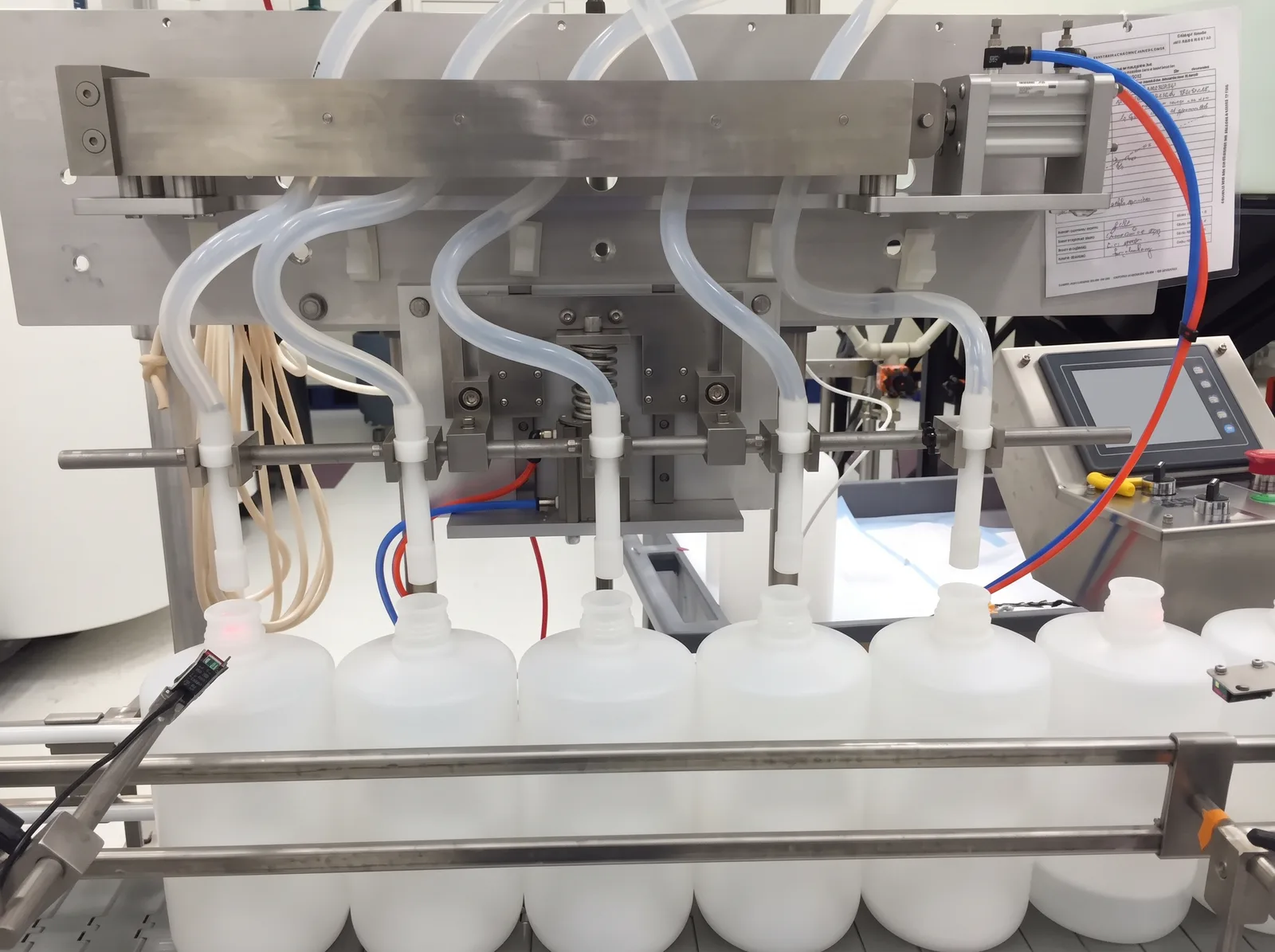
The IVD space is different from standard medical device manufacturing. You’re dealing with reagents that have unique viscosities, light sensitivities, fill volumes, and substrate requirements. Cartridges, tubes, bead fills, foil seals. Each one demands a different approach to automation. You can’t just drop an off-the-shelf vial filler onto the line and call it done.
This post walks through the actual trajectory from R&D handoff to full automation. Not the theoretical version. The real one, where sales needs to validate the numbers before engineering gets the green light to spend.
What Happens When R&D Hands Off an IVD Product?
The transferred process is almost never production-ready. R&D develops products to prove they work. Manufacturing engineering has to prove they can be built repeatably, at volume, within tolerance.
That gap is where projects stall. R&D groups tend to operate as silos. Scientists focus on efficacy, sensitivity, specificity. They aren’t thinking about pump compatibility, cycle times, or whether the sealing method they chose will survive a 50,000-unit production run. And they shouldn’t have to. That’s engineering’s job.
But the handoff itself is the problem. A BriefGlance analysis of medtech scaling found that moving a device from prototype to GMP readiness typically takes 19 to 24 months and can triple re-engineering costs. For IVD products with complex reagent chemistries, that timeline stretches further.
The fix isn’t complicated. It just requires intentional collaboration. R&D and manufacturing engineering should be in conversation before the 510(k) submission, not after. If the pumping system R&D used in the lab doesn’t match what the production equipment will use, you’re looking at a supplemental FDA submission. That adds months.
What Does the Real Product Trajectory Look Like?
Forget the textbook version where everything moves in a clean line from bench to full automation. Here’s what actually happens.
R&D transfer. The product arrives in manufacturing with a process that works in the lab. Engineering runs proof-of-principle tests (POPs) to figure out how to make that process production-viable. Different technologies, different speeds, different tolerances. This stage is about finding what works at scale, not just what works.
Manual production. If the market is early and volumes are low, you start with manual assembly and filling. This isn’t a failure. It’s intelligence gathering. Every manual run teaches the team something about the product’s behavior under real conditions. How does the reagent settle? What’s the actual fill variance? Where do operators struggle?
Knowledge capture and URS development. This is the step that gets shortchanged. All of that manual production knowledge needs to get captured in a User Requirement Specification document. The URS describes the process in enough detail that an automation vendor can build the right equipment. Skip details here and you’ll pay for it in change orders later.
Semi-automation. Depending on volume projections, the next move might be semi-automated production. Not everything needs to go straight to full automation. Sometimes a hybrid approach makes more sense while the market develops.
Full automation. Only after volumes justify the investment, the URS is complete, and vendor qualification is done. Not before.
The sequencing matters. I’ve worked on projects where a company jumped from R&D directly to full automation because leadership was impatient. 2 of those projects needed major rework within the first year because the engineering studies hadn’t been thorough enough. The R&D to production transfer guide covers the full process in detail.
Why Does Sales Have to Validate Before Engineering Spends?
The sales group has to make sure the numbers are right before the company commits to automation. Full stop.
I say this to clients all the time. Don’t automate prematurely. A full custom automation line for an IVD product can run anywhere from $500K to $3M depending on complexity. With the global IVD market projected to exceed $107 billion by 2029, the growth is real. But your product’s slice of that market needs to justify the capital spend.
Here’s what that validation looks like in practice. Sales forecasts need to show sustained volume demand, not just a spike from a single contract. The production team models the unit economics at different volume tiers. Finance runs the breakeven analysis. Only when all three groups agree that the demand is real and durable does engineering get the budget to proceed.
I’ve seen companies spend $1.2M on automation equipment for a product that never exceeded 30% of its projected volume. The machine sat underutilized for 3 years before they finally repurposed parts of it. That’s not an automation failure. That’s a sales validation failure.
How Do You Write a URS That Actually Works?
The URS is the single document that everything else traces back to. Assembly Magazine’s 8-step URS framework puts it well: the goal is simplicity. State what output you need from the machine. Don’t over-specify internal design choices. Treat the machine as a black box.
Good advice in theory. But IVD products add layers of complexity that general guidance doesn’t cover.
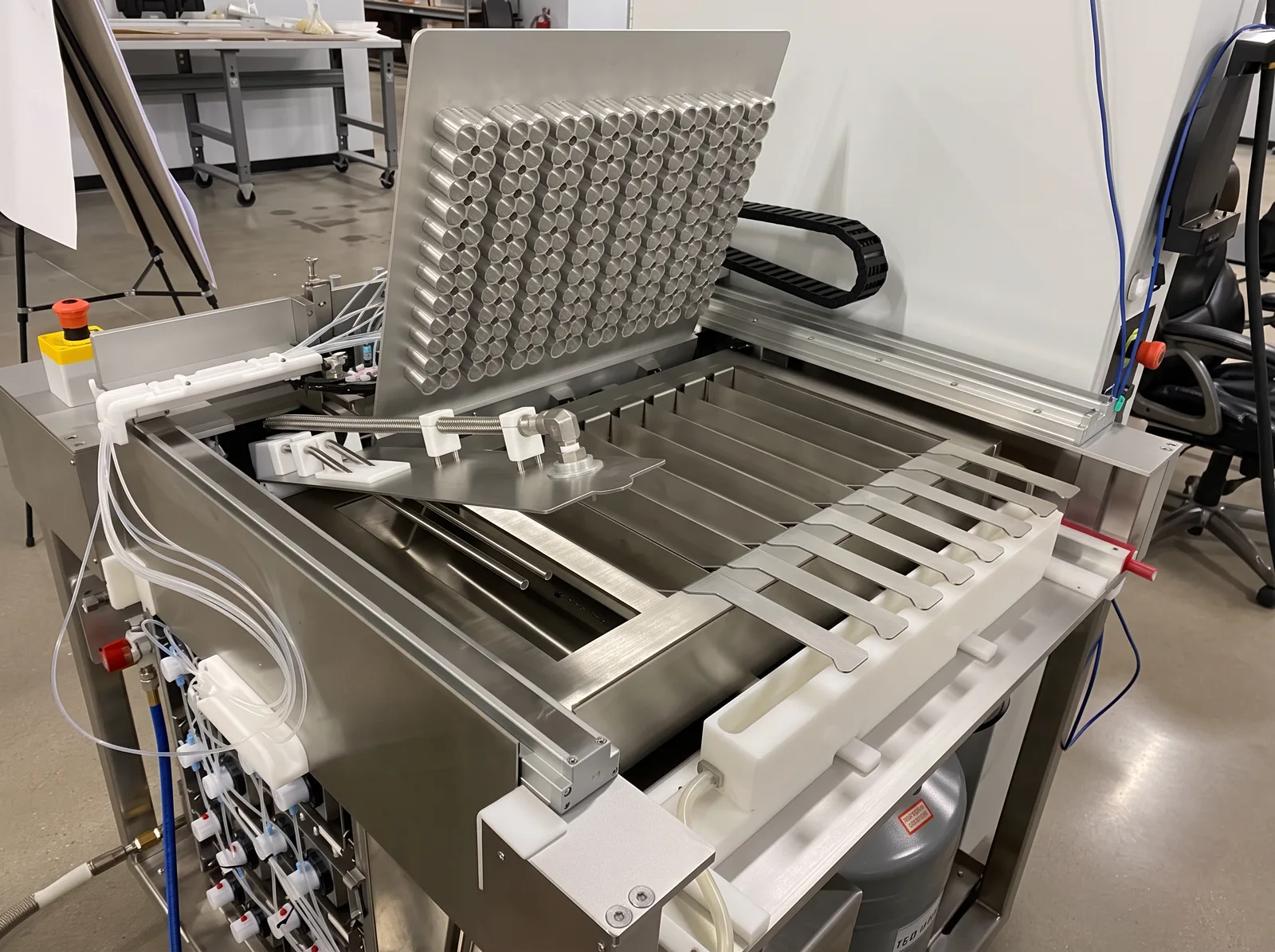
Your URS for a diagnostic fill line needs to address reagent-specific considerations. Viscous materials need different pump types than aqueous solutions. Light-sensitive reagents need UV-protected pathways. Caustic materials need corrosion-resistant contact surfaces. Bead manufacturing has entirely different dispense mechanics than liquid fills.
Then there’s the substrate. Cartridges, tubes, microwell plates, lateral flow strips. Each one has different handling requirements, different sealing methods (heat seal, foil seal, adhesive), and different tolerance ranges. Your URS has to capture all of it.
The interview process is where it starts. Someone with deep knowledge of both the product and the manufacturing process sits down with the production team, the operators, quality, and maintenance. Not for 30 minutes. For days, sometimes weeks. GAMP documentation services exist specifically because this work takes real expertise and real time. Automation vendors don’t spend enough time onsite to capture it all, which is why they shouldn’t be writing the URS themselves.
Why Shouldn’t the Automation Vendor Write the URS?
Because they’re quoting against the document they wrote. Conflict of interest.
I’ve lived through this scenario. The vendor writes the URS, submits a quote based on their own requirements, wins the job, and then 6 months later during FAT testing the machine can’t do something the manufacturing team assumed it would. The vendor points at the URS and says “that wasn’t in the spec.” And they’re right. Because they’re the ones who decided what went in.
The people who sign the contract are on the hook for what the URS says. If the vendor wrote it, they controlled the scope. If a critical requirement was left out, intentionally or not, that becomes a change order. And change orders on medical device automation projects are a guaranteed way to blow the budget and the timeline.
An independent party with deep product knowledge and automation procurement experience should own the URS. Someone who understands both the product requirements and what the automation equipment needs to deliver. That separation keeps everyone accountable.
How Do You Qualify the Right Automation Vendor?
Once the URS is done, it goes out to bid. This is where the GAMP process really starts to pay for itself.
Vendor qualification isn’t just about who gives you the lowest number. MasterControl’s supplier qualification research makes the point that purchase RFPs typically focus on functionality while ignoring a vendor’s GMP practices and quality management structure. That’s backwards.
What you actually need to evaluate falls into several categories.
Quality systems. Are they ISO 13485 certified? Do they have document control, design history files, configuration management? Not every automation shop has these. Some are great machinists who build excellent equipment but don’t maintain the documentation trail that medical device manufacturing demands.
Industry reputation. Have they built IVD-specific equipment before? Do they understand the regulatory environment? A vendor who builds great automotive assembly lines might not understand what validated state means for a diagnostic fill system.
URS compliance. Did they actually read the requirements document? I use a Kepner-Tregoe scoring methodology to evaluate vendor bids against weighted criteria. Technical capability, quality systems, financial stability, URS compliance, project management, references. Management cares about cost. Engineering cares about capability. The KT process forces both perspectives into a single evaluation framework.
The lowest bid almost always costs more. I’ve had projects where management overrode the KT scores and went with the cheapest vendor. The project came in a year and a half late with significant cost overruns from change orders. Some automation companies, and I hate saying this, but they overstate their capabilities to win bids. The qualification process is how you verify before you commit.
What Happens After Vendor Award?
Contract award kicks off the build phase, which flows through a specific sequence. According to MDDI Online’s process validation framework, the validation sequence runs through design qualification, IQ, OQ, and PQ, and a process is validated only when all steps are completed and documented.
Design and build. The vendor builds the equipment per the URS. Throughout this phase, there should be a traceability matrix tracking every requirement from the URS through design, build, and test. Every line item in the URS gets a corresponding verification.
Factory Acceptance Test (FAT). This happens at the vendor’s facility before the equipment ships. The FAT tests every function against the URS requirements. If the URS and trace matrix were done properly, FAT becomes a structured verification exercise. If they weren’t, FAT becomes a discovery exercise. Big difference.
Site Acceptance Test (SAT). Same tests, repeated at your facility after installation. Environmental factors change results. Lighting is different. Air handling is different. Floor vibration is different. What passed at the vendor’s shop needs to pass in your production environment.
IQ/OQ/PQ. Installation Qualification confirms the equipment is installed correctly. Operational Qualification tests all functions. Performance Qualification runs production with real product to verify the process handles real-world variability. Delta ModTech’s validation framework emphasizes that predetermined specifications need to be defined early, before design begins. Not after.
The whole sequence traces back to the URS. Everything does. That’s why getting it right at the beginning saves so much pain at the end.
Where Does IVD Scale-Up Go Wrong?
Same patterns, over and over.
Engineering studies get rushed. The POP phase gets compressed because leadership wants to see the product in market. Variables that should have been tested under controlled conditions get discovered during validation instead. By then it’s expensive.
The URS interview is shallow. Someone spends 2 days on it instead of 2 weeks. The reagent’s behavior under temperature variation isn’t documented. The fill tolerance for viscous materials isn’t specified precisely enough. The sealing method’s failure modes aren’t cataloged.
Vendor selection follows the budget, not the scoring. The cheapest vendor wins, and 9 months later the project is 40% over budget from change orders because the vendor underscoped the work. Or worse, their project manager left mid-build and nobody at the vendor has context on the decisions that were already made.
The traceability matrix isn’t maintained. Requirements get added verbally during build reviews and never make it back into the documentation. When FDA shows up for an audit, they’re looking at whether your manufacturing process is in a properly validated state and can handle the variability of your product. If you can’t show that traceability, per 21 CFR Part 820 process validation requirements, you’ve got a problem.
When Is the Right Time to Move from Manual to Automated IVD Production?
Not a fixed number. Product-dependent.
A high-value, low-volume assay might stay on manual production indefinitely. A consumable diagnostic cartridge that’s selling 100,000 units a month needs automation 6 months ago. The trigger isn’t “we want to automate.” It’s “manual production can’t keep up with validated demand.”
Here’s how I think about the decision.
Semi-automated makes sense when: you’re running 10,000 to 50,000 units per month, your process is well-characterized and documented, and your quality data from manual runs shows consistent yields. The investment is lower, the risk is manageable, and you maintain flexibility to adjust if the product changes.
Full automation makes sense when: validated sales forecasts show sustained volumes above 50,000 units per month, the URS is complete and reviewed, engineering studies confirm the process handles product variability, and you’ve completed vendor qualification. The HCLTech IVD automation analysis notes that the IVD industry is moving toward an automation-first approach, with the global IVD market projected to reach $144 billion by 2028. But “automation-first” at an industry level doesn’t mean your specific product is ready today.
Don’t let the market narrative drive a capital decision that your product data doesn’t support yet.
Conclusion
The path from R&D to automated IVD production is longer and more structured than the org chart suggests. R&D transfers a concept. Engineering proves it works at production scale. Manual runs generate the knowledge that feeds the URS. Sales validates the demand. Vendors get qualified on more than price. And validation confirms the whole system hangs together.
Every shortcut taken before the URS is finalized shows up later as a change order, a failed validation run, or a piece of equipment that doesn’t quite do what you needed it to.
If you’re an IVD manufacturer preparing to scale from R&D to production, the smartest thing you can do is invest in the documentation and engineering study work before you spend on hardware. The machine is the easy part. Knowing exactly what to tell the machine to build is the hard part.
MEPSCo GAMP is a fractional automation engineering firm that helps medical diagnostic manufacturers navigate the full GAMP lifecycle, from URS development through vendor qualification, FAT/SAT, and IQ/OQ/PQ validation. With 96+ completed projects and 25+ years of experience, we sit between the manufacturer and the automation vendor to make sure nothing falls through the gaps. If you’re preparing to move an IVD product from R&D to manufacturing, a Manufacturing Automation Assessment is the right first step.
Common Questions About IVD Production Scale-Up
How long does it typically take to move an IVD product from R&D transfer to full automation?
18 to 36 months, depending on product complexity and market readiness. Simple liquid fills on well-characterized reagents can move faster. Lyophilized bead products or multi-step cartridge assemblies take longer because the engineering study phase is more involved. And that timeline assumes the sales validation doesn’t stall the project while the market catches up.
Can we skip manual production and go straight to automation?
Technically, sure. But you’d be automating a process you don’t fully understand yet. Manual production runs generate the knowledge that makes your URS accurate. Without that data, you’re guessing at specifications, and vendors are quoting against incomplete information. I’ve seen it go both ways. When companies skip manual runs, the change order rate during build goes up significantly.
What’s the difference between semi-automated and full automation for IVD production?
Operator involvement. Semi-automated systems handle specific process steps, like dispensing or sealing, while operators manage material loading, transfers, and quality checks. Full automation runs the entire production sequence with minimal human intervention. The decision isn’t binary. Some IVD products run on hybrid lines permanently because the volumes never justify full automation.
Who should write the URS for IVD manufacturing automation?
Not the vendor. Someone independent who understands both the product and the automation requirements. The vendor builds the machine based on the URS. If they also wrote the URS, they controlled the scope of what they’re responsible for delivering. An experienced automation engineer or a fractional resource with GAMP expertise can bridge both sides without the conflict.
What happens if the URS isn’t detailed enough?
Change orders. Every requirement that wasn’t captured upfront becomes a mid-project addition. On a $1M automation build, I’ve seen change orders add 25% to 40% to the final cost. The vendor isn’t wrong to charge for them. They’re building what you asked for. The problem is you didn’t ask for everything you needed.
How does FDA view the automation procurement process during audits?
They’re looking at whether the manufacturing process is in a validated state and staying there. That means the equipment was qualified through IQ/OQ/PQ, the process handles product variability within established limits, and everything traces back through documentation. FDA doesn’t care which vendor you chose. They care that the equipment consistently produces product that meets specifications and that you can prove it.
The Bottom Line
The machine is the easy part. Knowing exactly what to tell the machine to build is the hard part.
If you’re preparing to move an IVD product from R&D to manufacturing, a Manufacturing Automation Assessment is the right first step. Or reach out directly.