
The Complete Automation Procurement Guide for Medical Device Manufacturers
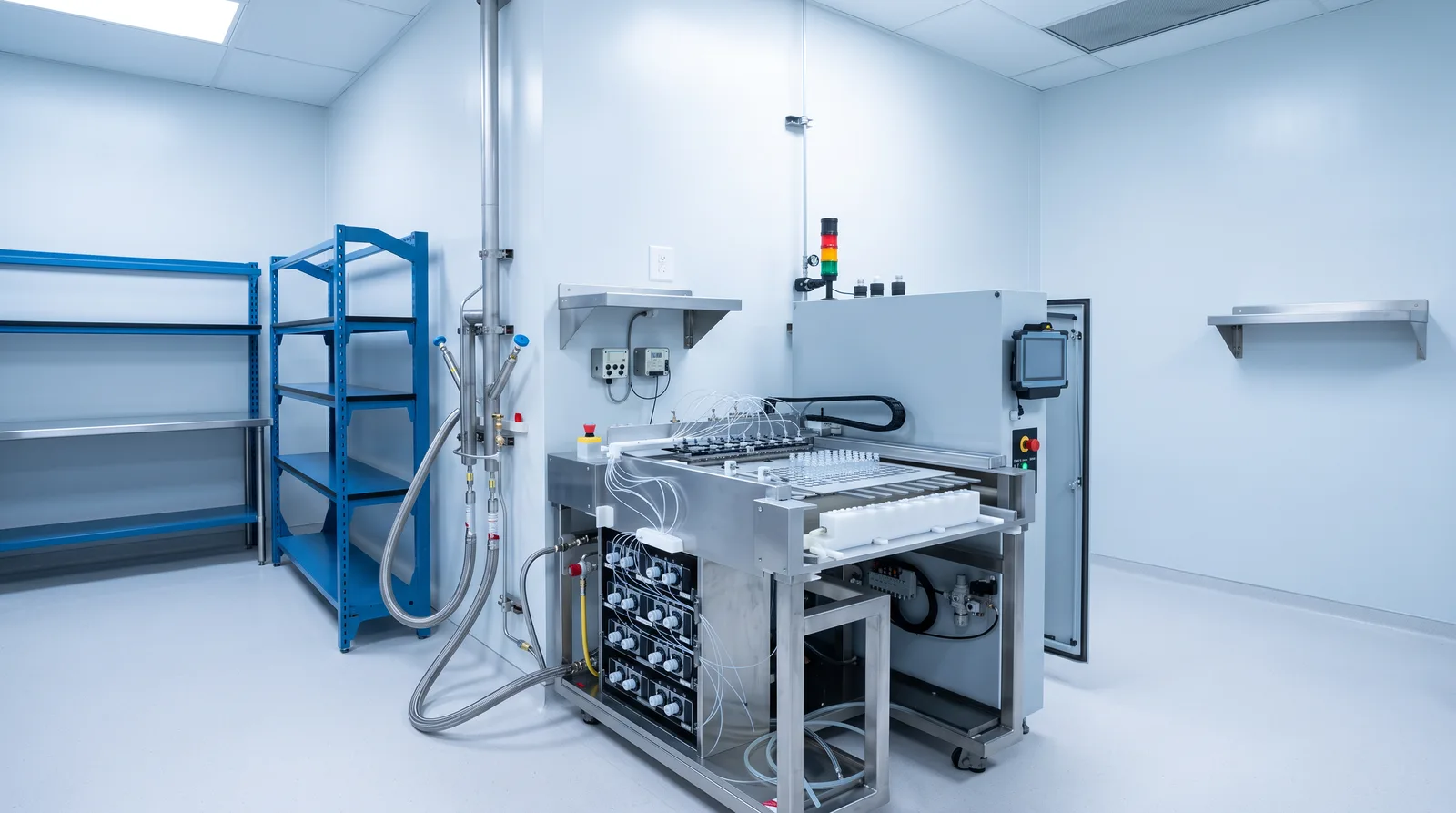
Automation procurement for medical diagnostic manufacturers is a structured process covering URS development, vendor qualification, design review, FAT/SAT testing, and IQ/OQ/PQ validation, with full GAMP documentation tying every requirement to its test result.
- Automation procurement is a managed vendor relationship, documented from the first requirement through final validation. It is not a purchase order.
- The process runs ten phases, from the customer requirements document to continued process verification, supported by 22 GAMP document types.
- A specific URS, design reviews at 30, 60 and 90 percent, FAT with real product and a living trace matrix are what prevent change orders.
- An independent engineer on the manufacturer’s side removes the conflict of interest that comes when vendors write their own validation documents.
Here’s what I’ve seen over 96+ equipment procurement projects across 25+ years in medical diagnostic manufacturing. The equipment procurement and vendor management process isn’t complicated. But it’s unforgiving when you skip steps.
A diagnostics company scaling from 5,000 units a month on manual lines to 50,000 on automated equipment will spend anywhere from $500K to $5M on that transition. And the difference between a project that delivers on time with zero change orders and one that spirals into cost overruns and finger-pointing comes down to one thing. Process.
It takes a lot to get a customer. You go to shows, you build relationships, you do the demos. But it’s very easy to lose that customer when you don’t pay attention to the details that matter to them. That reality cuts both ways. Manufacturers who don’t define their requirements clearly hand the vendor an excuse to change-order them to death. And vendors who treat the original spec as a starting point rather than a commitment lose the next project.
This guide walks through the full automation procurement lifecycle, from your first requirement through validated production. It’s built from the same GAMP process and 22 document types I’ve used across every project in my career. Some ended with the client ordering three more machines from the same vendor. A few ended with vendors I’ll never work with again. The process was the same. The discipline around it was the difference.
Why Automation Procurement in Medical Diagnostic Manufacturing Is Different
Buying manufacturing automation for a diagnostic device, an IVD test kit, or a consumable medical product isn’t like buying a CNC machine for a job shop. Every piece of equipment you bring into a GMP environment will face FDA scrutiny. And every decision you made along the way, from the vendor you picked to the test protocols you ran, needs a paper trail that holds up under audit.
The FDA’s Quality Management System Regulation (QMSR, 21 CFR Part 820) requires documented evidence that manufacturing equipment is installed correctly, operates within defined parameters, and consistently produces product meeting its specifications. That’s not a suggestion. IVD manufacturers, diagnostics companies, CGM sensor manufacturers, and any operation making consumable medical products under cGMP conditions are bound by it. The ISPE Baseline Guide on Commissioning and Qualification lays out the framework for how to get there.
But here’s what the guides don’t tell you. The regulatory requirements are the floor. The relationship between the manufacturer and the automation vendor is what determines whether the project actually works. Change orders are the clearest signal that the relationship has gone sideways.
I hate change orders. Not because they cost money, although they do. Because they mean someone, somewhere, didn’t do their job. Either the manufacturer’s requirements were incomplete, the vendor quoted something they couldn’t deliver, or nobody caught the gap until the equipment was half-built. Every change order embarrasses the engineer who did the original work, and it forces management to approve money that wasn’t in the budget.
Eliminating change orders isn’t aspirational. It’s an engineering discipline. And it starts with the first document in the process.
The MEPSCo GAMP Process: From Customer Interview Through Release to Manufacturer
The GAMP framework for automation procurement covers the full lifecycle. It’s built around 22 document types that trace every requirement from what the manufacturer needs through how the equipment proves it can deliver.
This isn’t theory. This is the actual process refined across 96+ projects since 2001, starting at Gen-Probe and continuing through Hologic and into dozens of IVD, diagnostics, and consumable medical device manufacturers. The documents have evolved, but the logic hasn’t changed.
The process breaks into distinct phases. Each phase produces specific documents. Each document feeds the next phase. Skip one and the gap compounds downstream.
Phase 1: Customer Interview and Customer Requirements Document (CRD)
Everything starts with the people who’ll touch the equipment. Not just the Director of Engineering. The operator on the floor. The maintenance tech who’ll service it at 2 a.m. The quality engineer who needs to defend the documentation during an audit. The facilities team responsible for utilities.
The Customer Requirements Document captures what every stakeholder needs before a single specification is written. This is where unknowns become known. If the R&D team hasn’t finalized the product formulation, that surfaces here. If facilities can’t support the compressed air pressure the vendor will assume, that surfaces here. If the quality team needs specific sampling protocols, that surfaces here.
This phase also determines whether Proof of Principle (POP) or Proof of Concept (POC) work is needed. If the product hasn’t been manufactured at production volumes before, if you’re dealing with a foamy reagent, a magnetic particle suspension, or a lyophilized bead formulation, engineering studies done at this stage prevent expensive surprises six months into the build.
The CRD is the foundation the entire project stands on. Rush it, and you’ll feel it at every subsequent milestone.
Phase 2: Budgetary URS and Budgetary Vendor Quotes
The Budgetary URS is a requirements document complete enough to get realistic, comparable vendor quotes without locking in a final specification. It gives management a defensible number before procurement begins.
This is the step that solves the problem every Director of Manufacturing faces. Leadership wants a budget number before approving the project. Without a Budgetary URS, the manufacturer gets quotes based on vague descriptions, and each vendor makes different assumptions about what’s included. One quotes a basic control system. Another adds a full HMI with data logging. A third pads for everything undefined. The quotes come back at wildly different numbers and nobody can compare them.
A Budgetary URS levels the playing field. Same scope. Same requirements. Comparable numbers.
For companies that don’t have a senior automation engineer or equipment engineer on staff, this is often where a fractional automation engineer enters the picture. The Budgetary URS engagement runs $10–25K and produces a deliverable the manufacturer can use even if they never do the full engagement.
Phase 3: Final URS and Vendor Selection
The final User Requirements Specification is the manufacturer’s complete statement of what the equipment needs to do. Not how it should be built. What it needs to accomplish.
A good URS for a diagnostic fill line, for example, specifies output rate (parts per minute), fill volume tolerance, product contact material requirements, cleanroom classification, and every interface with existing production systems. It defines the acceptance criteria before any vendor sees it.
The mistake I see over and over. Manufacturers rush the URS because they’re under pressure to get equipment ordered. They write vague requirements like “machine shall fill vials accurately” instead of “machine shall fill vials to 2.0 mL +/- 0.05 mL at a sustained rate of 60 parts per minute with product-contacting surfaces in 316L stainless steel.” That vagueness is where change orders are born.
The URS is not a wish list. It’s a requirements document. When manufacturers write it like a wish list, the machine costs far more than anyone planned, and the change orders start before the vendor even breaks ground.
Vendor selection happens against this document. I use a Kepner-Tregoe (KT) analysis, which scores each vendor against weighted criteria: technical capability, GMP experience, capacity, geographic proximity for service, financial stability, and past performance. Three to five vendors is the right range for a competitive quote. Fewer than that and you don’t have enough comparison. More than that and you’re wasting vendors’ time on proposals they won’t win.
The KT analysis also produces quotes and a vendor analysis document. Every vendor response is evaluated against the same URS. The comparison is apples to apples because the spec is the same.
One thing I always tell the vendors. It takes a lot to get a customer. You have to go to shows, do the demos, build the relationship. But it’s easy to lose that customer when you don’t pay attention to the details that matter to them.
Phase 4: Project Timeline and Management
Once the vendor is selected, the project doesn’t run itself. Reporting, communication protocols, and milestone tracking start from day one. Every timeline change is visible before it becomes a problem.
Scope creep starts with small requests that seem reasonable individually. An operator mentions something they’d like. A quality engineer suggests a change. The vendor agrees to each one informally. Six weeks later, the project’s scope has shifted and nobody documented when or why.
Structured project management catches that. Every decision is documented. Every deviation from the original URS goes through a formal change process. Not a casual email. Not a phone call.
Phase 5: FRS, FDS, Design Review, and Trace Matrix
The Functional Requirements Specification (FRS), Functional Design Specification (FDS), and Design Requirements Specification translate the manufacturer’s requirements into the vendor’s design language. This is where a machine failure mode analysis (MFMEA) gets built.
The trace matrix starts here and runs through the rest of the project. It connects every URS requirement to its design specification, test protocol, and test result. When an FDA auditor asks “how do you know this machine meets your requirements?” the trace matrix is the answer. One document. Every thread tied together.
Design reviews at defined milestones, typically at 30%, 60%, and 90% completion, compare every design element against the URS. Each review produces a punch list and summary. These aren’t ceremonial. They’re working sessions where the manufacturer’s engineer catches deviations before they become fabricated parts. That’s the cheapest place to fix anything.
Phase 6: Factory Acceptance Testing (FAT)
FAT happens at the vendor’s facility before the equipment ships. It’s the last chance to catch problems before the machine arrives at the manufacturer’s site and the clock starts on installation.
A proper FAT for medical diagnostic equipment tests against the URS requirements, not the vendor’s internal quality standards. There’s a difference. The vendor’s quality team verifies that the machine was built to their print. The FAT protocol verifies that the machine does what the manufacturer specified.
Run your product during FAT whenever possible. For IVD manufacturers and diagnostics companies, that means bringing actual reagent formulations, actual packaging components, and actual raw materials. A machine that runs perfectly with water will sometimes fail with a viscous diagnostic reagent. Better to find that out at the vendor’s facility where their engineers can fix it on the spot.
FAT produces a protocol, a report, and a punch list. Any open item on the punch list gets resolved before the machine ships. If FAT documentation is formally reviewed and accepted, the scope of the site IQ can be narrowed, according to the ISPE Commissioning and Qualification guidelines. That saves time and money on the back end.
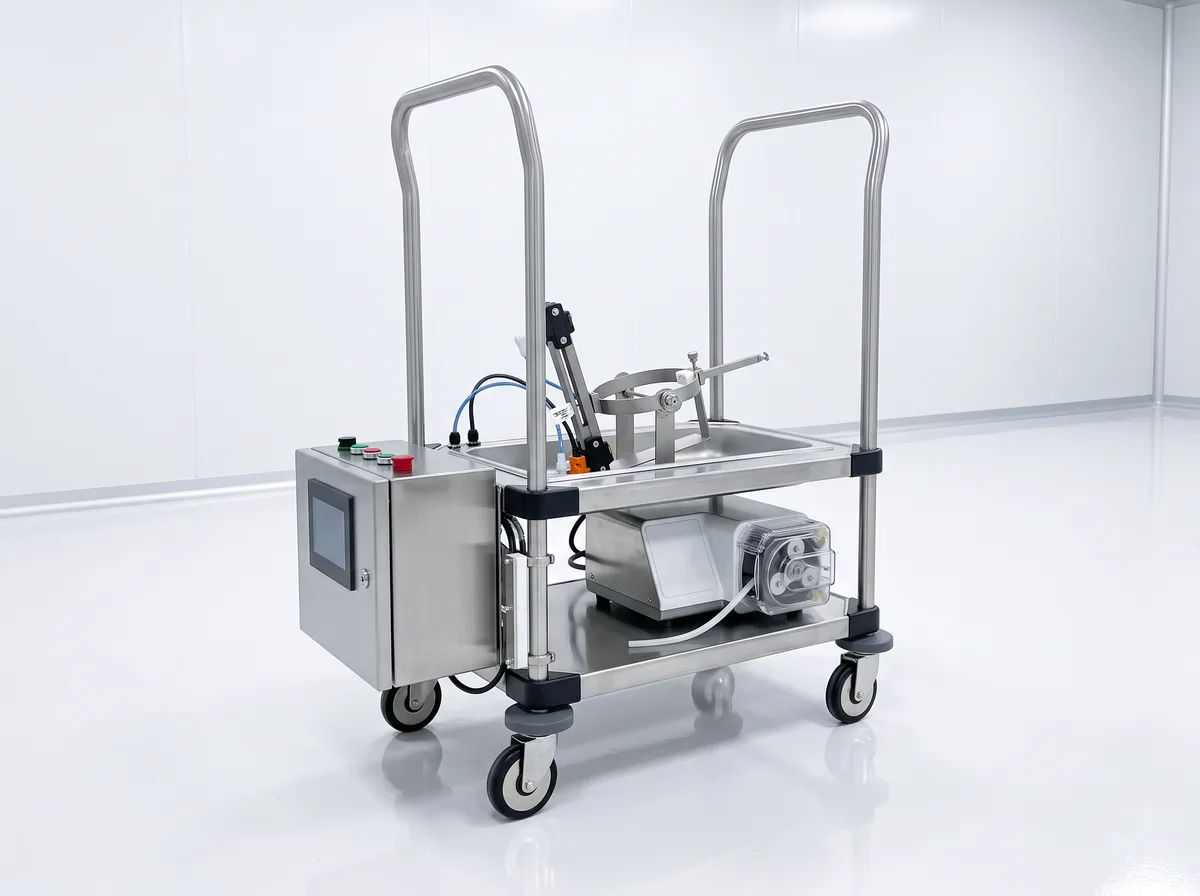
Phase 7: Equipment Delivery, Installation, and Site Acceptance Testing (SAT)
SAT confirms that the equipment survived shipping, installation was done correctly, and site utilities are connected properly. It bridges the gap between what worked at the vendor’s factory and what works on the manufacturer’s production floor.
The facility power, compressed air, vacuum, exhaust, purified water, all of it has to match what the equipment was designed for. Mismatches here are common. I’ve seen machines that ran perfectly at FAT fail at SAT because the site’s compressed air pressure was 10 PSI lower than the vendor assumed.
SAT isn’t a repeat of FAT. It’s a focused verification that the installation is correct and the equipment performs at the manufacturer’s site the same way it did at the vendor’s. Catching installation errors at SAT prevents expensive delays during qualification.
SAT produces its own protocol, report, and punch list, separate from the FAT documents.
Phase 8: Qualification and Validation (IQ/OQ/PQ)
Before qualification begins, two additional documents get finalized. The Process Failure Mode and Effects Analysis (PFMEA) identifies risk at the process level. Engineering studies validate any product-specific variables that affect equipment performance, fill volume consistency across reagent lots, for example, or torque values across different cap materials.
A Validation Plan ties the entire qualification sequence together, defining the approach, acceptance criteria, and roles for IQ, OQ, and PQ.
IQ (Installation Qualification) verifies that the equipment is installed according to manufacturer specifications and design documentation. It confirms identity, location, utility connections, instrument calibration, and component verification against the bill of materials.
OQ (Operational Qualification) tests that the equipment operates within its specified parameters across the full operating range. It can’t start until IQ is approved. For a diagnostic fill line, OQ tests fill volume accuracy, speed ranges, rejection mechanisms, and alarm functionality at minimum, target, and maximum values.
PQ (Performance Qualification) proves that the equipment consistently produces acceptable product under actual production conditions. PQ can’t start until OQ is approved. This typically involves multiple production runs using real product to demonstrate repeatability and consistency. According to the FDA’s process validation guidance, this stage establishes that the process is capable of reproducible commercial manufacturing.
The sequence matters. IQ before OQ before PQ. Each phase builds on the previous one. Skipping ahead, or running phases in parallel to save time, creates gaps that auditors find and regulators cite.

The trace matrix gets finalized during this phase. Every URS requirement maps to a design specification, a test protocol, and a test result. If any requirement can’t be traced to an approved test result, you have a gap. And gaps in the trace matrix are exactly what FDA investigators are trained to find during facility inspections.
Phase 9: Release to Manufacturer
Qualification documents are half the handoff. The other half is what the internal team needs to run and maintain the equipment after the engagement ends.
Operator SOPs. PM (Preventive Maintenance) SOPs. Incoming material specifications. These documents are written for the person who has to use them, not the person who wrote the URS.
Knowledge transfer is a deliverable, not an afterthought. By the time the equipment is released, the junior engineer can operate and maintain the equipment, the SOPs are in place, and the documentation is complete. The equipment engineer or fractional automation engineer works themselves out of a job on purpose. The documentation and processes left behind are the deliverable, not ongoing presence.
Phase 10: Post-Validation and Continued Process Verification
Validation isn’t the end. It’s the baseline for ongoing monitoring. FDA’s process validation lifecycle includes Stage 3, continued process verification, which requires manufacturers to monitor production data to confirm the process remains in a validated state.
Equipment changes, maintenance activities, and process modifications after validation all need to be evaluated against the original qualification. Some trigger requalification. Some don’t. The decision, and the rationale for it, has to be documented.
This is where the relationship between manufacturer and vendor really pays off. A vendor who understands your documentation requirements and supports your validation framework becomes a long-term partner. They get the next project. And the one after that.
The 22 GAMP Document Types
Twenty-two documents sounds like a lot. It’s not. Each one serves a specific purpose, and together they create the traceability that FDA expects. Here’s the actual document set, in the sequence they’re produced:
Requirements Phase
- Customer Requirements Document (CRD) — captures stakeholder needs across all functional groups before requirements are written
- Proof of Principle / Proof of Concept (POP/POC) — validates product and process assumptions before equipment specification begins
- Budgetary URS (BURS) — requirements document complete enough for comparable vendor quotes; gives management a defensible budget number
- Budgetary Quotes (BQ) — vendor quotes against the Budgetary URS for budget planning
Specification and Vendor Selection Phase
- User Requirements Specification (URS) — the complete requirements document the vendor builds against; every line item specific and verifiable
- Quotes / Vendor Analysis — scored vendor responses evaluated against the final URS using Kepner-Tregoe methodology
- Project Timeline and Management (PT) — milestone tracking, reporting structure, communication protocols from award through release
Design Phase
- Functional Requirements Specification (FRS) — translates URS requirements into functional design terms
- Machine Failure Mode and Effects Analysis (MFMEA) — risk analysis at the machine design level
- Design Review Punch List and Summary — formal documentation from 30%, 60%, and 90% design review milestones
Traceability
- Trace Matrix (TM) — the backbone document; connects every URS requirement to its design spec, test protocol, and test result; maintained as a living document from the FRS phase through PQ
Testing Phase
- FAT Protocol and Report — test execution at the vendor’s facility against URS requirements
- FAT Punch List — open items from FAT that must be resolved before the equipment ships
- SAT Protocol and Report — test execution at the manufacturer’s site after installation
- SAT Punch List — open items from SAT that must be resolved before qualification begins
Qualification Phase
- Process Failure Mode and Effects Analysis (PFMEA) — risk analysis at the process level
- Engineering Studies (ES) — validation of product-specific variables: fill volume, reagent behavior, torque, material compatibility
- Validation Plan (VP) — defines the qualification approach, acceptance criteria, and roles for IQ/OQ/PQ
- Installation Qualification (IQ) — verifies equipment is installed per specifications
- Operational Qualification (OQ) — verifies equipment operates within defined parameters across the full range
- Performance Qualification (PQ) — proves equipment consistently produces acceptable product under production conditions
Release Phase
- Operator SOP / PM SOP — operating and preventive maintenance procedures written for the people who run and service the equipment daily
Not every project uses all 22 in the same depth. A semi-automated workstation might have a shorter set. A complex multi-station IVD fill line with robotic handling, vision inspection, and serialization will use the full suite. The process scales. The discipline doesn’t change.
Why an Independent Engineer Should Manage This Process
There’s a structural conflict of interest when the automation vendor manages the procurement and validation documentation. The vendor built the machine. They have a financial incentive to pass the tests. They don’t have the same incentive to document every deviation or flag every gap in the URS.
An independent automation engineer or equipment engineer sits on the manufacturer’s side of the table. They write the URS for the manufacturer, score the vendors independently, review designs against the manufacturer’s requirements, and run test protocols that verify what the manufacturer specified, not what the vendor built.
Vendors don’t have dedicated GAMP documentation personnel as a core competency. Their documentation staff come and go. Validation typically happens six or more months after machine delivery, and by then, the person who understood the build may be long gone. That gap between who built it and who validates it is where documentation falls apart.
Does every project need an independent engineer? No. If you have a senior automation engineer on staff with 15+ years of GMP equipment procurement experience, you’re covered. That person exists at maybe 1 in 20 mid-market medical diagnostic manufacturers. The rest are running projects with junior engineers who’ve never done a FAT, or they’re relying on the vendor to manage the documentation.
Both of those scenarios produce change orders. The junior engineer doesn’t know what to look for in the design review. The vendor-managed documentation skips what isn’t convenient. And the manufacturer doesn’t realize the gap until the equipment is on the floor and the validation fails.
For companies in that position, a manufacturing automation assessment is a good starting point. It identifies where you are, what you need, and whether your internal team can handle the automation procurement or whether you need help.
How Do You Prevent Change Orders on Automation Projects?
Change orders are preventable. Not theoretically. Practically. Here’s how.
Start with a URS that’s specific enough to leave no room for interpretation. If a vendor can read your requirement two different ways, they’ll read it the way that’s cheaper to build. And when the equipment doesn’t match what you expected, that’s a change order.
Run engineering studies for any product characteristic that behaves differently at scale. If your reagent is foamy, viscous, or contains magnetic particles, that behavior needs to be tested and documented before the URS is finalized. Not during commissioning. Before.
Conduct design reviews at 30%, 60%, and 90% completion. These aren’t ceremonial. They’re working sessions where the manufacturer’s equipment engineer compares every design element to the URS and flags deviations before they become fabricated parts.
Run FAT with your actual product. Not with water. Not with a surrogate. Your actual reagent, your actual packaging, your actual raw materials. If the machine can’t handle the product at the vendor’s facility, you find out before it ships.
Maintain the trace matrix as a living document. When it’s updated in real time, deviations surface immediately instead of accumulating until someone has to explain a 40-page change order to management.
In process industries, large automation projects fail at rates as high as 65% for projects over $1 billion and 35% for projects under $500 million, with failure defined as 25%+ over budget or 50%+ late, according to Automation World. Medical diagnostic manufacturing projects are smaller, but the failure patterns are the same. Premature commitments, optimistic schedules, and mid-project changes drive overruns regardless of project size.
What Role Does R&D to Manufacturing Transfer Play in Automation Procurement?
This gets overlooked constantly. A product that works perfectly in the lab doesn’t automatically work on an automated production line.
R&D develops the product at bench scale. Volumes are small. Tolerances are wide. The scientist running the process can adjust on the fly. None of that translates to a machine running 60 parts per minute on a 24/7 production schedule.
Product variability is the enemy of automation. Lot-to-lot variation in raw materials, temperature sensitivity of reagent formulations, and mechanical behavior of packaging components under production speeds all need to be characterized before the equipment is specified.
I’ve worked on projects where the R&D formulation looked simple on paper but required completely custom fill equipment because the reagent couldn’t be handled by standard pumps. Foamy reagents need degassing systems. Magnetic particle suspensions need mixing systems that maintain homogeneity without damaging the particles. These aren’t things you can retrofit after the machine is built.
Engineering studies bridge the gap between R&D and manufacturing. They generate the data that feeds directly into the URS. Without them, you’re writing requirements based on assumptions. And assumptions become change orders.
Which Medical Diagnostic Manufacturers Need This Process?
This process is built for device-as-a-product companies. Manufacturers making the end product that goes to market, not components that go into someone else’s device. Consumable diagnostics. IVD test kits. Lab usage components. CGM sensors. Reagent-filled cartridges and vials. High-volume products manufactured under GMP conditions.
If you’re scaling from manual assembly to automated production, you need this. If you’re replacing aging automation equipment that’s generating downtime or compliance risk, you need this. If you’re transferring a product from R&D to manufacturing and the automated line doesn’t exist yet, you need this.
Companies making hand-assembled, low-volume surgical instruments or catheter assemblies have different needs. Their production doesn’t typically involve the kind of high-speed fill, seal, inspect, and package lines where this process delivers its value.
The sweet spot is a medical diagnostic manufacturer with 50 to 500 employees, producing consumable products at volumes where manual production can’t keep up with demand or can’t maintain the consistency that GMP requires.
What Does Automation Procurement Actually Cost?
It depends on what you’re automating. That’s the honest answer.
A semi-automated workstation for a single process step might run $100K to $500K. A fully automated multi-station production line for IVD consumables with fill, seal, inspection, labeling, and packaging can run $1M to $5M or more.
The equipment cost is only part of the number. Add engineering management (URS development, vendor qualification, design reviews, FAT/SAT support, IQ/OQ/PQ), documentation, facility preparation, utility installation, and operator training. For a mid-range project, engineering and validation typically add 10% to 20% on top of the equipment cost.
Here’s the number that should concern you more than the purchase price. A single change order on a complex automation project can add $50K to $200K and push the timeline by 4 to 12 weeks. Multiply that by the 3 to 5 change orders that a poorly managed project typically generates, and the math gets ugly fast.
Compare that to the cost of doing it right from the start. A thorough URS, proper vendor qualification, structured design reviews, and rigorous FAT testing cost a fraction of what change orders cost. Prevention isn’t free. But it’s reliably cheaper than the alternative.
How Do You Choose the Right Automation Vendor?
Price is the wrong place to start. Start with capability.
Can the vendor build equipment for a GMP environment? Do they understand FDA documentation requirements? Have they delivered to medical diagnostic manufacturers before, not just medical device companies in general? There’s a difference between building a surgical instrument inspection station and building a high-speed IVD fill line. The GMP documentation burden is fundamentally different.
Score vendors using a structured methodology like the Kepner-Tregoe analysis. Weight the criteria that matter for your project: GMP documentation capability should be weighted heavily for any FDA-regulated application. A vendor who can build a beautiful machine but can’t produce a trace matrix is a vendor who’ll cost you six months of documentation rework.
Visit the vendor’s facility. Watch them build. Talk to their engineers, not just their salespeople. Ask for references from medical diagnostic manufacturers specifically. The global medical device market is projected to reach about $1.03 trillion by 2034, according to Fortune Business Insights. Vendors who can serve this market with proper documentation will stay busy. Vendors who can’t will lose to competitors who can.
And check their change order history. Ask their references directly. How many change orders on your last project? A vendor with a pattern of change orders is a vendor with a pattern of incomplete quotes or inadequate design reviews. Walk away.
Bringing It All Together
Automation procurement in medical diagnostic manufacturing is a relationship managed through documentation. Every document in the GAMP process exists for a reason: to surface unknowns before they become change orders, to hold vendors accountable to the original specification, and to give FDA auditors a clear trail from requirement to test result.
The manufacturers who get this right aren’t lucky. They’re disciplined. They invest the time in the CRD and URS. They score vendors objectively. They review designs at milestones instead of waiting for the finished machine. They run FAT with their actual product. And they maintain the trace matrix as a living document from day one.
If you’re planning an automation procurement project and you’re not sure whether your team has the senior automation engineering expertise to manage it, start with a manufacturing automation assessment. It takes a few hours and tells you exactly where you stand.
What Manufacturers Ask About Automation Procurement
How long does a full automation procurement project take from URS to validated production?
12 to 18 months for a standard single-station system. 18 to 30 months for a complex multi-station IVD line. Those timelines assume the URS is solid and the vendor selection doesn’t drag. Add 3 to 6 months if the URS needs major revisions after vendors start quoting, because that resets the design phase.
What’s the biggest mistake manufacturers make during automation procurement?
Rushing the URS. Every single time. Manufacturers under production pressure want to skip ahead to the purchase order. But a vague URS is a blank check for change orders. I’ve seen projects where a thorough URS added 6 weeks to the front end and saved 4 months on the back end. The math writes itself.
Can an automation vendor handle the GAMP documentation instead of an independent engineer?
They can try. Should they? That depends on whether you’re comfortable with the entity building the machine also grading its own exam. And there’s a practical problem beyond the conflict of interest. Documentation staff at vendors come and go. Validation typically happens six or more months after machine delivery. The person who understood the build may not be there when the qualification starts. Even vendors with solid documentation teams benefit from an independent review of the trace matrix and test protocols.
Do I need GAMP documentation for semi-automated equipment, or only fully automated lines?
Any equipment that touches product in a GMP environment needs qualification documentation. Full stop. Semi-automated, fully automated, even a simple workstation with a pneumatic press. The depth of documentation scales with the complexity and risk classification of the equipment, but the requirement to qualify doesn’t go away just because the machine is simple.
How do I know if my company needs a fractional automation engineer or should hire full-time?
Count your automation projects. If you’re running 3 or more equipment procurement projects per year on an ongoing basis, a full-time senior automation engineer probably makes financial sense. If you run 1 or 2 projects a year, or you have a surge of projects followed by quiet periods, fractional is the better math. A senior automation engineer with 15+ years of GMP experience commands $160K to $200K fully loaded. If that person sits idle for 6 months between projects, you’re paying for a very expensive bench.
What happens if the vendor fails FAT?
The vendor fixes the issue at their facility before the machine ships. That’s the whole point. FAT failures at the vendor’s site cost a fraction of what they cost after the equipment is installed, connected, and your production team is waiting. If the vendor can’t resolve the FAT failure in a reasonable timeframe, you have a contractual conversation, not a surprise.
How much does a change order cost on a medical diagnostic automation project?
$25K to $200K per change order, depending on complexity. But the dollar cost isn’t the full picture. Each change order adds weeks to the timeline, requires re-validation of affected systems, and strains the vendor relationship. I’ve watched projects where 4 change orders turned a 14-month project into a 22-month project. The equipment eventually worked. The relationship didn’t survive.
What’s the difference between GAMP 4 and GAMP 5?
GAMP 4 prescribed a rigid validation approach based on software category. GAMP 5 shifted to a risk-based approach where validation effort is proportional to patient risk, not software category. GAMP 5 is the current standard. MEPSCo’s documentation process is built around GAMP 5 principles and aligned with FDA 21 CFR Part 820 requirements for medical diagnostic and device manufacturers.
Can MEPSCo step into a project that’s already underway?
Yes. One of MEPSCo’s case studies covers exactly this situation, a piece of off-the-shelf industrial filling equipment purchased without GAMP documentation that had to be retrofitted and validated. Recovery engagements are harder, more expensive, and take longer than doing it correctly from the start. But the equipment can be validated and released. A manufacturing automation assessment is the right starting point to evaluate where the project stands and what documentation needs to be created.
The Bottom Line
Procurement goes well when every requirement is documented and every vendor answers to the same specification.
Reza Bashar at MEPSCo GAMP provides fractional automation engineering for medical diagnostic manufacturers, from URS development through IQ/OQ/PQ. If you are planning an automation project, reach out directly.