
What Is GAMP 5? A Practical Guide for Medical Device Manufacturers

GAMP 5 is a risk-based validation framework published by ISPE that medical device manufacturers use to qualify computerized systems and production automation, tracing every requirement from URS through IQ/OQ/PQ to a documented, audit-ready state. It’s been the industry standard since 2008, with a Second Edition released in 2022. If you’re buying or qualifying regulated manufacturing equipment, GAMP 5 is the process that keeps you from scrambling at validation. MEPSCo’s GAMP documentation services help medical diagnostic manufacturers build this process from scratch or fix one that’s already broken.
- GAMP 5 is an ISPE industry guide, not an FDA regulation. It gives medical device manufacturers a risk-based framework for validating computerized systems and manufacturing automation.
- It walks your team from user requirements through IQ/OQ/PQ qualification using the V-model, connecting every spec to a test.
- The Second Edition (2022) added guidance on cloud, AI/ML, and Agile development, and aligns with the FDA’s Computer Software Assurance approach.
Why This Framework Exists
Here’s what used to happen. Somebody would show up with a piece of equipment, hand it to a manufacturer, and say “build something for me.” No specs. No documentation. No process for proving the machine actually did what it was supposed to do.
Reza Bashar, MEPSCo’s founder and a fractional automation engineer with 25+ years and 96+ projects in FDA-regulated manufacturing, watched it firsthand. When he started in this business, there was no GAMP. The framework didn’t exist yet. Equipment got ordered, delivered, and plugged in, and nobody had a structured way to trace requirements back to test results. If something went wrong during an FDA inspection, you were on your own.
GAMP changed that. It was adopted into the medical device world from other regulated industries (including military applications) roughly 26 years ago, and it’s been revised multiple times since. The current version, GAMP 5, gives manufacturers a complete documentation and validation process that connects every user requirement to a qualification test. Think of it as baby-stepping through the entire project so you’re not overwhelmed at the end with a validation process where you don’t know anything about the equipment you’re trying to validate.
What Does GAMP Stand For?
GAMP stands for Good Automated Manufacturing Practice. It’s published by ISPE (International Society for Pharmaceutical Engineering) and provides a standardized approach to validating computerized systems in GxP-regulated environments.
A couple of things worth clarifying. GAMP 5 isn’t a regulation. It’s industry guidance. The FDA doesn’t enforce GAMP directly. But GAMP gives you a structured way to meet the FDA’s actual regulatory requirements under 21 CFR Part 11 (electronic records and signatures) and the QMSR (which replaced 21 CFR Part 820 for medical device quality systems, aligning with ISO 13485). Auditors expect to see something like GAMP in your validation documentation. Walking into an FDA inspection without a structured validation process is a risk nobody should be taking.
The “5” is the fifth version. Each version has been refined based on real-world implementation. The first edition of GAMP 5 came out in 2008. The Second Edition dropped in July 2022, and that’s the current standard.
How Does the GAMP 5 Framework Actually Work?
At its core, GAMP 5 is a risk-based approach. The validation effort scales to the risk. A Category 1 infrastructure system (your operating system) gets minimal documentation. A Category 5 custom-built filling machine gets the full treatment.
The framework covers the entire system lifecycle in four phases, as outlined in ISPE’s GAMP 5 Second Edition.
| Lifecycle Phase | What Happens |
|---|---|
| Concept | Define business needs. Determine whether GxP requirements apply to this system. |
| Project | Design, build, test, and deploy using the V-model. This is where URS, specifications, FAT/SAT, and IQ/OQ/PQ live. |
| Operation | Maintain the system through change control, periodic reviews, incident management, and CAPA. |
| Retirement | Decommission the system. Migrate data. Archive records for regulatory retention. |
The Project phase is where the heavy lifting happens for medical diagnostic manufacturers buying production automation. That’s where your user requirements specification gets written, your vendor gets selected, and your equipment gets qualified.
What Is the GAMP 5 V-Model?
The V-model is the structural backbone of GAMP 5. It pairs every specification on the left side with a matching test on the right side.
Left side (specification, descending):
- User Requirements Specification (URS) defines what the equipment needs to do for your process
- Functional Specification (FS) translates those requirements into technical capabilities
- Design Specification (DS) details how the system will be built
Right side (testing, ascending):
- Installation Qualification (IQ) confirms hardware and software are installed per the design specs
- Operational Qualification (OQ) confirms features and functions work as intended
- Performance Qualification (PQ) confirms consistent performance in the actual production environment
Connecting the two sides is the Requirements Traceability Matrix (RTM), often called the trace matrix. Every single requirement on the left gets traced to a specific test on the right. That’s the document an FDA auditor will pull first. If a requirement exists without a corresponding test, that’s a finding.
Here’s where it gets real. As Reza puts it, validation means documenting a snapshot in time that the machine behaved in a certain way. Things change after that snapshot. Nuts and bolts come loose. Cameras come loose. Lighting in the environment changes. The question GAMP forces you to answer is whether you accounted for all the variables that could affect both the machine and the product. Time, temperature, pressure, everything.
How Does GAMP 5 Categorize Systems?
GAMP 5 classifies software and systems into four active categories (Category 2, previously used for firmware, was retired and folded into other categories). The category determines how much validation work the system needs.
| Category | Type | Examples | Validation Effort |
|---|---|---|---|
| 1 | Infrastructure Software | Operating systems, database engines, middleware | Minimal. Confirm installation and record version numbers. |
| 3 | Non-Configured Products | Off-the-shelf COTS software used as-is | Low. Installation verification and basic functional testing. |
| 4 | Configured Products | ERP, LIMS, SCADA, MES configured to your process | Moderate to high. Test configurations, business rules, and workflows. |
| 5 | Custom Applications | Custom-built automation, bespoke filling or assembly line software | Highest. Full SDLC, code review, structural testing, complete IQ/OQ/PQ. |
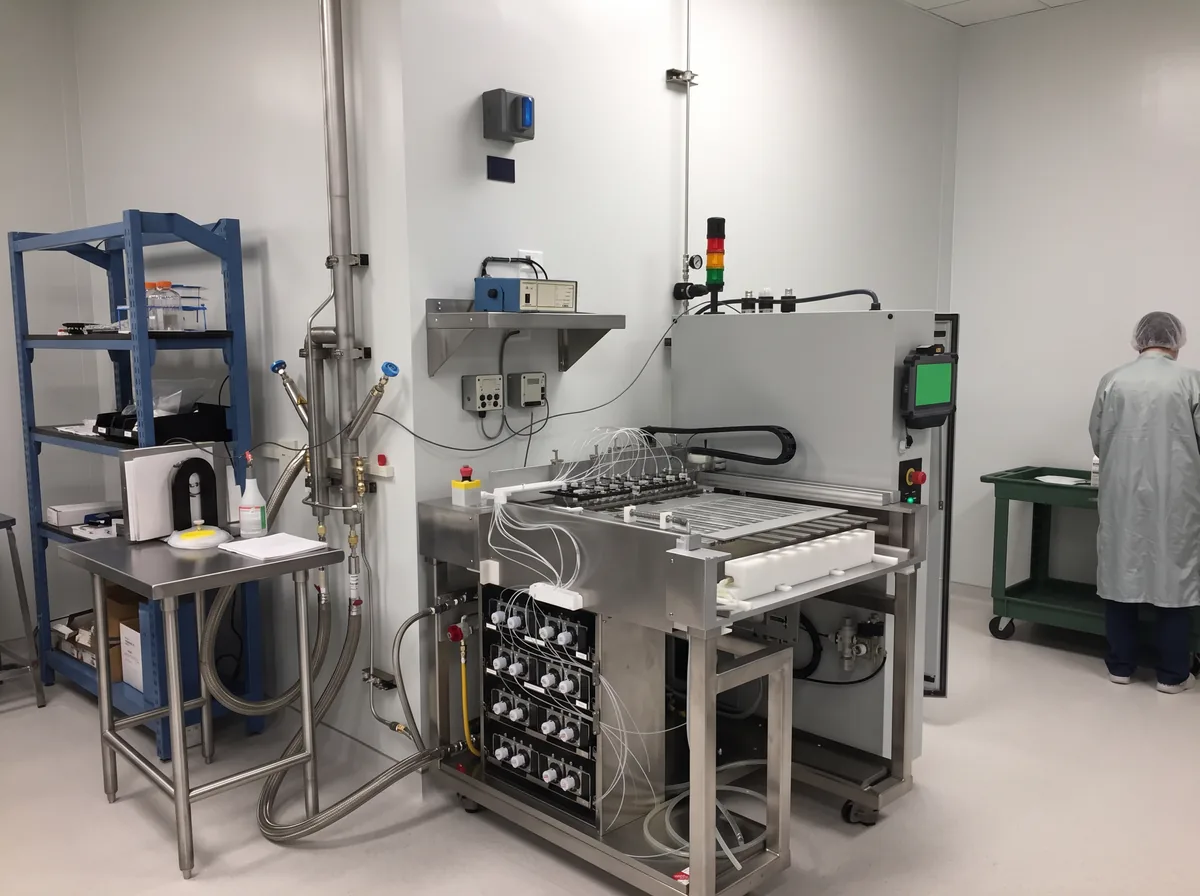
For medical diagnostic manufacturers buying custom production automation, the equipment almost always falls into Category 4 or Category 5. That’s where the validation effort lives. A custom-built IVD filling line with proprietary PLC code? Category 5. An off-the-shelf labeling system configured for your specific product? Category 4. The distinction matters because it determines documentation depth, testing rigor, and how much supplier qualification work you can reuse.
What Changed in the GAMP 5 Second Edition?
ISPE released the Second Edition in July 2022, 14 years after the original. The core framework, the V-model, and the risk-based approach didn’t change. What changed was the technology landscape around it.
Key updates in the GAMP 5 Second Edition:
- Cloud and SaaS validation guidance, including shared responsibility models and cloud supplier qualification
- Agile and iterative development methods now explicitly addressed (the original edition assumed waterfall)
- New appendices covering AI/ML systems and distributed ledger (blockchain) technology
- Alignment with the FDA’s Computer Software Assurance (CSA) guidance, finalized in September 2025, which emphasizes critical thinking over scripted testing
- Stronger ALCOA++ data integrity expectations woven throughout
- First explicit treatment of cybersecurity in the validation context
- A shift away from paper-based deliverables toward electronic records as the primary compliance evidence
That last point is significant. The Second Edition argues that when compliance can be shown through electronic records in validated tools, paper documents become non-value-adding work. For a manufacturer running a validated MES or SCADA system, this changes how you think about documentation overhead.
The guide is now over 400 pages with roughly 50 topic sections, example forms, and supplier questionnaires. It’s sold through the ISPE store, with separate member and non-member pricing.
How Does GAMP 5 Connect to FDA Regulations?
GAMP 5 doesn’t replace FDA regulations. It gives you a structured path to satisfy them.
For medical device manufacturers, the relevant regulations are:
- 21 CFR Part 11 covers electronic records and electronic signatures. If your manufacturing automation generates electronic batch records, stores process data, or uses electronic signatures for release, Part 11 applies.
- QMSR (Quality Management System Regulation), which replaced 21 CFR Part 820 in 2026, aligns with ISO 13485. Under the QMSR, manufacturers are responsible for ensuring production equipment is adequate, properly installed, and validated for its intended use.
- ISO 13485 clauses 4.1.6 and 7.5.6 specifically require validation of computer software used in the quality management system and production/service provision.
GAMP 5 addresses all of these by providing the documentation framework, risk assessment methodology, and lifecycle approach that auditors expect. A study by QBD Group found that systems set up according to GAMP 5 essentially satisfy ISO/TR 80002-2 (the technical report for medical device software validation) as well, since GAMP 5 covers nearly all the same topics and then some.
Practical reality for IVD and diagnostic manufacturers building automated fill lines, assembly systems, or labeling equipment in the U.S.: your validation documentation will get examined during FDA inspections. GAMP gives you the process to make those documents hold together. Without it, you’re assembling validation evidence after the fact, and that’s exactly how findings happen.
How Is GAMP Different for Medical Devices vs. Pharma?
GAMP 5 was written primarily for pharmaceutical and life sciences companies, but its application in medical device manufacturing has grown steadily. The framework translates well, but the context shifts.
In pharma, GAMP typically validates enterprise computerized systems like LIMS, ERP, and batch record management. The scope is often software-centric.
In medical diagnostic manufacturing, GAMP applies to the production automation itself. Filling machines, assembly lines, labeling systems, vision inspection stations. The equipment is physical, and the validation has to account for mechanical variables alongside software. Did you account for vibration? Environmental temperature changes? Lighting conditions in the cleanroom that could affect a camera-based inspection system?
That’s the gap Reza sees constantly. GAMP gives you the structure, but applying it to production automation requires understanding both the process and the equipment. The simplest thing is, do you have enough room for the size of the machine you’re asking for? It goes down to that level of detail. If your URS doesn’t address facility constraints, your FAT will, and that’s the expensive way to find out.

For IVD manufacturers and CDMOs running automated lines for consumable diagnostics, cartridge-based assays, or lab-usage components, GAMP 5 is the framework that connects your process requirements to equipment qualification. But someone has to own the manufacturer’s side of that process. The vendor builds the equipment. You validate that it does what your patients and your FDA filing need it to do.
What Makes the GAMP 5 Risk-Based Approach Different?
Before GAMP 5, the default was to validate everything at the same depth. Every system got the same pile of documents whether it was a Category 1 operating system or a Category 5 custom application. That’s wasteful, and it’s also counterproductive. Teams burned out on unnecessary documentation and missed the systems that actually mattered.
GAMP 5 flipped that. Validation effort scales to risk. The key principles (per the ISPE GAMP 5 framework):
- Scalable lifecycle activities. Hardware, software, operating systems, and automation are treated as one system. How the parts interact determines the testing strategy.
- Reusing supplier testing. Vendor testing and quality records can reduce redundant testing on your side. You don’t need to re-run every test your automation vendor already documented, as long as you’ve qualified the vendor.
- Product and process understanding. Your team needs to understand intended use and identify which components have GxP impact. That shapes risk assessments and determines where testing resources go.
- Knowledge management. Lessons from one project feed the next. Records stay traceable. This is where having a consistent process across multiple projects creates compound value.
The Second Edition doubled down on this with what ISPE calls “critical thinking.” Instead of scripted testing where engineers follow predetermined steps mechanically, the framework now encourages professional judgment. Does this test actually prove the system works for its intended purpose? Or are we just checking boxes?
That’s not a small shift. For medical diagnostic manufacturers running 5, 10, or 20 validated systems across a facility, a risk-based approach means you spend less time documenting low-risk infrastructure and more time testing the Category 4 and 5 systems that actually affect product quality and patient safety.
When Does a Manufacturer Actually Need GAMP?
Not every manufacturer arrives at GAMP at the same point. These are the triggers we see across 96+ projects:
- You’re buying your first piece of regulated production automation and your team has never run a GAMP process. The vendor will build equipment to spec. But whose spec?
- You’re scaling from manual to automated production for a consumable diagnostic product and need validation documentation that supports your 510(k) or PMA filing.
- An FDA inspection is approaching and your equipment validation records wouldn’t survive scrutiny. Retrofitting GAMP documentation after the fact is harder than building it in from the start.
- Your validation documentation is a patchwork. URS in one format, IQ/OQ/PQ in another, no traceability matrix connecting them. GAMP gives you the connective tissue.
- You’re upgrading or replacing aging automation and need to revalidate with current standards.
The common thread? Someone has to own the manufacturer’s side of equipment procurement and validation. That’s the role of an equipment engineer or automation procurement specialist who understands both the GAMP process and the production reality.
Getting GAMP Right the First Time
GAMP 5 isn’t complicated in principle. Write down what you need. Build to those requirements. Test against them. Document the proof.
Where it breaks down is execution. The URS gets written too loosely. The traceability matrix has gaps. The qualification protocols don’t map back to actual user requirements. And nobody catches it until the validation phase, when fixing it costs 10x what it would have cost at the requirements stage.
Three things to take from this:
- GAMP 5 is a lifecycle framework, not a phase-gate exercise. It starts before vendor selection and extends through equipment retirement.
- The Second Edition is the current standard. If your team is still working from the 2008 original, you’re missing guidance on cloud systems, Agile development, AI/ML, and the FDA’s CSA approach.
- For medical diagnostic manufacturers, GAMP applies to the production automation, not just enterprise software. Someone needs to own the manufacturer’s side of that process.
If you’re evaluating production automation for an IVD or medical diagnostic line and need the GAMP documentation built right the first time, book a manufacturing automation assessment with MEPSCo. One call. No sales pitch. Just a conversation about your project and whether GAMP support makes sense for your situation.
Sources: ISPE — GAMP 5 Guide, Second Edition; ECA/gmp-compliance.org — Review of GAMP 5 Second Edition; Hogan Lovells — FDA finalizes Computer Software Assurance guidance; eCFR — 21 CFR Part 820.
Questions Manufacturers Ask About GAMP 5
Is GAMP 5 legally required for medical device manufacturers?
No. GAMP 5 is industry guidance from ISPE, not an FDA regulation. But here’s the practical reality: the FDA expects manufacturers to validate computerized systems and production equipment under 21 CFR Part 11 and the QMSR. GAMP 5 gives you the structured approach to satisfy those requirements. Walking into an audit without something equivalent to GAMP is asking for a finding.
How long does a GAMP validation process take for a typical piece of production equipment?
Depends entirely on the equipment complexity and the category. A configured SCADA system (Category 4) might take 8-12 weeks from URS through PQ. A custom-built filling line (Category 5) with proprietary software? 4-6 months minimum, sometimes longer if the URS wasn’t tight enough and change orders start stacking. The timeline isn’t about GAMP being slow. It’s about catching problems early when they’re cheap to fix instead of late when they’re expensive.
What’s the difference between GAMP 5 and Computer Software Assurance (CSA)?
Different origin, converging direction. GAMP 5 comes from ISPE and covers the full lifecycle of computerized systems. CSA is the FDA’s final guidance (issued September 2025) encouraging risk-based, critical-thinking approaches to software validation instead of scripted testing. The GAMP 5 Second Edition explicitly aligned with CSA principles. They’re not competing. CSA tells you what the FDA expects. GAMP gives you a complete process to deliver it.
Can I use vendor documentation to satisfy GAMP requirements?
Partially. GAMP 5 explicitly encourages reusing supplier testing records. If your automation vendor runs a rigorous testing program and you’ve qualified them through a supplier audit, their FAT results and internal testing records can reduce your validation workload. That said, IQ/OQ/PQ on your production floor is still your responsibility. The vendor’s testing proves their equipment works. Your testing proves it works in your facility, with your process, under your environmental conditions.
Do I need the full GAMP process for every system?
That’s the whole point of the risk-based approach. Category 1 infrastructure gets minimal documentation. Category 3 off-the-shelf software gets installation verification and basic testing. Categories 4 and 5 get the full treatment. The goal isn’t to bury every system in paper. It’s to match your validation effort to the system’s actual impact on product quality and patient safety. Overvalidating low-risk systems wastes resources that should go to the high-risk equipment.
Get GAMP Right the First Time
Write down what you need. Build to those requirements. Test against them. Document the proof. GAMP 5 is simple in principle and unforgiving in execution.
If you’re evaluating production automation for an IVD or medical diagnostic line and need the GAMP documentation built right the first time, schedule a Manufacturing Automation Assessment with MEPSCo GAMP. One call. No sales pitch.