
When Standard Fill Equipment Won’t Work: Automation for Non-Standard IVD Reagents

Standard liquid filling equipment is designed for well-behaved liquids. Most IVD diagnostic reagents aren’t well-behaved. Foamy reagents, magnetic particle suspensions, lyophilized beads, and odd container geometries each break different assumptions the equipment vendor made when they built the machine you’re about to buy.
- Standard fill equipment is built for well-behaved liquids; the reagents that make IVD products differentiated — foamy, magnetic-particle, lyophilized-bead, odd containers — are the ones that break those assumptions.
- The failures show up at FAT or after installation: change orders, suspension non-uniformity, or fill-accuracy drift the scale never catches.
- The fix is reagent characterization before the URS — specify the actual foam, settling, and geometry behavior so the vendor builds to the real problem, not to standard assumptions.
- “Yes, we’ve done fills like that” is not the same as a vendor who can describe exactly how they’d handle your specific reagent.
There’s a version of this that most IVD manufacturers encounter the hard way.
You need a fill line. You find a vendor. The vendor has done a lot of fills. You explain the process and they say they can handle it. The quote looks reasonable. The lead time is manageable.
Then the reagent arrives at the vendor facility for FAT.
And the machine does what it was built to do — which is handle liquids that behave the way the vendor expected them to. Not a foamy reagent that takes 90 seconds to settle between fill cycles. Not a magnetic particle suspension where the carrier fluid settles at a rate nobody measured before writing the URS. Not a bottle geometry where the standard fill nozzle can’t reach the bottom without hitting the neck, so every fill leaves headspace that doesn’t match the spec.
The vendor fixes what they can at FAT. The things they can’t fix cleanly become change orders or workarounds. The equipment ships. It’s on your floor. The IQ/OQ/PQ is underway and the line is behind schedule because the performance it qualified to isn’t quite what the process actually needed.
For context on where this fits in the full procurement process, see our IVD manufacturer automation procurement overview.
Non-standard reagent handling is not a niche problem in IVD manufacturing. It’s the problem most diagnostic manufacturers face when they try to automate, because the reagents that make IVD products differentiated are usually the ones that break standard equipment assumptions.
What Makes IVD Reagents “Non-Standard” for Filling Equipment
Filling equipment vendors think in terms of how a liquid behaves under fill conditions: viscosity, surface tension, foam characteristics, particle content, temperature sensitivity. Their standard equipment is designed around aqueous solutions in the middle of that range — a food-grade liquid, a pharmaceutical buffer, a standard consumer product formulation.
IVD diagnostic reagents span a very different range.
Foamy reagents create fill accuracy problems because foam compresses in ways that liquid doesn’t. Standard time-pressure fill systems and peristaltic pump systems measure volume or weight. They’re calibrated for liquids that don’t significantly change phase under the fill conditions. A reagent with a surfactant component, or a protein-based reagent that generates foam under shear, introduces air volume that registers as fill volume. The dispense looks complete. The actual liquid volume is short.
Magnetic particle suspensions settle. The particles are denser than the carrier fluid, and without continuous agitation in the hold tank and ideally through the fill nozzle path itself, the particle concentration at the nozzle drifts over time. Fill one hundred vials from a settling suspension and the first fill has a different particle concentration than the hundredth. For an IVD product where particle concentration is part of the performance specification, that’s a quality problem — and it won’t show up as a fill accuracy problem on the scale. The fill weight is correct. The suspension uniformity isn’t.
Lyophilized bead assemblies aren’t filled at all in the traditional sense. They’re made — formed from liquid enzyme reagent dropped into a liquid nitrogen bath, freeze-dried, and then placed in a cartridge or capsule. The bead is extremely delicate. Handling equipment for lyophilized beads has to be designed around bead integrity, not around liquid dispensing. The container geometry, the pick-and-place or transfer mechanism, the dry room environment — all of it matters, and none of it is what a standard fill equipment vendor is thinking about.
Odd container geometries — bottles with narrow necks, low-profile cartridges, containers designed around a product that was developed in R&D without filling equipment in mind — create mechanical access problems for standard fill nozzles. The nozzle can’t reach the fill target without fouling on the container walls. The fill technically dispenses into the container, but the accuracy and repeatability at the intended fill volume aren’t there because the nozzle position isn’t consistent relative to the fill target.
The Foamy Reagent Problem — A Real Project
When I started MEPSCo, the plan was to focus on GAMP documentation — the engineering discipline of writing URS, running FAT, and building the IQ/OQ/PQ packages that IVD manufacturers and CDMOs need. Automation equipment procurement, yes. Actually designing and building equipment, less so.
Then a CMO in Carlsbad, California came in with a problem that changed that.
They needed to fill an odd-shaped bottle with a foamy reagent. They needed two units. And they needed them in under two months — a timeline that the standard fill equipment vendors either couldn’t meet or weren’t interested in bidding on, because the project was too small and the reagent was too difficult.
Working with another engineer I’d met at a symposium, we designed, built, and delivered two fill units to that CMO within the timeline.
The units worked. They worked better than specified. Using a custom-designed process and nozzle, the line filled just over one liter of foamy reagent in under 60 minutes — which was better than what the CMO’s original lab setup had been producing.
The key was reagent characterization before design. Not assuming the reagent would behave like water and then adapting when it didn’t, but starting with the specific foam behavior of the actual reagent, at the actual fill volume, in the actual container, and designing the nozzle geometry and cycle timing around those characteristics from the beginning.
That sequence — characterize, then specify, then design — is what the URS is supposed to capture. When it does, the vendor builds to the actual problem. When it doesn’t, the vendor builds to their assumptions about what a liquid does.
The Magnetic Particle Suspension Problem — Another Real Project
The magnetic particle case is a different kind of problem, but the root cause is the same.
A company was filling vials with a magnetic particle suspension — a carrier fluid with magnetic particles that would settle out of suspension if the fill process wasn’t designed to prevent it. Standard fill operations had the fill crew pre-weighing every bottle before and after fill to verify particle concentration. That verification process was time-consuming, labor-intensive, and produced significant sampling burden.
The fill process was working — barely, and at substantial cost in labor and quality overhead.
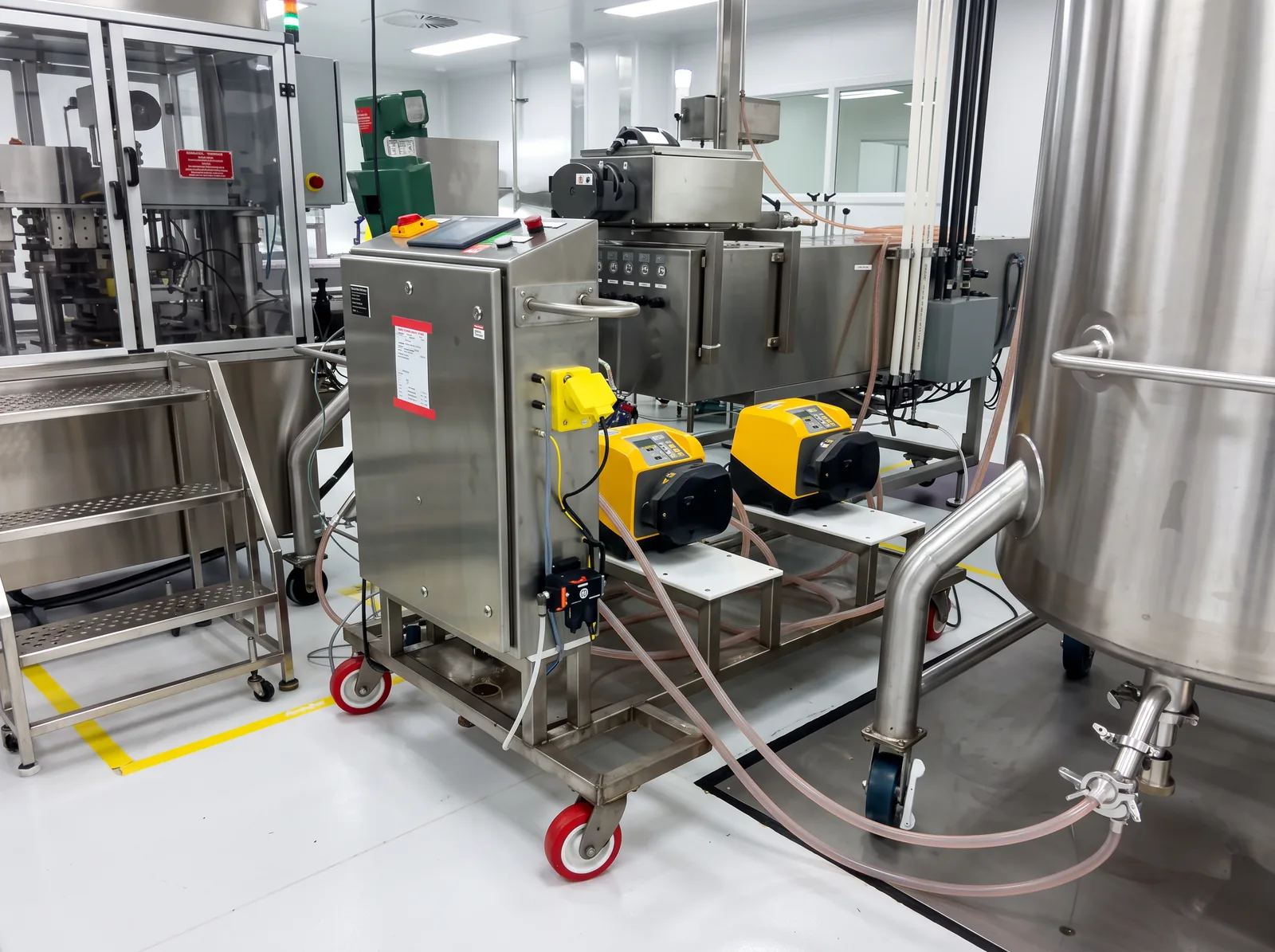
The engineering problem was continuous suspension maintenance through the fill cycle. The solution was a custom pump/valve skid, holding tanks with appropriate agitation, a mixer, and a flow-through reservoir that maintained suspension homogeneity from the tank through the nozzle. Once that system was in place, the fill crew no longer needed to pre-weigh every bottle. Sampling was reduced by over 95%.
The approach came from fluid dynamics work that had nothing to do with IVD manufacturing directly — creative water features, specifically, where maintaining suspension in moving water is the engineering challenge. The domain is different. The physics is the same.
What matters for IVD manufacturers is the underlying principle: magnetic particle suspensions need suspension maintenance engineering, not standard fill engineering. A vendor who says they handle magnetic particle reagents should be able to describe specifically how they maintain suspension homogeneity through the fill path. If the answer is “we’ll figure it out at FAT,” that is not an answer.
The Lyophilized Bead Case
Lyophilized bead manufacturing is in a different category entirely.
The process starts with R&D scientists dropping enzyme reagent from a pipette into a liquid nitrogen bath to form frozen beads, then lyophilizing them. The beads are small, delicate, and have to maintain their structural integrity through handling, drying, and packaging into the cartridge format the product uses.
Early attempts with large, cumbersome equipment proved too expensive and too dangerous. The equipment went into storage. The project stalled.
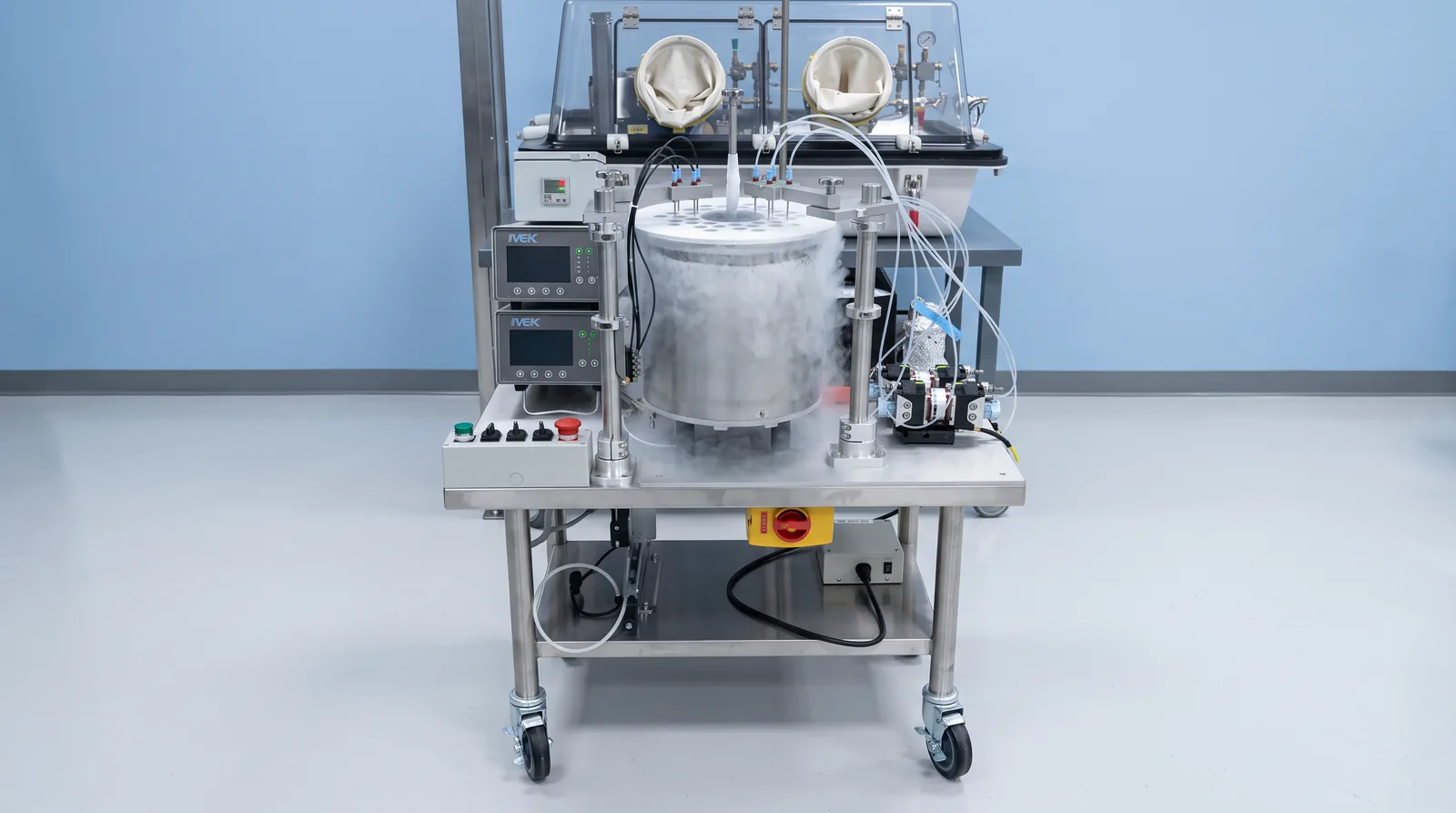
The re-engineering approach started at the dispensing step — moving from a pipette to a positive displacement pump, which was a significant throughput improvement on its own. From there, a rotary 4-pump channel unit was designed and built, then expanded to an 8-channel system with separated chambers and quick changeover features. Additional equipment to lyophilize the frozen beads and fill the 2×6 cartridges was designed in sequence. A whole manufacturing suite was built, including a dry room, and an automated liquid nitrogen supply system replaced the manual LN2 tank exchange process.
The end result was an end-to-end production process that went from proof-of-concept to full production. The process generated two patents.
The point isn’t the patents. The point is that lyophilized bead manufacturing requires engineering from a completely different starting place than liquid fill — and that starting place has to be defined in the URS before vendor conversations happen. Biofortuna, a specialist lyophilization CMO, has documented the scale that’s achievable with the right process engineering in place. Getting to that scale requires building the process correctly from the first unit.
What the URS Has to Cover for Non-Standard Reagents
The URS for a non-standard IVD fill or assembly process is fundamentally different from the URS for a standard liquid fill.
A standard liquid fill URS specifies fill volume, fill accuracy, cycle time, container type, and a handful of supporting requirements. The reagent behaves predictably. The vendor has seen it before.
For non-standard reagents, the URS has to capture what makes the reagent non-standard — because if it doesn’t, the vendor will build to standard assumptions, and the gap between those assumptions and reality will surface at FAT or after installation.
For a foamy reagent, the URS should specify: foam generation rate under fill conditions at the specified pump type and pressure, required settling time between fills if applicable, acceptable fill accuracy at steady-state (not the first fill of the day when the nozzle is cold and the reagent is fresh), nozzle geometry requirements based on container access, and cleaning protocol between product changeovers.
For a magnetic particle suspension, the URS should specify: acceptable particle concentration uniformity across the fill run (not just fill volume), agitation type and rate in the hold tank and through the fill path, settling rate characterization for the specific particle formulation, and sampling protocol for suspension uniformity verification.
For lyophilized beads, the URS should specify the bead formation process, the handling mechanism and allowable contact forces, the lyophilization cycle, the cartridge loading method, the environmental requirements (dry room, humidity limits, LN2 supply), and the qualification scope for each equipment element in the process.
None of this can be written from template. It has to come from engineering knowledge of what the specific reagent does under the specific process conditions — which is the characterization work that has to happen before the URS is drafted, not after.
Why Standard Vendors Often Can’t Help — and Won’t Tell You
Standard automation vendors are businesses. They take the projects that fit their capabilities and their economics.
A foamy diagnostic reagent fill into a custom container, two units, six-week timeline — that’s a small, difficult, specialty project. Most standard fill equipment companies will decline it or quote a delivery timeline that doesn’t work, because building to a non-standard reagent specification in a compressed timeline for a small order is not what their production model is built for.
The companies that say they can do it sometimes can. The question is whether their “yes” is based on having actually solved this problem before, or on confidence that they can adapt their standard process if it doesn’t work quite right. Those are very different kinds of yes, and telling them apart requires asking specific technical questions about what they’ve done with similar reagents — not accepting a general statement of capability.
This isn’t a critique of standard fill equipment vendors. It’s just a description of how vendor markets work. There are fill equipment vendors with genuine expertise in IVD-specific reagent handling. They’re not the first vendor who returns your call.
The right procurement approach — independent of any specific vendor — is to characterize the reagent behavior first, write the URS to capture what the fill process actually requires, and evaluate vendors against those specific requirements. A vendor who can describe specifically how they’d handle your foamy reagent, or your magnetic particle suspension, or your lyophilized bead assembly, is a different conversation than one who says “yes, we’ve done fills like that.”
Common Questions From IVD Manufacturers With Non-Standard Fill Challenges
Our reagent foams. Every vendor says they can handle it. How do we know who actually can?
Ask them to fill your specific reagent, in your specific container, at your target fill volume and accuracy, before you sign the purchase order. Not a demonstration with water, not a test with a model fluid — your reagent, your container, your spec. FAT is the official test, but a pre-FAT demonstration with actual reagent protects you from a FAT failure after the machine is built. A vendor who is confident in their foamy reagent capability will agree to this. One who says it’s unnecessary probably hasn’t thought carefully about what your specific reagent will do.
What’s the risk of buying standard fill equipment and trying to adapt it for a magnetic particle suspension?
The main risk is suspension uniformity across the fill run — something standard fill equipment doesn’t measure or maintain. You can verify fill volume with a scale. You can’t easily verify particle concentration uniformity without a characterization protocol built into your PQ, which requires knowing what uniformity looks like in advance and building a measurement method around it. If the equipment wasn’t designed to maintain suspension homogeneity through the fill path, the adaptation is essentially retrofit engineering on equipment that was built for a different problem. It works sometimes. When it doesn’t, it’s expensive to fix after qualification.
Can we use a standard fill vendor for our IVD reagent if we specify the requirements precisely enough in the URS?
Sometimes, yes. The URS works to prevent the most common problems by forcing the vendor to design to your specific reagent behavior rather than their standard assumptions. But a URS can specify requirements that a standard fill vendor’s equipment architecture can’t meet — because the way a peristaltic pump handles foamy reagent at a given viscosity is a function of the pump design, not just the operating parameters. If the vendor’s standard equipment has fundamental constraints that make your spec unachievable without redesign, the URS will surface that — ideally before purchase, not at FAT. That’s one of the reasons evaluation happens before vendor selection.
How long does it take to characterize a non-standard reagent for fill specification purposes?
Reagent characterization scope depends on how non-standard the reagent actually is. For a mildly foamy aqueous reagent with known formulation, characterization might be a few days of fill testing at the lab scale — enough to measure foam generation rate, settling time, and fill accuracy under representative conditions. For a magnetic particle suspension with an unknown settling rate and particle size distribution, characterization takes longer and may involve analytical work to establish the baseline behavior before fill conditions can be specified. Rushing characterization to get to the URS faster is the decision that produces change orders later.
We have a container geometry that doesn’t work with standard fill nozzles. What are the options?
Custom nozzle design is the first option and usually the right one — it’s often less expensive and faster than finding a container that works with standard nozzles, especially when the container was designed around the product rather than around manufacturing. The nozzle has to be specified in the URS, with the container geometry documented and the fill accuracy requirement tied to a specific nozzle design. A vendor who designs and builds their own nozzles can solve this problem. A vendor who installs catalog nozzles and doesn’t do custom work can’t, and you should know that before the purchase order.
The Engineering Knowledge That Makes This Solvable
Non-standard IVD reagent fills are solvable problems. They’re solved every day by IVD manufacturers who have the engineering support to characterize the reagent correctly, write a URS that captures the actual requirements, and evaluate vendors against those requirements rather than against catalog capabilities.
What makes them difficult is the skill set required: fluid dynamics knowledge, IVD reagent experience, fill equipment familiarity, and GAMP documentation expertise. That combination is uncommon in a single person. Most IVD manufacturers don’t have it internally. Most fill equipment vendors have part of it — the equipment side — but not the regulatory documentation side.
MEPSCo GAMP’s approach to non-standard IVD fill challenges starts with characterization. What does the reagent actually do under fill conditions? That answer drives the URS. The URS drives vendor evaluation. Vendor evaluation drives FAT scope. FAT scope drives IQ/OQ/PQ. The documentation package that comes out the other end holds up under audit because it was built to describe what the equipment actually does with the actual reagent.
That’s the sequence. And it starts before the vendor conversation.
- ScienceDirect — “Model fluids representing aqueous in-vitro diagnostic reagents for the development of dispensing systems”
- Biofortuna — lyophilized bead manufacturing automation and output scale
- IVEK — precision dispensing systems for lateral flow and reagent fill
- eCFR — 21 CFR Part 820, §820.70: Production and Process Controls
The Bottom Line
Non-standard reagent fills are solvable — but only when the reagent behavior is characterized before the URS, so the vendor builds to the actual problem instead of to standard assumptions.
Ready to discuss your specific reagent and container geometry? Start with a Manufacturing Automation Assessment — 30 minutes with Reza to scope the problem before it becomes an expensive change order.