GAMP documentation for a single piece of capital equipment typically runs 8%–12% of the equipment purchase price. On a $500,000 fill line, that’s $40,000–$60,000 in documentation — covering the CRD, URS, FRS, FAT, SAT, IQ/OQ/PQ protocols, and SOPs.
What you pay varies based on equipment complexity, your existing quality system, and whether you bring in outside help.
- GAMP documentation typically runs 8%–12% of the equipment purchase price.
- IQ/OQ/PQ protocols and their execution typically consume 35%–50% of the total documentation budget.
- URS development is the second biggest cost, and it’s the one that pays the most dividends.
- Change orders on capital equipment are expensive. $15,000 is common. $50,000 is not unusual on complex systems.
Most IVD manufacturers don’t find out what GAMP documentation costs until they’re staring down a capital equipment purchase and someone in QA mentions it needs to be “validated.” Then the quotes come in, nobody knows what’s normal, and the project either gets delayed or the documentation gets done cheaply — which causes worse problems later.
This guide gives you a real cost framework. Not a consulting pitch. Not a “it depends” non-answer. Numbers you can actually use when building a capital equipment budget or evaluating a vendor proposal.
Reza Bashar has completed GAMP documentation packages for 96+ equipment installations across IVD manufacturers, diagnostic CDMOs, and consumable diagnostic companies. The benchmarks below come from that work. If you want to understand automation procurement for medical device manufacturers, this is one of the key cost line items you need to plan for.
The Benchmark Nobody Publishes
Most resources on GAMP documentation avoid specific cost numbers. They explain the process. They list the document types. They don’t tell you what it costs.
Here’s what Reza’s 96+ completed projects show: GAMP documentation typically runs 8%–12% of the equipment purchase price.
On a $200,000 piece of equipment, that’s $16,000–$24,000. On a $500,000 fill line, $40,000–$60,000. On a $1.2M automated assembly system, $96,000–$144,000.
That range assumes a competent engineer who knows the process. It doesn’t assume you’re paying a Big Four consulting firm or a validation-software vendor. It also doesn’t assume you’re cutting corners — this is what thorough, audit-ready documentation actually costs when done right.
The benchmark shifts depending on three things.
Equipment complexity. A benchtop analyzer with one operator interface costs less to document than a multi-station fill-and-seal line with five programmable axes and a vision system. More complexity means more IQ checkpoints, more OQ test conditions, more SOPs.
Your existing quality system. If your site templates are built, your SOPs for document control exist, and your QA team is comfortable reviewing GAMP deliverables, the engineer spends less time on scaffolding and more time on the actual documentation. If you’re building everything from scratch, budget toward the higher end.
Who does the work. A fractional automation engineer embedded in your project team during equipment procurement will document it for less than a validation consulting firm that comes in after the equipment is installed and starts from zero. Timing matters. So does whether the person writing the URS is the same person who attended the FAT.
What the Documents Actually Cover
GAMP documentation for a capital equipment installation isn’t one thing. It’s a sequence of documents that build on each other. Each one has a different purpose and a different cost driver.
CRD (Conceptual Requirements Document). Defines what the equipment needs to do, in business and operational terms, before you talk to any vendor. This is where scope gets locked. Most manufacturers skip this. Skipping it is why change orders happen later. Cost driver: engineer time; typically 10–20 hours depending on complexity.
URS (User Requirements Specification). The technical version of the CRD. Specifies performance parameters, interface requirements, safety requirements, and regulatory requirements. This document — if written well — eliminates most vendor ambiguity and most change orders. Cost driver: engineer time plus review cycles with QA; 20–40 hours is typical.
FRS/FDS (Functional Requirements Specification / Functional Design Specification). Sometimes combined, sometimes separate depending on equipment type. Describes how the equipment will meet the URS requirements. Usually the vendor’s responsibility, but a qualified automation engineer reviews and challenges it before sign-off. Cost driver: review time; 8–16 hours.
FAT (Factory Acceptance Testing) Protocol and Report. The test protocol run at the vendor’s facility before the equipment ships. Verifies that the equipment meets the URS before it leaves. Missing FAT documentation is one of the most common FDA 483 observations for equipment-related inspections. Cost driver: travel, engineer time on-site, protocol writing and execution; 16–40 hours.
SAT (Site Acceptance Testing) Protocol and Report. Same concept, run at your facility after installation. Verifies the equipment still performs correctly in your environment. Cost driver: engineer time on-site; 12–24 hours.
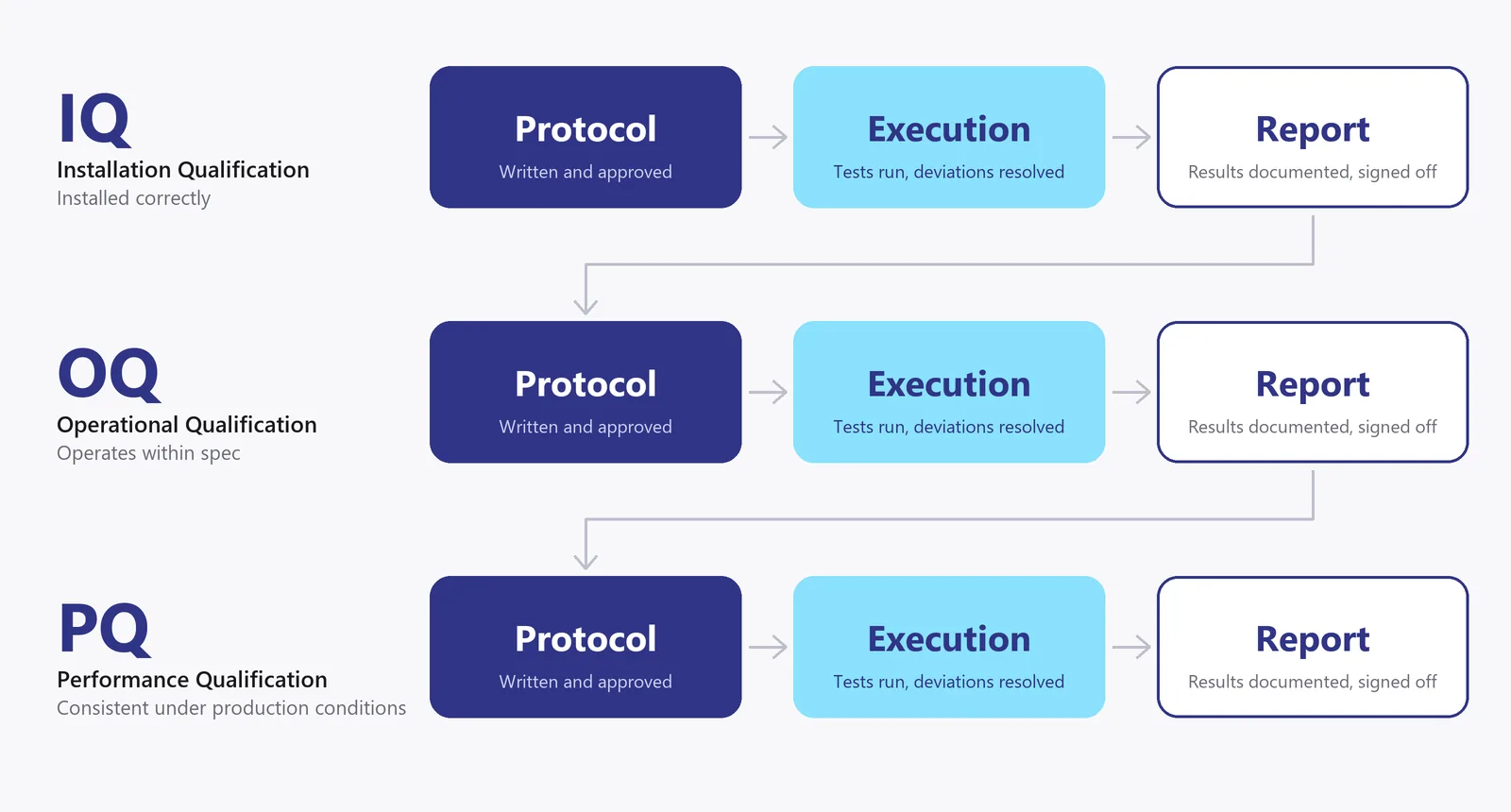
IQ/OQ/PQ Protocols and Reports. Installation Qualification, Operational Qualification, Performance Qualification. The formal evidence package that proves the equipment is installed correctly (IQ), operates within spec (OQ), and performs consistently under production conditions (PQ). Per Greenlight Guru’s 2026 IQ/OQ/PQ guide, these three phases are the core of any equipment validation package under FDA 21 CFR Part 820 and ISO 13485. Cost driver: protocol development plus execution plus deviation resolution; typically the largest single cost center.
SOPs (Standard Operating Procedures). The operational documents your production team actually uses. Equipment-specific SOPs for operation, cleaning, maintenance, and troubleshooting. Cost driver: scope-dependent; a simple instrument might need two SOPs, a complex line might need twelve.
| Document | What it does | Typical effort |
|---|---|---|
| CRD | Defines what the equipment needs to do, in business and operational terms, before you talk to any vendor | 10–20 hours |
| URS | Specifies performance, interface, safety, and regulatory requirements | 20–40 hours, including QA review cycles |
| FRS/FDS | Describes how the equipment will meet the URS; usually the vendor’s document | 8–16 hours of review |
| FAT protocol and report | Verifies the equipment meets the URS at the vendor’s facility, before it ships | 16–40 hours, plus travel |
| SAT protocol and report | Verifies the equipment still performs correctly in your environment | 12–24 hours on site |
| IQ/OQ/PQ protocols and reports | Proves correct installation, operation within spec, and consistent performance under production conditions | The largest single cost center |
| SOPs | Operation, cleaning, maintenance, and troubleshooting procedures | Two for a simple instrument, up to twelve for a complex line |
Where Most of the Money Goes
If you’re wondering where the 8%–12% actually goes, it’s not evenly distributed.
IQ/OQ/PQ protocols and their execution typically consume 35%–50% of the total documentation budget. Writing a protocol takes time. Running it takes time. Deviations — when the equipment doesn’t perform exactly as specified — take time to investigate and resolve. Any deviation requires a documented investigation before you can close the protocol.
URS development is the second biggest cost, and it’s the one that pays the most dividends. A well-written URS cuts change orders. It cuts FAT surprises. It cuts SAT deviations. Per ISPE’s March/April 2026 message on risk-based equipment qualification, structured risk assessment during design and specification reduces late-stage surprises. In Reza’s experience, every hour in URS saves three to five hours downstream.
FAT travel and execution is a cost most manufacturers underestimate. If the equipment is built overseas or in another state, you’re adding airfare, hotel, and engineer time away from other projects. Some manufacturers skip FAT entirely to save money. This is almost always a mistake — equipment that fails SAT costs far more to fix than equipment that failed FAT.
What GAMP Documentation Costs When You Don’t Do It
This is a question nobody asks until they get a 483.
An FDA Form 483 observation for inadequate equipment qualification documentation typically triggers a mandatory corrective action. The equipment may need to be re-qualified. Production may need to pause. A consent decree or warning letter can follow if the response is inadequate.
Per CGMP Consulting’s analysis of FDA 483 financial risks, legal and consulting fees for a 483 response alone can run from tens of thousands to hundreds of thousands of dollars, and remediation can range from thousands to millions, depending on the scope of the operation and the number of findings. A warning letter response with third-party oversight runs significantly more. A review published in the Journal of Industrial Engineering and Management (Anderson and Tan, 2023) puts the cost of non-routine quality events, including major FDA observations, warning letters, and consent decrees, at $7.5 billion to $9 billion a year across the medical device industry, and notes that Medtronic’s stock fell more than 9% after it received a warning letter.
The 8%–12% documentation budget looks different when the alternative is a 483 response.
The Change Order Problem
There’s another cost that doesn’t show up in documentation budgets: change orders.
When the URS isn’t written correctly — or isn’t written at all — vendors quote to assumptions. Then the equipment arrives and the assumptions are wrong. Or the equipment arrives and QA needs a feature that wasn’t specified. Or the validation team discovers during IQ that a utility wasn’t installed correctly because the URS didn’t specify it.
Every one of those scenarios generates a change order. Change orders on capital equipment are expensive. $15,000 is common. $50,000 is not unusual on complex systems.
A complete, technically rigorous URS eliminates most of this. Not by magic. By forcing specificity before money changes hands. Reza’s GAMP process starts with the CRD and URS for this exact reason. The documentation isn’t a paper exercise — it’s the engineering specification that holds vendors accountable and protects the manufacturer’s budget.
Read more about how the URS prevents change orders in medical device automation procurement.
Fractional vs. In-House vs. Consulting Firm
The who matters as much as the what.
An in-house engineer handles GAMP documentation as part of a broader role. If you have a senior automation or equipment engineer with GAMP experience, in-house is often the right model for ongoing programs. The challenge is availability. Capital equipment projects don’t flow evenly. Your in-house engineer is either overloaded or waiting.
A validation consulting firm brings documentation expertise but not necessarily equipment engineering expertise. They write good protocols. They may not understand why a particular parameter was specified, which matters when you’re defending a deviation during a 483 response. The FDA Group’s guide to IQ, OQ, PQ notes that everyone executing a qualification protocol should be trained on the equipment itself, as well as on documentation practices.
A fractional automation engineer works on your project during the procurement and validation cycle, then steps off. You get senior expertise without the full-time cost. For manufacturers doing 1–3 capital equipment installations per year, this is often the most cost-efficient model. The engineer attends the FAT because they wrote the URS. That continuity matters for documentation quality.
Learn more about how the fractional automation engineer model compares to hiring full-time.
What a Realistic Budget Looks Like
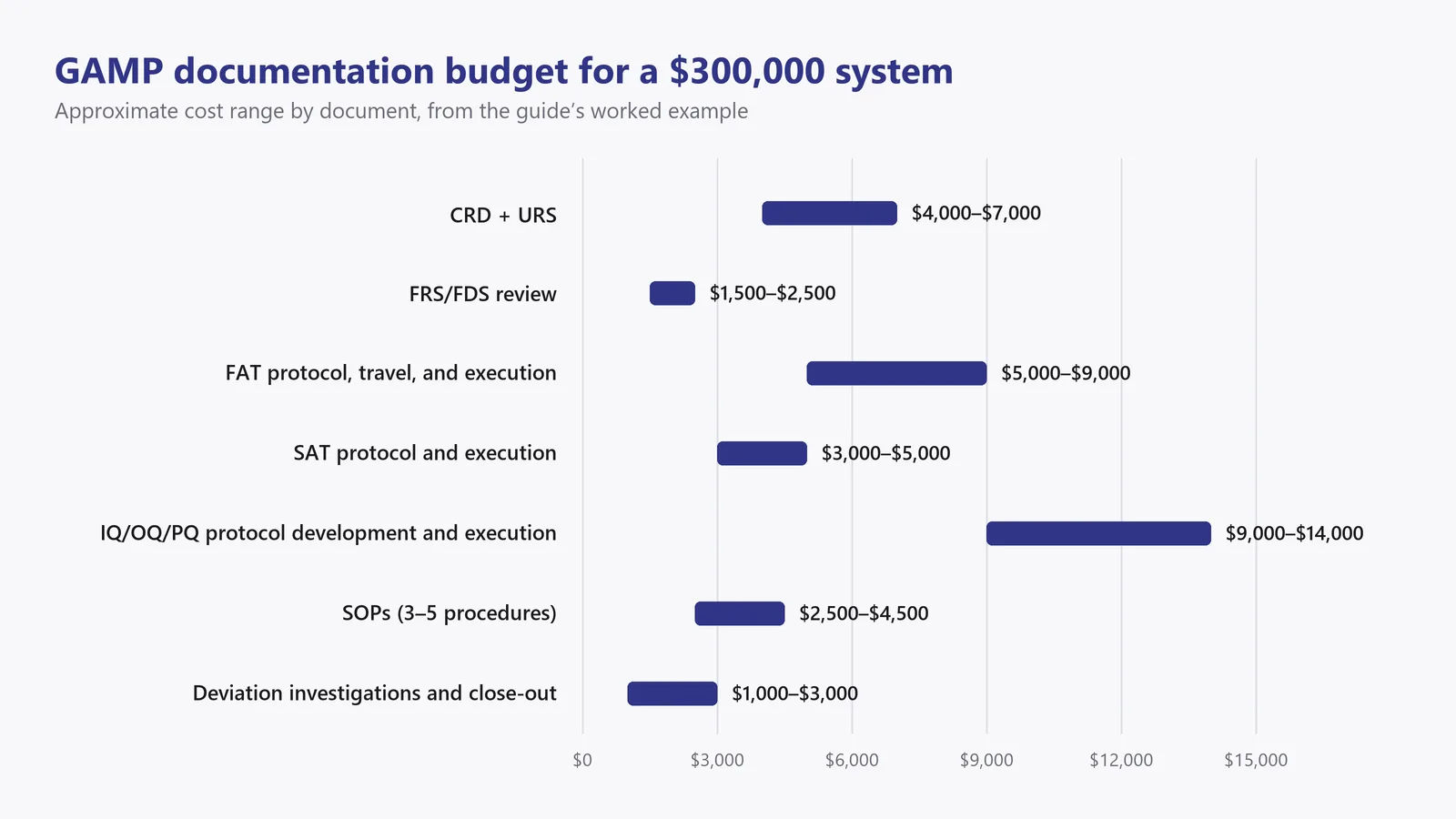
For a $300,000 piece of automated diagnostic equipment in a mid-sized IVD manufacturer:
GAMP documentation budget: $24,000–$36,000 (8%–12% of equipment cost)
Approximate breakdown:
- CRD + URS: $4,000–$7,000 (engineering time, QA review cycles)
- FRS/FDS review: $1,500–$2,500
- FAT protocol, travel, and execution: $5,000–$9,000
- SAT protocol and execution: $3,000–$5,000
- IQ/OQ/PQ protocol development and execution: $9,000–$14,000
- SOPs (3–5 procedures): $2,500–$4,500
- Deviation investigations and close-out: variable, typically $1,000–$3,000
These figures assume an experienced engineer working efficiently with your QA team. They don’t assume a validation software platform subscription, which adds cost but can reduce execution time for larger programs.
Questions About GAMP Documentation Costs
How much does GAMP documentation cost for a single piece of equipment?
GAMP documentation for a single capital equipment installation typically costs 8%–12% of the equipment purchase price. On a $500,000 piece of equipment, that’s $40,000–$60,000. The total covers CRD, URS, FRS, FAT, SAT, IQ/OQ/PQ protocols and reports, and SOPs. Cost varies based on equipment complexity, your existing quality system, and whether the engineer was involved during procurement or brought in after installation.
What’s included in a GAMP documentation package?
A complete GAMP documentation package covers the full sequence from requirements to validation close-out: Conceptual Requirements Document (CRD), User Requirements Specification (URS), Functional Requirements Specification (FRS), Factory Acceptance Testing (FAT) protocol and report, Site Acceptance Testing (SAT) protocol and report, IQ/OQ/PQ protocols and reports, and equipment-specific SOPs. Each document builds on the previous one. Gaps in the sequence create audit exposure.
Why is IQ/OQ/PQ so expensive?
IQ/OQ/PQ typically accounts for 35%–50% of total GAMP documentation cost because it involves three layers of work: writing the protocols, executing the tests, and resolving any deviations. A deviation — when the equipment doesn’t perform exactly as specified — requires a documented investigation before the protocol closes. On complex equipment with many test conditions, this adds up fast. The best way to reduce IQ/OQ/PQ cost is to write a complete URS upfront, so the equipment is built and installed correctly before qualification begins.
Can we skip FAT to save money?
Skipping FAT is one of the most common ways manufacturers accidentally increase their total validation spend. Equipment that fails SAT at your facility is much more expensive to fix than equipment that failed FAT at the vendor’s facility — the vendor is still accountable, and the equipment hasn’t shipped yet. Missing FAT documentation is also a frequent FDA 483 observation. The protocol and travel cost less than one round of post-installation rework.
What’s the difference between GAMP documentation and CSV?
GAMP stands for Good Automated Manufacturing Practice — the framework published by ISPE. CSV (Computerized System Validation) is what GAMP specifically covers for software and computerized systems. When manufacturers talk about GAMP documentation for capital equipment, they usually mean the equipment qualification documentation sequence: URS, FAT/SAT, and IQ/OQ/PQ. CSV applies when the equipment has embedded software, control systems, or computer interfaces that require software validation on top of the physical qualification.
Budget the Documentation Before You Buy the Equipment
Planning a capital equipment purchase? Build the 8%–12% GAMP documentation budget into it from the start.
Reza Bashar at MEPSCo GAMP works with medical device manufacturers on equipment procurement and GAMP documentation, from the CRD and URS through FAT, SAT, IQ/OQ/PQ, and SOPs. To scope the documentation package for your next system, reach out directly.