Automation Procurement for IVD Manufacturers
Automation procurement for IVD manufacturers requires custom-built filling equipment, GAMP-compliant documentation, and reagent-specific engineering expertise. Standard pharma automation (vial and syringe filling) doesn’t account for the substrate variability, material contact requirements, and sealing methods that diagnostic consumable production demands. MEPSCo provides fractional automation engineering across the full procurement lifecycle, from URS development through IQ/OQ/PQ validation. Reza has completed 96+ GAMP-documented automation projects over 25+ years, including a $150M DOD pandemic validation program at Hologic with zero change orders.
Custom filling equipment, validated documentation, and a GAMP process built for the complexity of diagnostic reagent manufacturing. We scope IVD automation projects within 1 week.
Why IVD Companies Can’t Buy Automation Off the Shelf
The global IVD market reached $85.6 billion in 2025, growing at a 6.9% compound annual rate (Nova One Advisor, 2024). Reagents alone account for 68% of that revenue. Behind every one of those reagent products sits a filling line, a sealing station, and a documentation trail that FDA expects to hold up under audit.
That’s the part that catches companies off guard.
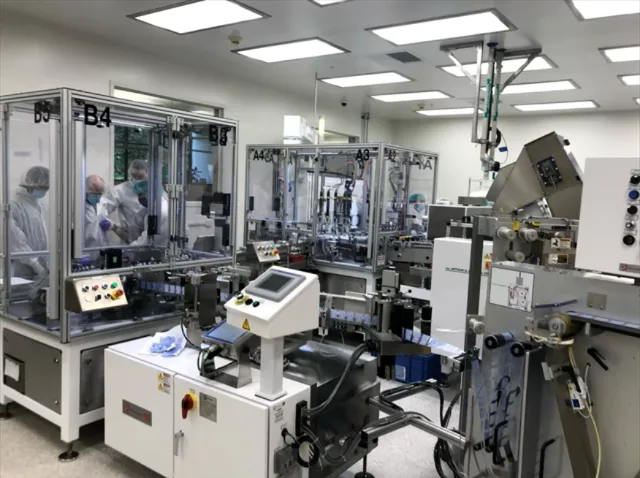
Manufacturing equipment for diagnostic consumables isn’t available from a catalog. Bead fills behave differently than liquid reagents. Caustic materials require different contact surfaces than light-sensitive formulations. Cartridge substrates need different handling than tubes. And every one of those variables changes what kind of pump, what kind of seal, and what kind of leak detection belongs on the line.
IVD manufacturers face a procurement challenge that pharma companies don’t. Off-the-shelf automation is designed for vial filling and syringe filling. Diagnostic filling is a custom build. If your automation procurement process doesn’t account for that from day one, the gap shows up during FAT, during validation, or worse, during an FDA audit.
We work with IVD and diagnostic manufacturers across the industries we serve, providing fractional automation engineering that bridges the space between your product team and your automation vendor.
The IVD Automation Procurement Problems Nobody Warns You About
Here’s where IVD manufacturers run into trouble. Not at the equipment level. At the documentation level.
R&D-to-Manufacturing Transfer Gaps
R&D develops the reagent chemistry in a silo. The product works. Passes internal validation. Then it gets handed to manufacturing engineering, and the process that worked at bench scale doesn’t translate to automated production. The pumping system R&D used doesn’t match what’ll run on the machine. Once you’ve submitted through 510(k), changing the process means another FDA submission. That adds months. Sometimes a full year.
URS Documents That Miss Critical Variables
The user requirement specification is the foundation document. Everything traces back to it. If the interview process wasn’t thorough enough, if reagent characteristics weren’t documented with enough detail, the automation vendor quotes a machine that doesn’t match your actual production needs. We see this regularly. The URS captures the fill volume and the throughput target but misses the material contact specifications, light sensitivity requirements, or leak detection tolerances for foil-sealed cartridges.
Vendor-Written GAMP Documentation
Some manufacturers let the automation vendor write the URS and the GAMP documentation. Built-in conflict. The vendor is quoting a machine against requirements they authored. When something doesn’t perform during FAT, the finger-pointing starts. Who owns the specification gap? The vendor wrote it. The manufacturer signed it. Nobody wins that argument.
Validation Gaps That Surface During FDA Audit
FDA doesn’t care who wrote the URS. They care whether your manufacturing process is in a validated state, whether it can handle the variability of your product, and whether you can prove it with documentation. If the trace matrix doesn’t connect every requirement through design, FAT, SAT, and IQ/OQ/PQ, you’re going to have problems showing state of control when an auditor asks.
One thing we see a lot.
Companies assume that once the equipment is installed and running product, the hard part is over. It isn’t. The documentation is the hard part. And the documentation problems almost always trace back to a URS that wasn’t detailed enough to begin with.
What Is Automation Procurement for IVD Manufacturers?
Automation procurement for IVD manufacturers is the structured process of specifying, sourcing, qualifying, and validating custom filling and assembly equipment for diagnostic consumable production. It follows GAMP 5 methodology and FDA quality system requirements, covering everything from initial user requirement specification through vendor qualification, factory acceptance testing (FAT), site acceptance testing (SAT), and IQ/OQ/PQ validation.
How IVD Manufacturers Work with MEPSCo
Equipment procurement and vendor management for IVD companies follows the same GAMP framework we use across medical device manufacturing. But the application looks different for diagnostic consumables.
Reagent Fill Line Procurement
Reza and MEPSCo have procured and documented automation for foamy reagent fills at contract manufacturers, magnetic particle reagent dispensing lines, lyophilized bead production equipment, and multi-reagent cartridge filling systems. Each project required custom URS documentation that captured the specific reagent handling characteristics, substrate formats, and quality specifications that off-the-shelf equipment specs wouldn’t cover.
R&D-to-Production Equipment Transfer
When IVD products move from bench to production, the equipment procurement path needs to account for process differences. We work with your R&D and manufacturing engineering teams before the URS gets written to confirm that the processes specified are automation-ready, that pumping systems align between development and production, and that the 510(k) submission doesn’t get complicated by a preventable process change.
At this stage, the VP of Manufacturing or Director of Engineering usually asks the same things.
How long will this actually take? Will the vendor be able to build to these specs? What happens if the reagent characteristics shift between lots and the machine can’t handle the variability?
Vendor Qualification and Kepner-Tregoe Scoring
Not every automation company can build IVD filling equipment well. We run a structured KT vendor scoring process that evaluates quality systems, industry reputation, financial stability, and how thoroughly the vendor responded to the requirements document. The lowest bid almost always costs more. We’ve seen projects come in 18 months late and well over budget because management picked the cheapest quote from a vendor who overstated their capabilities.
The IVD contract manufacturing market hit $21.1 billion in 2024, growing at over 10% annually (Grand View Research, 2025). CDMOs are scaling fast, and they’re buying automation to keep up. The procurement process for that equipment determines whether the line validates cleanly or generates change orders for a year and a half.
URS Development
Vendor Qualification
FAT and SAT
IQ/OQ/PQ
Regulatory Framework for IVD Automation Equipment
IVD manufacturing equipment operates under a regulatory framework that has real teeth. And it recently got updated.
FDA QMSR (Effective February 2, 2026)
The FDA’s Quality Management System Regulation incorporates ISO 13485:2016 by reference into 21 CFR Part 820 (LSO, 2025). For IVD manufacturers, this means your equipment validation documentation needs to align with both FDA and ISO requirements simultaneously. Section 7.5.6 of ISO 13485 specifically requires process validation when manufacturing output can’t be fully verified by inspection and testing alone. That applies to nearly every automated IVD filling process.
GAMP 5 (Second Edition)
ISPE’s Good Automated Manufacturing Practice framework remains the industry standard for automation procurement documentation. MEPSCo’s proprietary 22-document GAMP process, which Reza built from scratch starting in 2001, aligns with GAMP 5 methodology. It covers everything from URS through validation, with a trace matrix that connects every requirement through every phase of the project.
21 CFR Part 820 and Equipment Validation
FDA auditors look at whether your manufacturing equipment is in a validated state, whether that state has been maintained, and whether the process can handle product variability. The IQ/OQ/PQ qualification package needs to trace directly back to the URS. If FAT and SAT were done properly, if every requirement was verified and documented, then IQ/OQ/PQ becomes a straightforward separation of that documentation into installation, operational, and process qualification packages. If requirements were missed along the way, it becomes a much bigger project at the worst possible time.
EU IVDR
IVD manufacturers selling into European markets face separate QMS obligations under the In Vitro Diagnostic Regulation. Plan for both FDA and IVDR compliance early in the automation procurement process. Retrofitting documentation for a second regulatory framework after the equipment is validated is painful and expensive.
That’s 25+ years of refinement. Not a template someone downloaded.
How We Procure and Validate IVD Automation Equipment
Assess your current manufacturing automation readiness before writing a URS. That’s where every engagement starts.
Manufacturing Process Assessment
We evaluate your current production state, reagent handling requirements, substrate formats, throughput targets, and quality specifications. This determines whether you need semi-automated or fully automated equipment, and what the URS needs to capture. For IVD companies still in manual production, we assess automation readiness before anyone starts spending.
URS Development and Stakeholder Interviews
Detailed interviews with R&D, manufacturing engineering, quality, and operations. We document every reagent characteristic. Every substrate variable. Every tolerance requirement. The URS is the foundation, and if it’s weak, everything downstream pays for it. For IVD products, this means capturing pump type requirements for specific reagent viscosities, material contact surface specifications for caustic or corrosive formulations, and environmental controls for light-sensitive materials.
Vendor Qualification and Bid Management
Structured KT vendor scoring. We evaluate automation companies against your specific IVD requirements, assess their quality systems and track record with diagnostic equipment, and manage the bid process so you’re comparing vendors on capability. Not just price.
FAT/SAT Oversight and Documentation
Factory acceptance testing at the vendor site, followed by site acceptance testing at your facility. Every test traces back to the URS. Every result gets documented. No gaps in the trace matrix. We’ve managed FAT/SAT on projects ranging from single-reagent fill lines to multi-station cartridge assembly systems.
IQ/OQ/PQ Validation Support
Installation qualification, operational qualification, and process qualification. Structured as GAMP-compliant documentation packages that hold up under FDA audit. When the FAT/SAT was done right, this phase is a documentation exercise. When it wasn’t, this is where the project timeline blows up.
So what does that look like in practice?
A typical IVD automation procurement project runs 6 to 18 months from URS kickoff to validated equipment. A single-reagent fill line sits closer to 6. A multi-reagent cartridge system with custom leak detection and light-sensitive handling pushes 18. The URS development phase alone takes 6 to 10 weeks when done right.
Tell Us About Your IVD Filling Equipment Project
We’ll assess the procurement path and scope the engagement within 1 week.
Schedule a Manufacturing Automation Assessment96+ Projects. 25+ Years. Zero Change Orders on a $150M Program.
96+ completed GAMP-documented automation projects across medical device and diagnostic manufacturing. 25+ years of procurement experience. A proprietary 22-document GAMP process, built from scratch, refined across every one of those projects.
On one $150M DOD pandemic validation program at Hologic, Reza delivered zero change orders. That result happened because the URS was written with enough detail, the trace matrix was maintained throughout, and the vendor delivered exactly what was specified. That doesn’t happen by accident. It happens because the procurement process worked.
Here’s a pattern we’ve seen across IVD projects specifically. A diagnostic manufacturer retrofits an existing filling machine, trying to avoid the cost of new automation. The retrofitted equipment sort of works, but the documentation doesn’t trace properly, the validation package has gaps, and when production variability shows up (lot-to-lot changes in the reagent, slight differences in substrate molding), the line can’t handle it. They end up procuring new equipment anyway, 12 to 18 months behind where they would’ve been with a proper procurement process from the start.
The global IVD market is projected to reach $157 billion by 2034, at 6.9% annual growth (Nova One Advisor, 2024). Reagents represent 68% of IVD industry revenue. Every one of those reagent products needs validated manufacturing equipment. The procurement process determines whether that equipment runs cleanly or becomes a multi-year documentation problem.
What You Get with MEPSCo on an IVD Project
Reagent-Specific URS Development
We document the fill characteristics, material contact requirements, substrate variables, and tolerance specifications your automation vendor needs to build the right equipment.
Vendor Qualification with KT Scoring
Structured evaluation of automation companies against your IVD-specific requirements, quality systems, financial stability, and actual track record with diagnostic equipment builds.
GAMP-Compliant Validation Packages
A 22-document process from URS through IQ/OQ/PQ, with a trace matrix that connects every requirement through every phase of the project.
Built for IVD and Diagnostic Consumable Manufacturers
This is a fit if you:
This is not the right engagement if you:
The distinction matters. We help companies that manufacture consumable diagnostics at volume. If you’re making a product that gets used once in a lab, a cartridge that runs through an analyzer, a tube that holds a reagent, a lateral flow test strip, that’s our lane.
IVD Automation Procurement vs. Standard Pharma Procurement
| Factor | Pharma (Vial/Syringe) | IVD / Diagnostics |
|---|---|---|
| Equipment availability | Off-the-shelf lines common | Custom build required |
| Substrate types | Vials, syringes, pre-filled | Cartridges, tubes, plates, lateral flow |
| Reagent complexity | Single-product fills typical | Multiple reagent types per line |
| Material contact concerns | Standardized | Varies by reagent (caustic, viscous, light-sensitive) |
| URS complexity | Template-driven | Custom; requires deep product knowledge |
| Validation risk | Well-established protocols | Higher; more variables to document |
Concerns IVD Buyers Raise Before Signing
“We already have an automation vendor. Why do we need a separate procurement engineer?”
Your vendor builds equipment. They don’t write the URS, manage the trace matrix, or run the validation documentation. Letting the vendor author the requirements they’re quoting against creates a conflict of interest. We sit between you and the vendor. The URS is written from your manufacturing perspective, not the vendor’s build perspective.
“Our quality team can handle the GAMP documentation.”
Quality teams validate product. Equipment procurement documentation (the URS, vendor qualification, FAT/SAT protocols, trace matrices) requires automation engineering expertise. Quality teams don’t typically have deep experience specifying pump types for viscous reagent fills or evaluating whether an automation vendor can actually build to a set of IVD-specific requirements. Different skill set.
“A fractional automation engineer sounds expensive.”
A full-time senior automation engineer costs $180K to $220K in total compensation. A fractional engagement with MEPSCo covers the procurement lifecycle for a fraction of that, and you’re getting 25+ years of IVD-specific experience. Not a junior engineer learning on your project. The real cost question is what happens when the equipment arrives and the documentation doesn’t hold up. Change orders alone on one project we’ve seen ran over $400,000.
If you’re filling 1 or 2 products a year with no regulatory pressure and no scale-up plans, you probably don’t need us. That’s an honest assessment. But that’s not why IVD manufacturers usually call. They call because a project is already moving and they need someone who’s done this 96+ times before.
Zero Change Orders on a $150M Program
Reza delivered a $150M DOD pandemic validation program at Hologic with zero change orders, because the URS was detailed, the trace matrix was maintained throughout, and the vendor built exactly what was specified. Read the case study.
Non-Standard Fill, Carlsbad CMO
Two custom fill units designed, built, and delivered in under 2 months for a foamy reagent in an odd-shaped bottle. A custom nozzle design exceeded the required fill spec, filling just over 1 liter in under 60 minutes. Standard vendors couldn’t meet the timeline or weren’t interested in a project this small. Read the case study.
What IVD Buyers Ask Before Starting a Project
How long does a typical IVD automation procurement project take?
6 to 18 months from URS kickoff to validated equipment. A single-reagent fill line is closer to 6. A multi-reagent cartridge system with custom leak detection and light-sensitive handling might push 18. The URS development phase takes 6 to 10 weeks by itself when done properly, because for IVD products, the reagent handling interview process is more involved than a standard pharma fill.
Can you work with our existing automation vendor?
Absolutely. We don’t replace your vendor relationship. We manage the procurement documentation alongside it. The vendor builds the machine. We make sure the URS is complete, the trace matrix holds, and the FAT/SAT documentation supports a clean validation. We’ve worked alongside Kinematic Automation, Jerit Automation, and other equipment builders on medical device projects.
What makes IVD equipment procurement different from pharma?
Substrates, reagent characteristics, and sealing methods. Pharma filling is vial and syringe with established tooling and well-documented fill parameters. IVD filling handles cartridges, tubes, multi-well plates, bead fills, viscous materials, caustic materials, and light-sensitive reagents. Each combination requires different pump types, material contact surfaces, and detection methods. The URS for an IVD line is a more involved document than a standard pharma fill spec.
Do we need GAMP documentation for our filling equipment?
If FDA regulates your product, yes. 21 CFR Part 820 requires process validation for manufacturing equipment. The updated QMSR (effective February 2026) incorporates ISO 13485 by reference, which means your equipment documentation needs to satisfy both frameworks. GAMP 5 provides the structured methodology to get there without scrambling during an audit.
What if our R&D process doesn’t transfer cleanly to automated production?
Common situation. We work with both teams early, before the URS is written. The goal is making sure what gets specified is automation-ready. If the pumping system R&D used at bench scale won’t work at production throughput, or if the container handling doesn’t translate, we identify that before it becomes a 510(k) resubmission problem. Getting this right up front saves 6 to 12 months on the back end.
How do you handle vendor disputes during FAT?
This is exactly why we push for independent URS authorship. When MEPSCo writes the URS (not the vendor), the requirements document serves as the objective standard. Every FAT test traces back to a numbered line item in the specification. If the machine doesn’t meet a requirement, the trace matrix shows it. No finger-pointing. No ambiguity about what was specified versus what was delivered.
Related Pages
CDMO Automation Procurement
Equipment engineering for contract diagnostic manufacturers.
READ MORE →R&D to Production Transfer
Getting from a working bench process to a qualified production line.
READ MORE →Equipment Procurement and Vendor Management
How we run the procurement process from quote to qualified line.
READ MORE →GAMP Documentation Services
22 document types and the 8-step process.
READ MORE →Hire a Fractional Automation Engineer
Senior equipment procurement and GAMP, on a project basis.
READ MORE →Case Studies
Real builds, real timelines, real qualification outcomes.
READ MORE →Every Week of Delay Has a Cost
Every week of delay on an IVD automation project costs production capacity, pushes back market entry dates, and increases the risk of documentation gaps that surface during FDA audit.
If your diagnostic manufacturing team is planning automation procurement, or if a project is already underway and the documentation isn’t where it should be, we can assess the situation and scope the engagement within 1 week.
Schedule Your Manufacturing Automation AssessmentNot ready to talk yet? Review our equipment procurement and vendor management process to see how we approach automation projects.