On-Time Equipment Delivery for the DOD During the Pandemic
Developing the First URS
In 2001, shortly after starting at Gen-Probe in San Diego, my boss placed an order for filling equipment and asked me to perform the Factory Acceptance Test. No URS. No specs. No documentation of any kind.
I asked: to what document? He had no answer.
That question changed everything. GAMP was a new concept at the time — nobody in the industry was sure what to do with it or how to apply it. I started studying the guidelines from scratch and mapping what a properly documented procurement process should look like. I sat by that machine for weeks, built the FAT document from first principles, and figured out what the equipment was actually doing before I could test it.
From that project came a roadmap. Then 22 document types describing every step of the equipment procurement process. Then nearly 100 projects at Gen-Probe and Hologic where those documents were tested, refined, and applied.
Refining Templates and Processes
As Gen-Probe grew and projects became more complex, so did the documentation process. I created a stakeholder interview process to surface requirements from every level — management, engineering, the operator on the floor, the validation team, the maintenance team. Everyone who touches the equipment has a concern. The job is to collect, voice, and document all of them before the vendor starts building.
The URS that came out of that process was airtight enough to use as both a project baseline and a vendor quote evaluation tool. On several projects, a vendor declined to quote because they couldn’t support the GAMP documentation requirements. That’s useful information before you’re six months into a build.
Using URS and GAMP Discipline to Qualify New Equipment During COVID
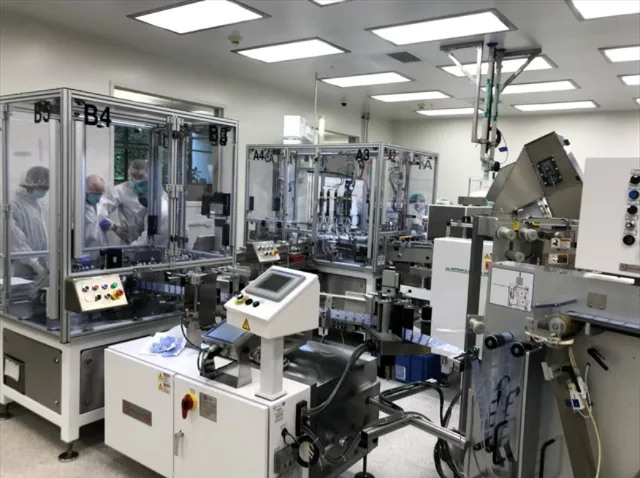
When the company decided to scale from a 70 PPM filling machine to a 200 PPM line, I produced the URS with enhanced technology requirements: automated pump calibration and recalibration, 100% fill volume and print vision inspection, 100% torque verification, online instrument validation, and additional process improvements. Three vendors were sent the URS for quotes. Using the URS and a structured vendor qualification process, I selected the right automation partner for the first two machines — one for San Diego, one for the UK facility.
Then COVID became a national emergency.
Hologic was asked to expand production of its diagnostic products for the DOD. The San Diego 200 PPM machine was finished with no change orders in record time. The UK unit was supported remotely. Three more machines were ordered for San Diego. Because the URS and subsequent GAMP documents were complete and thorough, those machines were brought in, qualified, and released to manufacturing in record time — with minimal involvement from me. Hologic met its obligations to the DOD contract.
In that same period, several supporting fill and cap assembly lines were also ordered, qualified, and released.
Total: $150M in equipment validated in one year, with a reduced engineering team, during a global pandemic.
in one year
San Diego and the UK
San Diego machine
and released in record time
Why It Worked
Vendors chose to support these projects over work from larger companies. Not because of the size of the contract. Because of the documentation.
A complete, well-written URS tells a vendor exactly what to build. It eliminates the ambiguity that produces change orders, delays, and disagreements. It creates the kind of project — defined scope, clear requirements, documented milestones — that vendors want to work on. The relationships built through proper process and professionalism over 20+ years proved to be one of the most important factors when the situation became critical.
When COVID hit and timelines compressed, the process held. The documentation was already done. The vendor relationships were already built. The machines came in and went out the other side of qualification on schedule.
That’s what the GAMP process is for.
About This Project
How much equipment was validated during the DOD pandemic project?
$150M in manufacturing equipment was validated in one year during COVID-19, including multiple 200 PPM filling lines for facilities in San Diego and the UK, plus several supporting fill and cap assembly lines.
How did Reza manage the UK equipment qualification remotely?
The UK unit was qualified remotely using the same GAMP documentation process applied to the San Diego machines. Because the URS and qualification documents were complete before the machines were built, remote execution was possible without compromising the validation standard.
What made it possible to qualify three additional machines so quickly?
The original URS and GAMP documentation were complete and thorough enough that the replicate machines required minimal additional engineering involvement. When the documentation is right the first time, every subsequent machine runs faster. That’s the point of the process.
Was the GAMP process at Gen-Probe the starting point for MEPSCo?
Yes. The process Reza built at Gen-Probe starting in 2001 — 22 document types covering every step from CRD through release to manufacturer — is the same process MEPSCo uses today, refined across 96+ projects.
Book a Manufacturing Automation Assessment
Or download the GAMP Roadmap to see the full 8-step process.