What Is an Automation Procurement Specialist for Medical Device Manufacturers?
An automation procurement specialist is an engineer who manages equipment selection, specification, and GAMP qualification for medical device manufacturers. They work exclusively for the manufacturer, not for automation vendors, ensuring every piece of production equipment meets FDA 21 CFR and ISO 13485 requirements before it goes live.
- An automation procurement specialist handles the equipment engineering side of buying and qualifying manufacturing automation for regulated medical device companies.
- They sit on the manufacturer’s side, not the vendor’s.
- They write specs, manage the vendor process, and make sure everything you buy can pass an FDA audit.
- If your company is scaling production of IVDs, consumable diagnostics, or lab components and nobody internally owns the equipment qualification piece, this is the role you’re missing.
Most companies buying production automation don’t realize they’re playing the game on the vendor’s terms.
The automation vendor sends a sales engineer. That person is good at their job. They know the equipment inside and out. But they represent the vendor. Their job is to close the deal and move on. Your job is to make sure whatever you buy can actually run in a regulated environment, pass qualification, and hold up during an FDA audit.
Those two jobs aren’t the same. And the gap between them is where procurement goes wrong.
An automation procurement specialist fills that gap. This post explains what the role actually covers, who needs it, and how it works inside a medical device manufacturing company. If you’ve been wondering whether your next equipment purchase needs this kind of support, read through. The answer is almost certainly yes if you’re scaling production of IVDs or consumable diagnostics without a dedicated equipment engineering function.
So What Does an Automation Procurement Specialist Actually Do?
Short answer: they own the equipment engineering process from concept to validation, on your behalf.
Longer answer: the role covers a specific sequence of work that most medical device manufacturers either skip entirely or hand off to the wrong people.
That sequence starts before you ever talk to a vendor. It starts with a user requirements specification, which defines exactly what the equipment needs to do, what regulatory requirements it has to meet, and what failure modes you can’t tolerate. Get that document right and the rest of the procurement process is manageable. Get it wrong and you’re looking at change orders, qualification failures, and delays that eat months.
From there, the specialist runs a vendor selection process. Not “we talked to three vendors and picked the one who seemed most responsive.” A structured evaluation against your URS requirements, with technical scoring, risk assessment, and a clear rationale that holds up during a supplier audit.
Then comes negotiation, FAT (Factory Acceptance Testing), SAT (Site Acceptance Testing), IQ/OQ/PQ validation, and finally SOP development for ongoing operation. Each step has regulatory implications under FDA 21 CFR Part 820 (now updated to the QMSR) and ISO 13485. The specialist knows those implications and builds the documentation accordingly.
That’s not what an automation vendor does. And it’s not what a general procurement manager does either.
What Makes This Role Different from an Automation Engineer?
Fair question. The titles overlap, and companies use them interchangeably in job postings.
The distinction that matters in practice: an automation engineer typically works inside a company building or maintaining automation systems. An automation procurement specialist focuses specifically on the acquisition side — getting external equipment from vendor specification through regulatory qualification. The skillset is different. So is the context.
Automation engineers are typically focused on controls, software, and system integration after equipment arrives. Procurement specialists are focused on what happens before equipment arrives and during the qualification phase. Both matter. They don’t always show up in the same person.
In a company that can afford it, you’d have both. Most IVD manufacturers and diagnostic CDMOs we work with can’t justify two separate hires at this stage, especially when the equipment buying cycle is episodic. That’s where a fractional model makes sense, but we’ll get to that.
When Does a Medical Device Manufacturer Need One?
Not every company needs a dedicated automation procurement specialist on staff. But most companies scaling production of diagnostic consumables, IVD reagents, or lab components need this function covered by someone.
Here’s a quick gut-check. You probably need this role covered if:
- You’re buying production automation from an external vendor for the first time and don’t have an engineer in-house who has done FDA-regulated equipment qualification before.
- You’ve had change orders blow up a capital equipment budget and you’re not entirely sure why.
- Your operations team is being asked to own the URS and validation documentation but they’re already running production.
- You have an upcoming FDA inspection and you’re not confident your equipment validation records would hold up to scrutiny.
- You’re a CDMO bringing on a new client whose product requires new equipment configurations you don’t currently run.
Any one of those scenarios means the function is either missing or being handled by someone who doesn’t have the regulatory background to do it safely.
The Hidden Risk in Letting Vendors Fill This Role
Here’s something vendors won’t tell you.
When you don’t have a specialist on your side, vendors fill the vacuum. They write the requirements. They interpret what “validation-ready” means for their equipment. They define the acceptance criteria. And sometimes those definitions are convenient for closing the deal rather than convenient for your quality system.
That’s not a character flaw in vendors. It’s just how the incentive structure works. They’re selling equipment. You need someone who is optimizing for your regulatory outcome.
The FDA’s QMSR is clear that the manufacturer is responsible for ensuring production equipment is adequate, properly installed, and validated for its intended use. The vendor hands you a piece of equipment. The qualification obligation is yours. If that documentation doesn’t exist or doesn’t hold up, the violation lands on your 483, not theirs.
That asymmetry is why the role exists. And why skipping it is almost always a more expensive decision than it looks.
| Automation procurement specialist | Capital equipment buyer | Vendor sales engineer | |
|---|---|---|---|
| Represents | The manufacturer | The manufacturer | The vendor |
| Focus | Technical requirements, regulatory qualification, and validation | Sourcing and commercial terms | The equipment, and closing the deal |
| Optimizes for | Your regulatory outcome | Price and terms | The sale |
| Requirements and acceptance criteria | Written from your side, starting with the URS | Usually not owned; the regulatory piece is where the buyer lacks depth | Written by the vendor when no specialist is in place |
| Involvement | Concept through validation and SOPs | Sourcing through purchase | Until the deal closes |
What the GAMP Process Looks Like When Done Right
GAMP stands for Good Automated Manufacturing Practice. It’s the framework most regulated manufacturers use to govern equipment and software validation in medical device and pharmaceutical contexts.
An automation procurement specialist who knows GAMP isn’t just checking boxes. They’re building a documentation trail that connects your equipment purchase decision to your quality system from the beginning.
The way Reza Bashar runs this at MEPSCo GAMP, the process runs in a consistent sequence: CRD (Concept Requirements Document) → URS (User Requirements Specification) → FRS/FDS (Functional and Design Specification) → vendor selection and negotiation → FAT → SAT → IQ/OQ/PQ validation → SOPs for ongoing use. Twenty-two documents across eight steps, each with specific content requirements and linkages to the next.
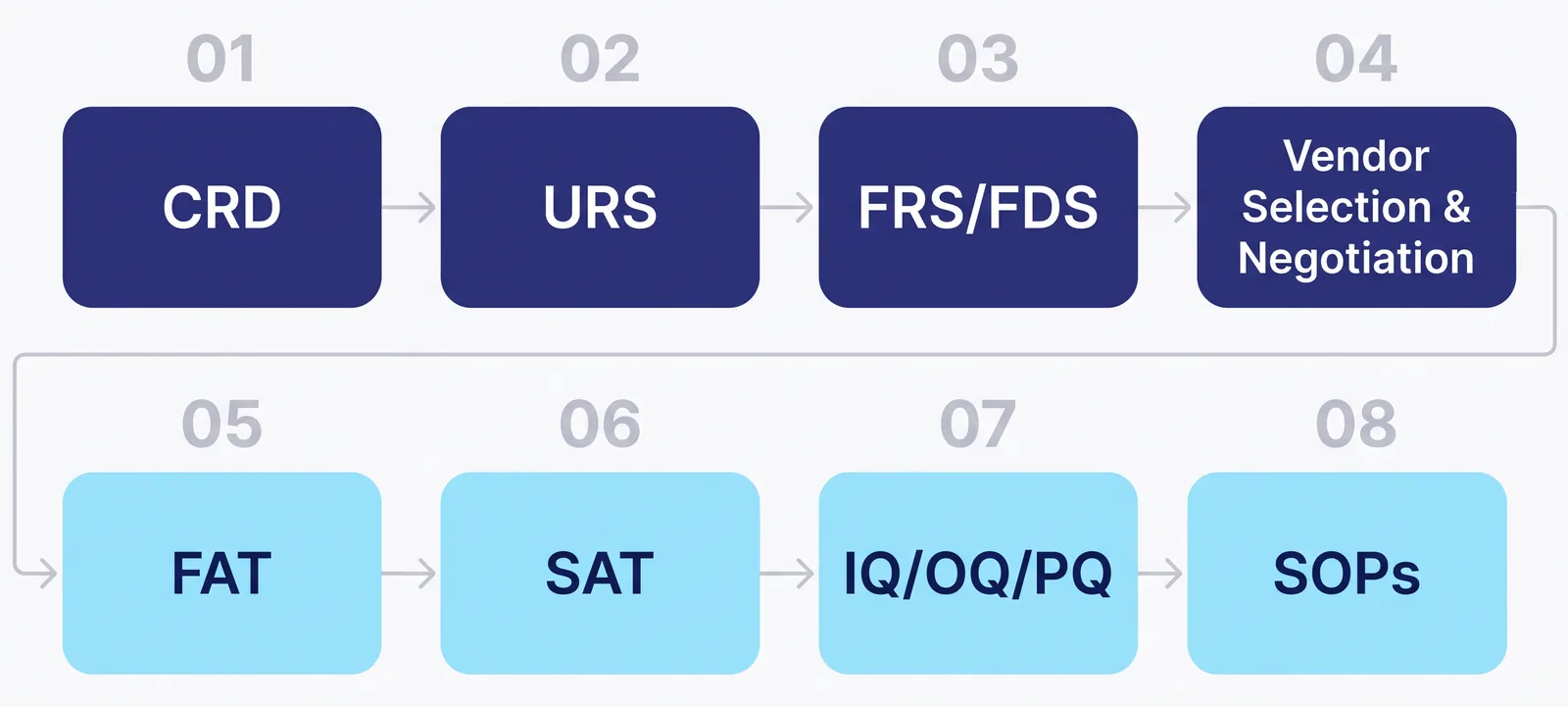
Most companies either skip half of those or produce versions that don’t connect to each other. An audit finds that quickly.
Across Reza’s 96+ completed projects, the pattern he sees most often is manufacturers who bought the right equipment but wrote the wrong documentation. Or wrote the right documentation but too late, after qualification issues had already surfaced. Or let the vendor write the documentation, which means it describes the vendor’s perspective rather than yours.
Getting all eight phases right, in the right order, with the right documentation, is what separates equipment that sails through qualification from equipment that generates corrective actions six months into production.
Fractional vs. Full-Time: Which One Makes Sense?
For most IVD manufacturers and diagnostic CDMOs, a full-time automation procurement specialist is hard to justify. The work is project-driven. You need intense support during a capital equipment cycle, then the load drops significantly until the next one.
Hiring a full-time senior automation engineer with GAMP expertise means a six-figure salary before benefits and overhead. PayScale puts average U.S. base pay for a senior automation engineer at about $117,000, with the top 10% at $148,000 or more (May 2026). And you need that person for maybe 60–80 days out of 200 during a procurement cycle. The math rarely works for a company under a certain revenue threshold.
Fractional engagement gives you the same expertise level without the full-time cost structure. You get someone who has done this specific type of project dozens of times, already knows the documentation framework, and can start being useful on day one instead of day 60.
The tradeoff is continuity. A fractional specialist isn’t embedded in your team full-time. If you have ongoing automation needs that require daily presence, a full-time hire is the right answer. If your needs are project-driven and episodic, fractional usually wins.
The thing most companies don’t plan for: the knowledge transfer phase at the end. A good specialist should leave you with documentation that your internal team can maintain and use for the next validation cycle. If they walk out and take the institutional knowledge with them, that’s a process problem, not an inherent limitation of the fractional model.
What to Look For When Hiring or Engaging One
Whether you’re looking at a full-time hire or a fractional engagement, the screening criteria should focus on regulated environment experience, not just automation knowledge.
Lots of engineers know automation. Fewer know what it means to build qualification documentation that survives an FDA inspection. Even fewer have done it specifically for IVD or consumable diagnostic manufacturing, which has specific process requirements that differ from pharma or general medical device.
Questions worth asking during evaluation:
- What does your URS development process look like? Can you walk through a real example?
- Have you led an equipment qualification for a [specific equipment type relevant to your process]? What happened when something didn’t pass FAT the first time?
- How do you handle scope creep between URS sign-off and delivery? What does your change control process look like?
- Can you provide a sample documentation package from a past project (anonymized) that reflects the format you’d deliver?
The answers to those questions separate engineers who have genuinely owned the end-to-end process from engineers who have supported parts of it and are comfortable stretching their resume accordingly.
Questions Medical Device Manufacturers Actually Ask
What’s the difference between an automation procurement specialist and a capital equipment buyer?
A capital equipment buyer focuses on sourcing and commercial terms. An automation procurement specialist focuses on technical requirements, regulatory qualification, and validation. You need both for a compliant equipment purchase. They’re often the same person in smaller organizations, but the regulatory piece is usually where the buyer lacks depth.
Does every equipment purchase in a medical device facility need GAMP documentation?
Not every piece of equipment. But any equipment that directly affects product quality, yield, or traceability typically does. The FDA’s QMSR requires manufacturers to establish procedures to ensure production equipment is adequate and properly maintained. What “adequate” means for your specific process is the gap a specialist fills.
How long does a full equipment procurement and qualification cycle typically take?
Three to six months for a straightforward system. Longer for custom automation, complex integrations, or equipment that requires extensive software validation. That timeline includes URS development, vendor selection, FAT, installation, and IQ/OQ/PQ. Companies that skip the front-end documentation work often find the back-end qualification taking twice as long because they’re chasing gaps.
Can we use our existing quality engineer to cover this role?
Sometimes. If your quality engineer has hands-on experience with equipment procurement and GAMP qualification, and has bandwidth, that can work for a simpler purchase. For complex or first-time equipment types, or when the quality engineer is already fully allocated, that combination usually stretches thin. The cost of a qualification failure is almost always higher than the cost of specialist support.
Is there a standard cost benchmark for GAMP documentation work?
A rough benchmark used in the industry is that GAMP documentation should cost roughly 10% of the equipment purchase price. On a $500K piece of automation, that’s about $50K in documentation and qualification work. That number scales with complexity and regulatory risk profile. It’s a useful check when evaluating proposals.
The Bottom Line
If you’re running a medical device manufacturing operation and buying production automation without someone who specifically owns the equipment engineering and qualification process, you’re taking on regulatory risk that shows up later, usually at the worst possible time.
The automation procurement specialist role exists because vendors represent vendors and quality teams have their hands full. Somebody needs to own the manufacturer’s side of that transaction from requirements through validation.
If you’re evaluating whether that function is covered at your company right now, a good starting question is: who wrote your last URS? If the answer is “the vendor helped with that,” it’s worth a conversation.
Reza Bashar at MEPSCo GAMP works exclusively with medical device manufacturers on equipment procurement and GAMP qualification. If you want to understand what that process looks like for your specific situation, reach out directly.