
Equipment Validation Lifecycle: From URS to IQ/OQ/PQ in Medical Diagnostic Manufacturing
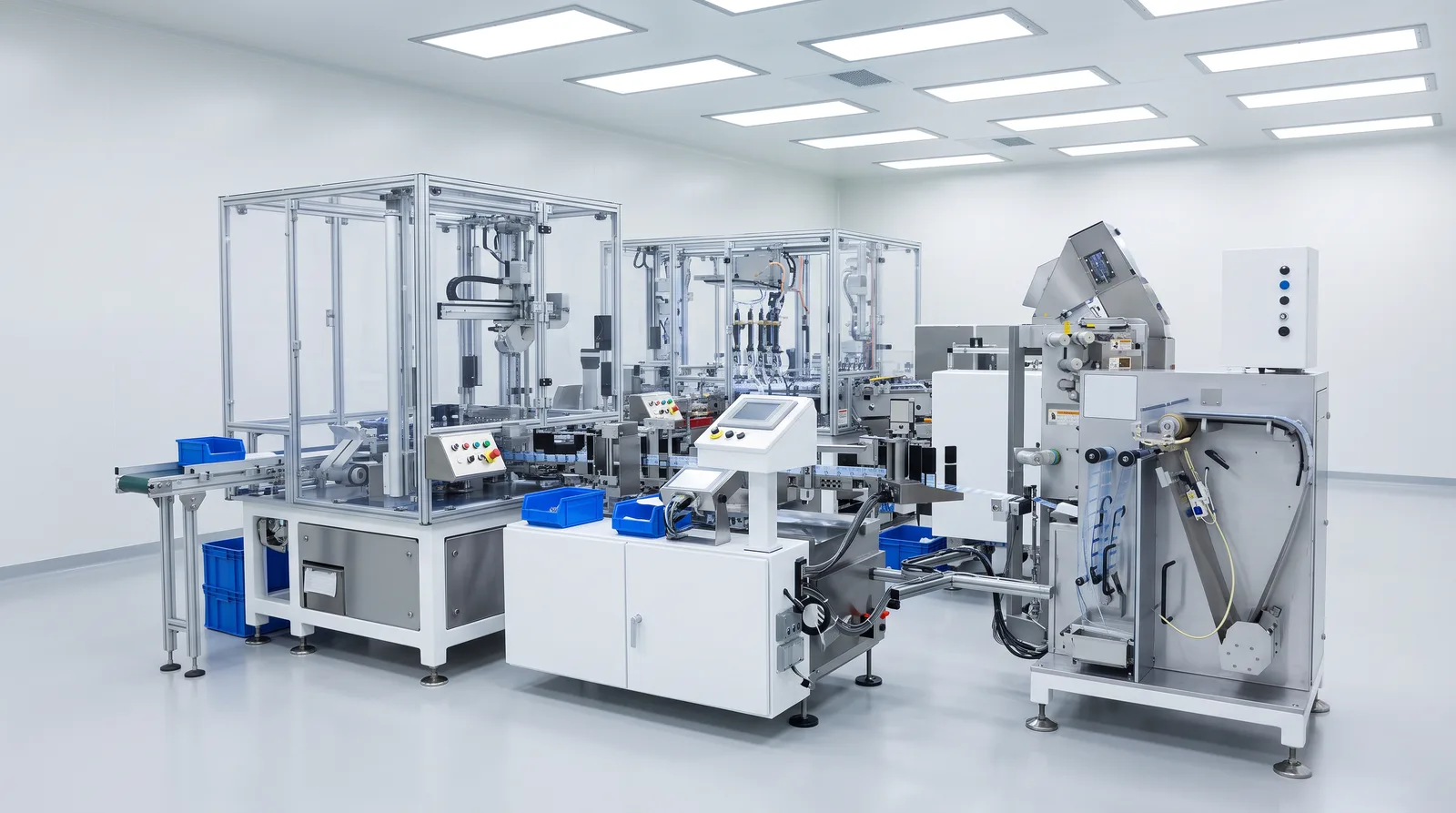
The equipment validation lifecycle is the documented sequence that takes a medical diagnostic manufacturer from defining what a machine needs to do (URS) through proving it performs reliably under production conditions (IQ/OQ/PQ). Each phase builds on the last, and traceability between them is what makes the documentation audit-ready.
- The lifecycle runs from the URS through functional design, FAT, SAT and IQ/OQ/PQ, and every phase traces back to the URS.
- Teams rarely fail inside a single phase. They fail at the handoffs, where requirements disappear between documents.
- Run engineering studies before validation, not during it, so OQ and PQ test against a defined process window.
- A traceability matrix that traces every requirement clean through every phase is what makes the package audit-ready.
Here’s something I’ve seen play out on dozens of projects. A medical diagnostic manufacturer buys a $2M automation line. The vendor ships it. It arrives on the production floor. And then someone asks, “So, what exactly were we supposed to validate?”
That question should’ve been answered months earlier, during URS development. But it wasn’t. And now the team is reverse-engineering requirements from the machine that’s already sitting on the floor. I’ve watched this happen at companies with 50 employees and companies with 500. The pattern is the same.
The equipment validation lifecycle isn’t complicated in theory. It’s a sequence. URS leads to functional specifications. Functional specifications lead to design. Design gets tested at the vendor’s facility (FAT), then at yours (SAT). And if those steps went well, IQ/OQ/PQ becomes straightforward. If they didn’t, you’re looking at a much bigger project right when management wants the machine making product.
After 25+ years and 96+ completed projects across medical diagnostic manufacturing, IVD production, and CDMO environments, I can tell you this with certainty: the lifecycle itself isn’t where teams fail. They fail at the handoffs between phases. This guide covers each phase, what belongs in it, and where the breakdowns actually happen.
What Is the Equipment Validation Lifecycle?
The equipment validation lifecycle is the complete documented path from defining what a piece of manufacturing equipment needs to do through proving it does it consistently. For medical diagnostic manufacturers operating under FDA 21 CFR Part 820 and ISO 13485, it’s not optional. It’s how you demonstrate that your automated processes produce conforming product every time.
Validation, at its core, is documenting a snapshot of time that the machine behaved in a certain way. That’s it. Because things change. Nuts and bolts come loose. Cameras drift. Lighting shifts. The validation record captures the moment when everything was confirmed to be working within spec.
The lifecycle runs through these phases, each feeding the next:
- User Requirements Specification (URS) – what the machine needs to do, written from the manufacturer’s perspective
- Functional and design specifications that translate URS requirements into engineering language the vendor can build against
- Factory Acceptance Testing (FAT) at the vendor’s facility, before shipment
- SAT (Site Acceptance Testing) once the equipment lands on your production floor
- IQ, OQ, and PQ, which qualify the installed equipment and prove the process works under real conditions
- A traceability matrix tying every single requirement back through each phase
ISPE’s GAMP 5 Second Edition reinforces a risk-based approach to this sequence. The idea isn’t to generate paper for its own sake. It’s to generate the right paper, at the right depth, based on the system’s impact on product quality and patient safety.
Where Does Everything Start? The URS
Every validated system starts with the URS. No exceptions. The User Requirements Specification captures what the equipment needs to accomplish from the manufacturer’s operational perspective, not from the vendor’s perspective. That distinction matters more than people realize.
The interview process for building a URS has to be thorough. If the URS is incomplete, every downstream document suffers. I’m not exaggerating. Every functional spec, every test protocol, every qualification document traces back to what you wrote in the URS. Leave a requirement out, and it won’t be tested at FAT. It won’t be confirmed at SAT. And it’ll surface during IQ/OQ/PQ as a gap that shouldn’t exist.
A strong URS covers:
- Process requirements: throughput, cycle times, reject rates, batch sizes
- Environmental conditions the machine will operate in, including cleanroom classifications
- Product specifications for the diagnostics or IVDs being manufactured, with tolerances
- Regulatory requirements: 21 CFR Part 11 for electronic records, ISO 13485 clauses, FDA design controls
- Safety, ergonomic, and maintenance requirements from the operators who’ll actually run the line
- Integration points with existing equipment, LIMS, or quality systems
Here’s where medical diagnostic manufacturing adds complexity. You’re not just validating that a machine runs. You’re validating that it produces consumable diagnostics, IVD cartridges, or lab components that meet tight biological and dimensional tolerances. The product variability window is small. The URS has to account for that.
One detail teams consistently miss: getting manufacturing engineering involved early. R&D develops the product. Manufacturing engineering needs to partner with R&D before the process gets transferred, so the process that’s handed over is actually automation-ready. When that partnership doesn’t happen, the URS ends up describing a process that can’t be automated efficiently. I’ve seen that add six months to a project timeline.
How Do Functional Specifications and Design Reviews Connect to the URS?
Functional specifications translate URS requirements into engineering terms. The URS says “the machine shall process 120 cartridges per hour with less than 2% reject rate.” The functional spec defines the mechanical, electrical, pneumatic, and software design that’ll achieve that. Different documents, different audiences, same traceability thread.
The design review sits between functional specs and build. It’s the checkpoint where engineering, quality, and operations confirm that what’s about to be built will actually satisfy the URS. Skip it, and you’ll find out at FAT that the vendor interpreted a requirement differently than you intended. That’s an expensive conversation to have at the vendor’s facility with a completed machine in front of you.
Functional specs should address:
- Mechanical design parameters: speeds, forces, tolerances
- Control system architecture, PLC/HMI specifications, alarm handling
- Software requirements, including data integrity under GAMP documentation standards
- Material handling, orientation, and feeding mechanisms specific to the diagnostic product
- Utility requirements: compressed air, electrical, vacuum, facility connections
For IVD and diagnostic manufacturing equipment, the functional spec also needs to address how the machine handles product variability. Incoming material dimensions, moisture content, biological characteristics. Did you take into account all the variables that could affect the machine as well as the product? Time, temperature, pressure. If the answer is no, the spec has gaps.
What Happens During FAT (Factory Acceptance Testing)?
FAT happens at the vendor’s facility. Full stop. This is where you verify that the equipment performs against the functional specifications before it ships. Finding problems at the vendor’s shop is cheaper, faster, and less disruptive than finding them on your production floor.
The FAT protocol is built directly from the functional specifications, which trace directly to the URS. Every test you run at FAT should map to a specific requirement. That mapping lives in the traceability matrix, and it needs to be clean before you sign off on the FAT report.
Typical FAT activities include:
- I/O verification for every sensor, actuator, and control point on the machine
- Software functionality testing: error handling, recipe management, data logging
- Mechanical operation at specified speeds, with measurement of cycle times and repeatability
- Safety system verification: e-stops, light curtains, interlocks, guarding
- Dry runs and, where possible, runs with actual product or representative samples
One thing I always push for during FAT: test with real product if the manufacturer can provide it. Simulated materials tell you the mechanics work. Real product tells you the process works. Those are two different things when you’re manufacturing consumable diagnostics where dimensional and biological variability is a factor.
The FAT and SAT phase is where the vendor relationship gets tested. Good vendors welcome rigorous FAT protocols. Vendors who push back on testing depth are telling you something. Listen to that signal.

What Does SAT (Site Acceptance Testing) Cover After Equipment Arrives?
SAT happens on your production floor after the equipment is delivered, unpacked, installed, and connected to your facility utilities. The purpose is confirming that the machine performs the same way it did at the vendor’s facility, now that it’s connected to your compressed air, your electrical, your cleanroom environment.
Transportation can affect equipment. Vibration, temperature swings during shipping, handling damage that isn’t visible until you power up. SAT confirms nothing shifted during transit. It also catches environmental differences between the vendor’s test conditions and your actual production environment.
SAT typically includes:
- Utility verification: electrical connections, compressed air pressure, vacuum levels
- Repeat of critical FAT tests under site conditions
- Verification that all documentation, manuals, and spare parts arrived with the equipment
- Confirmation that operator training materials match the delivered configuration
SAT is shorter than FAT if FAT was done right. You’re confirming, not discovering. But if the FAT was thin, SAT becomes the catch-up session, and it takes longer, costs more, and delays the start of formal qualification.
How Do IQ, OQ, and PQ Build on FAT and SAT?
This is where it all comes together. If the FAT and the SAT were done correctly, and everything traces back to the URS, then it becomes a simple separation of the FAT document into the installation qualification and operational qualification. Otherwise, if they missed certain requirements along the way, then it becomes a much bigger project at the time when management is looking forward to having the machine start to make product. I’ve seen both scenarios. More times than I’d like to admit, it’s the second one.
Installation Qualification (IQ)
IQ confirms the equipment is installed correctly per manufacturer specifications and design documents. It’s the “is it here and is it set up right” verification.
IQ verification covers:
- Equipment identification: serial numbers, model numbers, firmware versions
- Utility connections verified against specifications
- Environmental conditions confirmed: temperature, humidity, cleanroom classification
- Calibration status of all instruments and sensors, with certificates on file
- Documentation received: manuals, drawings, as-built records, software backup
IQ should reference the same requirement IDs from the URS and functional specs. That traceability thread doesn’t stop at FAT. It runs through every qualification document. FDA inspectors look for it. Proper IQ/OQ/PQ qualification depends on that traceability being intact from URS through to the final PQ report.
Operational Qualification (OQ)
OQ proves the equipment operates within specified parameters across its full operating range. This isn’t “does it turn on.” It’s “does it perform at the limits of what we need it to do.”
Worst-case testing belongs here. High speed and low speed. Maximum load and minimum load. Environmental extremes within your operating range. If you only test at nominal conditions during OQ, you haven’t qualified the equipment. You’ve confirmed it works when nothing is difficult. Not the same thing.
OQ protocols test:
- Functional performance at each operating parameter’s upper and lower limits
- Alarm and interlock functionality under fault conditions
- Software functions: recipe execution, data logging, user access controls, audit trails
- Repeatability and reproducibility of critical measurements
For IVD and diagnostic manufacturing equipment, OQ is where you confirm the machine can handle the range of product that’ll run through it. Different lot materials. Different dimensional tolerances within spec. If your cartridge diameter spec is 10.0 mm plus or minus 0.1 mm, OQ should test at 9.9 and 10.1. Not just 10.0.

Performance Qualification (PQ)
PQ is different from IQ and OQ in a fundamental way. The process qualification is something that the company’s quality group determines as the right documentation run. It has less to do with the URS and more to do with the product coming off the machine. Is the product that’s coming off the machine within specification? Can the process handle all the variability it’ll encounter in real production?
PQ runs use production materials, production personnel, and production conditions. No vendor engineers hovering over the machine making adjustments. No optimized test batches. Real product, real operators, real conditions.
PQ addresses:
- Process capability across multiple consecutive runs (typically 3 runs minimum, though product complexity may require more)
- Statistical analysis: Cpk, Ppk, yield rates, defect rates measured against acceptance criteria
- Product quality attributes: dimensional, visual, functional, and where applicable, biological performance
- Operator-to-operator variability, shift-to-shift consistency
Engineering studies need to happen before PQ. Not during. Not after. Before. If the product variability issues aren’t understood before you start PQ runs, you’ll burn through time, material, and credibility running PQ attempts that fail because the process window wasn’t properly defined.
The FDA’s Process Validation Guidance frames validation in three stages: process design, process qualification (PQ), and continued process verification. PQ isn’t the end. It’s the formal confirmation that the process, as designed, produces conforming product. Continued verification picks up from there.
What Role Does the Traceability Matrix Play Across the Lifecycle?
The traceability matrix is the spine of the entire validation lifecycle. It traces every requirement from the URS through functional specs, design, FAT, SAT, IQ/OQ/PQ. Every line item traces clean, or there’s a gap that needs to be addressed before you close out the validation.
Think of it this way. The URS might have 150 requirements. Each one needs to appear in a functional spec, get designed into the equipment, get tested at FAT, confirmed at SAT, and verified during IQ/OQ/PQ. The traceability matrix tracks that journey for every single requirement. When an FDA auditor asks “how do you know this requirement was tested,” the traceability matrix is the answer.
Requirements that trace clean through every phase are validation gold. Requirements that disappear between documents are audit findings waiting to happen. I’ve walked into projects where the URS had 200 requirements and the FAT protocol only covered 140. Those 60 missing items became a three-month remediation effort during what should’ve been IQ/OQ/PQ execution.
Equipment Validation Lifecycle Phase Summary
| Phase | Location | Purpose | Key Output |
|---|---|---|---|
| URS | Manufacturer site | Define what the equipment needs to do | Approved URS document |
| Functional Spec | Both | Translate requirements to engineering terms | Functional/design specification |
| Design Review | Vendor/Manufacturer | Confirm design satisfies URS | Design review report |
| FAT | Vendor’s facility | Verify equipment against functional specs | FAT protocol and report |
| SAT | Production floor | Confirm performance post-installation | SAT protocol and report |
| IQ | Production floor | Verify correct installation | IQ protocol and report |
| OQ | Production floor | Prove operation within spec parameters | OQ protocol and report |
| PQ | Production floor | Demonstrate consistent product quality | PQ protocol and stats |
What Variables Can Compromise Validation Results?
Validation is a snapshot. The machine behaved this way, at this time, under these conditions. That snapshot is only as good as the variables you controlled and measured.
Did you take into account all the variables that could affect the machine as well as the product? Time. Temperature. Pressure. Incoming material properties. Operator technique. Environmental conditions. If any of those variables weren’t measured, controlled, or documented, your validation has a hole in it.
Variables that catch teams off guard in medical diagnostic manufacturing:
- Incoming material variability between lots, especially for biological or chemical reagent-based diagnostics
- Environmental drift: cleanroom temperature and humidity fluctuations over a 24-hour cycle
- Tool wear on stamping, cutting, or sealing stations that shifts product dimensions gradually
- Camera and vision system calibration drift affecting inspection accuracy
- Operator-dependent variables: loading technique, material handling, response to alarms
FDA investigators regularly cite inadequate process validation in inspection observations. Common findings include failure to identify critical process parameters, insufficient challenge testing during OQ, and PQ runs that don’t reflect actual production variability. GMP Compliance reports document cases where equipment qualification gaps led to warning letters, with companies unable to demonstrate their validation covered the full range of operating conditions.
The fix is straightforward but requires discipline: identify every variable before validation starts. Not during. Not after. Before. Engineering studies exist for this purpose. Run them.
When Should Engineering Studies Happen Relative to Validation?
Before validation. Always before. Engineering studies define the process window, identify critical parameters, and establish the ranges that OQ and PQ will test against. Running them after validation starts is backwards, and it’ll cost you time and material.
Engineering studies include design of experiments (DOE), capability studies, and gage R&R. They answer questions like: what’s the process window for sealing temperature? How much dimensional variation can the feeding mechanism tolerate? What’s the minimum and maximum line speed that produces conforming product?
For medical diagnostic manufacturing specifically, engineering studies also need to account for product-specific variability. IVD cartridges made from injection-molded plastic will have lot-to-lot dimensional variation. Lateral flow strips have biological reagent variability. The engineering studies need to quantify these ranges before validation protocols lock in acceptance criteria.
When engineering studies don’t happen, or happen too late, the result is predictable. PQ runs fail. Not because the machine is broken, but because nobody defined the process window accurately. I’ve seen PQ failures that added four to six months to a project timeline because the team had to go back and do the engineering work that should’ve happened before protocol execution started.
Who Benefits From a Structured Equipment Validation Lifecycle?
Not every manufacturer needs the same level of validation rigor. The approach should match the product, the regulatory environment, and the risk to the patient.
This lifecycle approach is built for:
- Medical diagnostic manufacturers producing consumable products: IVD cartridges, lateral flow tests, CGM sensors
- CDMOs running automated fill/finish or assembly lines for diagnostic clients
- Companies bringing new automated equipment into an existing GMP manufacturing environment
- Manufacturers preparing for FDA pre-approval inspections or responding to 483 observations related to process validation
This approach is less relevant for:
- Manufacturers with fully manual production processes and no automated equipment
- Companies producing surgical instruments or implantable devices through low-volume hand-assembly
- Organizations outside FDA-regulated or ISO 13485 environments
MEPSCo GAMP provides fractional automation engineering for medical diagnostic manufacturers navigating this lifecycle. With a proprietary 8-step GAMP process covering 22 document types, the approach spans every phase from URS development through IQ/OQ/PQ completion. For companies that don’t have a senior equipment engineer on staff full-time, the fractional model fills that gap without the overhead of a permanent hire.
Bringing the Lifecycle Together
The equipment validation lifecycle isn’t a checklist you hand to a junior engineer and hope for the best. It’s a connected sequence where each phase builds on the one before it. URS feeds functional specs. Functional specs feed design and FAT. FAT feeds SAT. SAT feeds IQ/OQ/PQ. And the traceability matrix holds it all together.
Where teams struggle isn’t with any single phase. It’s with the handoffs. Requirements that disappear between documents. Test protocols that don’t map back to what the manufacturer actually needs the equipment to do. PQ runs that start before engineering studies have defined the process window.
If you’re bringing new automated equipment into a medical diagnostic manufacturing environment, or if your existing validation documentation has gaps, start with the URS. Everything flows from there. Get that document right, maintain traceability through every phase, and the rest of the lifecycle falls into a predictable sequence.
For manufacturers who need an experienced equipment engineer to guide this lifecycle without the commitment of a full-time senior hire, explore MEPSCo GAMP’s fractional automation engineering approach.
Common Questions About Equipment Validation
What’s the difference between equipment qualification and process validation?
Two different things, often confused. Equipment qualification (IQ/OQ) confirms the machine is installed and operates correctly. Process validation (PQ and beyond) confirms the process running on that machine produces conforming product. You can have a perfectly qualified machine that runs a poorly validated process. Qualification is about the equipment. Validation is about the output.
Can you skip FAT and go straight to SAT?
Technically, nothing in the regulations prohibits it. Practically, it’s a terrible decision about 95% of the time. Finding a wiring error or a software bug at the vendor’s facility costs a fraction of what it costs on your production floor. The only scenario where skipping FAT makes sense is simple, off-the-shelf equipment with no custom configuration. For custom automation in medical diagnostic manufacturing, FAT is where you save the real money.
How many PQ runs does the FDA actually require?
Three consecutive successful runs is the traditional baseline. But “three” isn’t an FDA requirement. It’s an industry convention that’s stuck around. FDA expects you to justify your sample size statistically based on process capability and risk. For a complex IVD assembly line with multiple critical parameters, three runs might not be enough. For a simple labeling operation, it might be more than necessary. The justification matters more than the number.
What happens when a URS requirement doesn’t trace through to IQ/OQ/PQ?
That’s a gap, and it needs resolution before you close out validation. Either the requirement was intentionally excluded and you document the rationale, or it was missed and you write the test protocol and execute it. Untraced requirements are the kind of finding that extends FDA inspections from three days to three weeks. I’ve been on projects where 60 untraced requirements turned a routine validation into a three-month remediation effort.
Does GAMP 5 apply to manufacturing equipment, or just computerized systems?
GAMP 5 was originally written for computerized systems, and the Second Edition published by ISPE in 2022 still focuses there. But the risk-based principles translate directly to manufacturing equipment validation. The idea that validation depth should scale with system complexity and quality impact applies whether you’re validating a PLC-controlled assembly line or a standalone environmental monitoring system. In medical diagnostic manufacturing, the equipment and the computerized system are usually the same thing.
How long does the full lifecycle take from URS to PQ completion?
Six months to eighteen months for custom automated equipment in medical diagnostic manufacturing. That range is wide on purpose. A single-station assembly cell with limited automation might move through the lifecycle in six months. A multi-station IVD cartridge assembly and packaging line with vision inspection, serialization, and data integration? Twelve to eighteen months isn’t unusual. The URS development and functional specification phase alone can take two to three months if done properly. Teams that try to compress that phase pay for it later in FAT and OQ rework.
The Bottom Line
Start with the URS. Keep traceability through every phase, and the rest of the lifecycle falls into a predictable sequence.
Reza Bashar at MEPSCo GAMP provides fractional automation engineering for medical diagnostic manufacturers, from URS development through IQ/OQ/PQ completion. If your validation documentation has gaps, reach out directly.