
What Actually Breaks When an IVD Manufacturer Tries to Scale From Manual to Automated Production

Most IVD companies don’t know automation procurement is going to be a problem until they’re already in the middle of it. The product is validated. The orders are real. The manual line has hit its ceiling. And then someone realizes no one on staff has ever bought a piece of production equipment in a regulated environment before.
- IVD manufacturers usually discover automation procurement is a problem mid-project — after the manual line maxes out and nobody on staff has bought regulated production equipment before.
- In a 21 CFR Part 820 environment, every production machine needs a manufacturer-owned IQ/OQ/PQ; the vendor’s commissioning records are not enough for QA or an FDA inspector.
- The root cause is usually the URS — a wish-list spec instead of the full operating envelope drives change orders, FAT failures, and qualification gaps, and reagent behavior (foam, viscosity, settling) has to be captured there too.
- A realistic first project runs ~22–30 weeks; the fix is experienced automation engineering, fractional or hired, from the URS through handoff.
There’s a version of this story that gets told in medical device circles. A diagnostic company hits a good commercial moment — their product is validated, orders are coming in, the manual assembly process that made sense at 2,000 units a day is visibly failing at 15,000 — and they need automation fast.
So they do what seems reasonable. They find a vendor. They explain what the process looks like. They get a quote. They buy the machine.
Six months later, the machine is on the floor and they’re starting to understand the actual problem. The validation documentation isn’t there. QA won’t release the line to production. There’s a change order conversation happening with the vendor that nobody planned for. And the equipment does what it does — it’s just that what it does doesn’t match what the process actually needed, because the requirements were never written down precisely enough to specify it.
That pattern isn’t rare. It’s close to the default outcome for IVD manufacturers procuring automation equipment for the first time without the right engineering support.
For related context on what a complete GAMP documentation package requires, see our IVD manufacturer automation procurement overview.
The Scale-Up Wall Most IVD Companies Hit
Manual production works until it doesn’t. For most IVD consumable manufacturers — the companies making test kits, assay components, diagnostic reagents, and the physical pieces that go into point-of-care or lab-based diagnostic platforms — the wall appears somewhere specific.
Not at the first thousand units. Not at the first ten thousand. Usually somewhere between 5,000 and 20,000 units per shift, when the combination of floor space, labor cost, and output variability becomes visibly unsustainable. Operators get tired. Fill volumes drift. Assembly quality becomes inconsistent. The headcount required to hit daily volume doesn’t match the margin model.
At that point, automation is obvious. What’s not obvious is how different the procurement process is in a regulated environment versus a general manufacturing setting.
A company making widget components buys a machine, installs it, and uses it. Their quality system may require some documentation, but the standard for “we verified this works” is generally straightforward.
A 21 CFR Part 820-regulated IVD manufacturer can’t do that. Every piece of production equipment that touches or produces the product needs to be formally qualified. The Installation Qualification establishes that the equipment was installed correctly. The Operational Qualification verifies it operates within defined parameters. The Performance Qualification demonstrates consistent output meeting specification. And all of that has to be documented in a way that would hold up to an FDA inspector asking to see it.
The equipment doesn’t come with that documentation. The vendor writes their own commissioning records — useful engineering data, not an FDA-facing qualification package. The responsibility for the IQ/OQ/PQ is the manufacturer’s. Always.
Most first-time IVD automation buyers learn this at exactly the wrong moment: when QA reviews what they have and says it’s not enough to release the line to production.
The URS Problem Comes First
Before the IQ/OQ/PQ problem, there’s a URS problem.
The URS — User Requirements Specification — is the document that defines what the equipment needs to do, in enough specificity that a vendor can build to it and a QA team can test against it. It’s the foundation. Everything downstream is traceable back to it.
What most IVD manufacturers write the first time they buy automation equipment is something closer to a wish list. “We need to fill these vials at this volume, at this rate, and within this accuracy tolerance.” That’s a start. It’s not a URS.
A real URS covers the full parameter range the equipment will actually encounter. Not just the first product. Not just the nominal operating conditions. The edge cases — what happens at high ambient temperature, what happens at maximum fill volume, what happens with a batch of reagent at the viscous end of its specification range. It covers cleaning and changeover procedures. It covers the environmental requirements for the installation. It covers the GMP-relevant utilities. It covers what the software does and what records it generates. It covers what FAT has to demonstrate before the machine leaves the vendor facility.
When those details aren’t in the URS, they become change orders. Or they become gaps that show up in the qualification documentation and have to be addressed through engineering studies that weren’t planned for. Or they become the reason QA can’t sign off on the IQ/OQ because the scope of what was qualified doesn’t match what the line is actually being asked to do.
SCIENION, a custom automation developer with deep IVD experience, noted in a technical post on automation project failures that underspecified requirements are a primary driver of projects that fail to complete on schedule or within budget. The document gets written quickly. The vendor builds to it. The gaps surface at FAT or after installation, when fixing them costs far more than catching them in the URS.
This is the mechanic behind the “no change orders when the URS is done right” principle. A URS that was written to cover the full operating envelope doesn’t generate change orders, because the vendor already built and tested what’s needed. A URS that was written to get the vendor quote process started generates change orders every time something wasn’t covered.
What the Timeline Actually Looks Like
IVD manufacturers typically underestimate the timeline. Not because they’re not trying to be realistic — because they haven’t done this before and have no baseline.
The realistic picture for a standard automation project (not custom-build, not highly complex reagent behavior) from URS development through QA sign-off on the completed IQ/OQ/PQ package is 22–30 weeks. The fast end requires everything to go right: a URS that doesn’t need revision, a vendor with available build capacity and a short lead time, FAT that passes on the first pass, a clean installation, and IQ/OQ/PQ execution without protocol deviations that require investigation.
Most projects don’t go right in all of those places. A vendor quote process that runs long, an equipment lead time at 16 weeks instead of 10, a FAT finding that requires a vendor rework before the machine ships — any of these push the timeline past 30 weeks without being exceptional failures. They’re just normal project friction in a complex technical procurement.
For IVD manufacturers with non-standard reagent formulations — foamy reagents, magnetic particle suspensions, temperature-sensitive antibody reagents, lyophilized bead assemblies — the timeline extends further. The equipment may require custom engineering. The fill performance has to be demonstrated with the actual reagent before FAT. Engineering studies may be needed to characterize reagent behavior under fill conditions before the PQ protocol can even be written.
Planning for 30 weeks and getting 22 is a good outcome. Planning for 16 and getting 34 is an operations crisis.
The Reagent Fill Assumption That Gets IVD Companies in Trouble
Reagent filling sounds simple. It usually isn’t.
Most automated liquid filling equipment is designed around well-behaved liquids. The assumptions built into standard peristaltic pump systems, time-pressure fill heads, and rotary fill stations — viscosity range, surface tension behavior, foam characteristics, particle settling rate — don’t cover a lot of what diagnostic reagent formulations actually do.
A lateral flow assay reagent with gold nanoparticle conjugates behaves differently than water at a fill nozzle. A capture antibody solution with a surfactant additive foams. A magnetic particle suspension settles in a holding tank if the agitation isn’t right. A temperature-sensitive enzyme reagent tolerates only a narrow processing window before activity loss starts to look like fill accuracy variance.
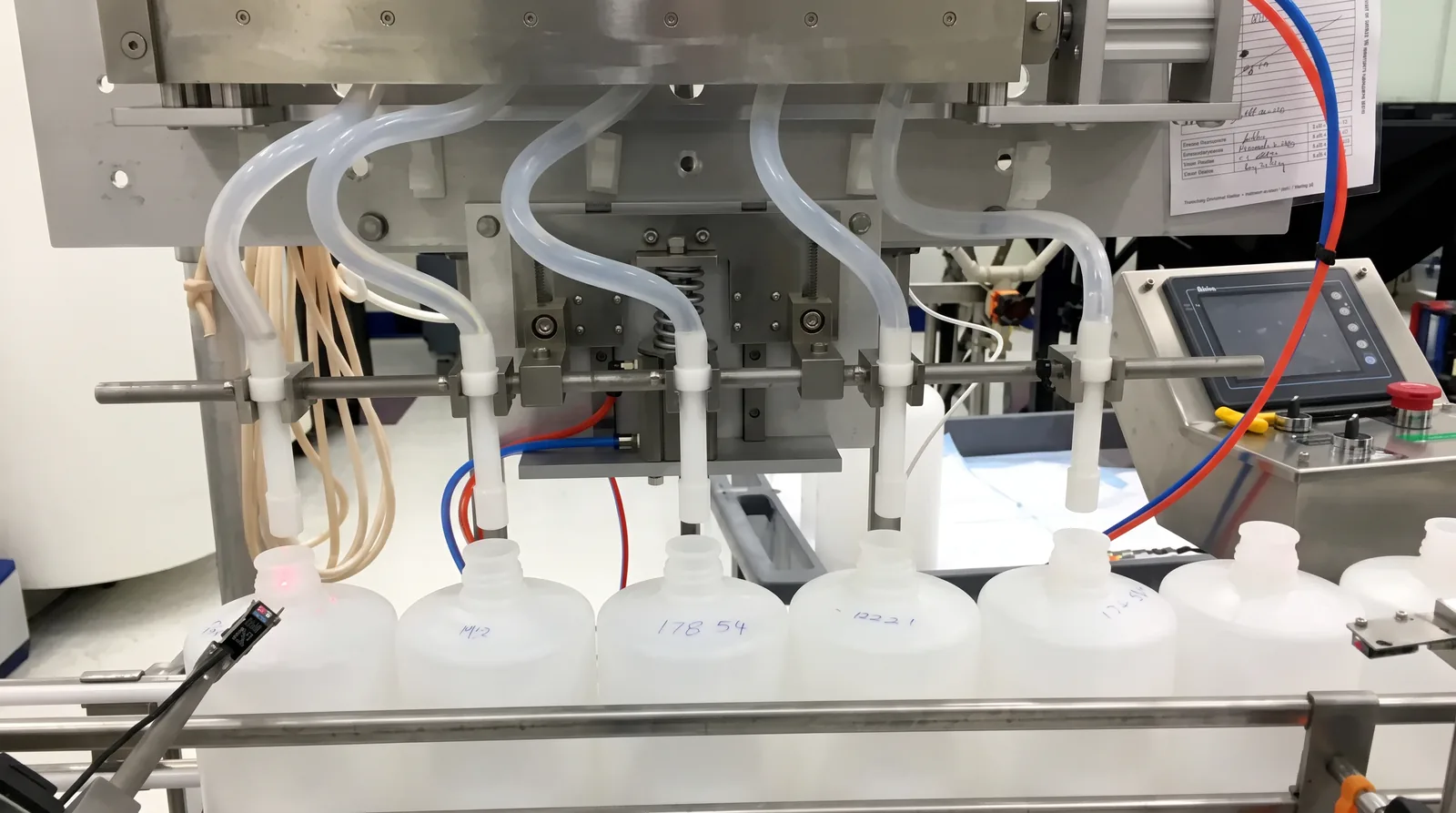
Vendors who have seen these problems know how to spec around them. Vendors who haven’t — and most general automation vendors haven’t worked extensively with IVD reagents — will take the order, build to what was specified, and discover the problem at FAT.
The fix is in the URS. The reagent characteristics have to be captured in the requirements document, including any engineering characterization work needed to establish what the fill conditions have to be. Nozzle type, pump type, tank agitation, temperature conditioning, cycle time targets that allow for foam settling — all of it. If it’s in the URS, the vendor accounts for it. If it’s not, it surfaces when the reagent arrives at the vendor facility for FAT and behaves in ways the machine wasn’t designed for.
Tecan’s published analysis of why IVD system project launches fail consistently points to the gap between what was specified and what the reagent actually requires — a gap that’s known before procurement starts and still gets skipped.
What Good Engineering Looks Like at Scale-Up
The IVD companies that navigate the manual-to-automated transition without a painful first project almost always have one thing: someone on the project who has actually done this before in a regulated environment.
That’s not a commentary on the competence of IVD operations teams. Process engineers at IVD manufacturers are often excellent at what they do — reagent formulation, process optimization, quality systems, regulatory submissions. They’ve just never run a capital equipment procurement project in a regulated manufacturing environment, because most IVD companies haven’t bought that many production machines.
The URS requires a specific type of engineering knowledge — understanding what the equipment needs to do AND understanding how to document it in a way that the vendor can build to and QA can test against. The FAT requires someone who knows what to look for and what to push back on before the machine ships. The IQ/OQ/PQ requires someone who understands qualification scope, protocol design, deviation handling, and what the final documentation package needs to contain.
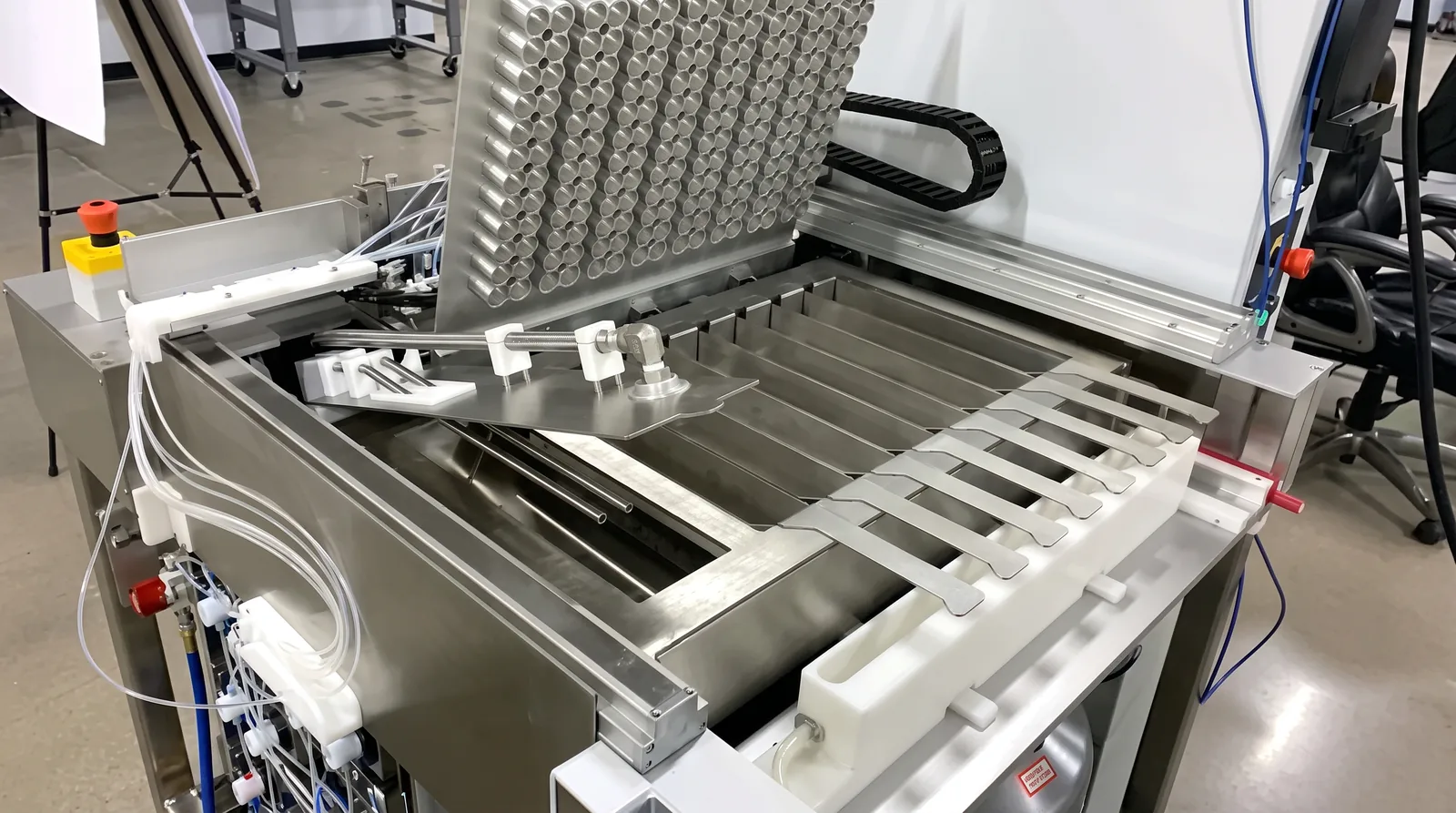
That skill set doesn’t develop on the job during a first automation project without cost. The first project becomes the learning experience — which means it takes longer, costs more, and produces a documentation package that may need rework before QA can close it.
The fractional model addresses this without requiring the company to hire a senior automation engineer full-time. An experienced automation engineer embeds with the team for the project — URS through handoff — brings 96+ projects of IVD-specific and adjacent experience, runs the GAMP documentation process, transfers the SOPs and qualification records to the internal team, and exits when the line is released.
No change orders when the URS is done right. No IQ/OQ/PQ gaps at QA review. No reagent surprise at FAT.
The Five Points Where IVD Scale-Up Automation Projects Break
Based on a real project base across IVD manufacturers and CDMOs serving IVD clients, these are where the problems consistently appear:
URS scope: Requirements written without the full operating envelope. Reagent behavior not characterized before specification. Cleaning and changeover not addressed. The result is a vendor build that meets the spec and doesn’t do what’s needed.
FAT preparation: FAT run as a final acceptance ceremony rather than a technical evaluation. Actual reagent not present. Full operating envelope not tested. Problems that surface after installation then require field service calls, production delays, and protocol amendments to address.
Equipment lead time: The 10–20 week vendor build window is real. IVD manufacturers who underestimate it find themselves with a validated product, paying orders, and a production line that won’t be qualified in time to fill them.
PQ scope: Performance Qualification designed around the first product to run, without accounting for the full range of products or reagent variants the line will eventually handle. A PQ that doesn’t cover the operating range will need to be rerun — or supplemented with engineering studies — when a new product variant gets added.
Knowledge transfer: SOPs that describe the equipment in engineering terms rather than operator terms. PM schedules that weren’t calibrated to real failure modes. Training that covers what the machine does without covering what to do when something goes wrong. These gaps surface in production, not during qualification.
Who Should Be Running This Type of Project
If your IVD company is approaching the scale-up moment, the question worth asking before vendor conversations start is: who has run this type of project before?
Not who is available to manage it. Not who has project management experience. Who has sat in a FAT at a fill equipment vendor and pushed back on fill accuracy data that didn’t hold up. Who has written a URS for a foamy reagent fill process and worked with the vendor to specify a custom nozzle. Who has run IQ/OQ protocols and navigated the documentation conversation with QA when a deviation occurred.
If the honest answer is no one on staff, the options are: hire someone (49–62 days to fill a senior automation role, total first-year loaded cost approaching 230K–280K for someone at the level this work requires), outsource to an equipment vendor who will represent their own interests, or bring in fractional automation engineering support from someone who has done this work on the manufacturer’s side. MEPSCo’s IVD automation procurement service is designed for exactly this moment.
Common Questions From IVD Manufacturers at Scale-Up
We’re planning to automate our fill line. When in the process should we bring in outside engineering help?
Before the vendor RFQ. The URS is written before vendor conversations start, and the URS is what prevents change orders, FAT failures, and IQ/OQ gaps. Bringing in experienced automation engineering help after the URS is written — or after the vendor is selected — means working with a requirements document and a vendor relationship that may already have problems baked into them. The ideal entry point is before the URS draft, when the engineering requirements can be captured correctly from the beginning.
How do we know if our URS is detailed enough to send to vendors?
A URS is detailed enough when every claim in the IQ/OQ/PQ can be traced back to it. If the URS doesn’t specify it, the qualification protocols can’t test against it — which means anything the vendor assumed rather than was told becomes unverified. Run through the qualification scope before the URS is finalized: IQ checks, OQ performance criteria, PQ acceptance criteria. If any of those criteria aren’t derivable from the URS, the URS needs more specificity before it goes to vendors.
Our reagent is a magnetic particle suspension. Are there vendors who can handle that?
Some can. The qualification question is whether you know which ones and how to evaluate their claims before FAT. Magnetic particle suspension behavior under fill conditions — settling rate, viscosity at the fill nozzle, response to agitation type — varies significantly by formulation and has to be characterized before the equipment can be specified correctly. Vendors who say they’ve handled magnetic particle reagents before should be able to describe specifically what they did to address settling and maintain suspension homogeneity during fill. If the answer is vague, it’s a flag. The specific answer is the one you can put in the URS.
What does FDA actually look at when they inspect a production line under 21 CFR Part 820?
FDA inspectors reviewing production equipment will ask to see the IQ/OQ/PQ records. They’ll check that the executed protocols match the approved protocols, that any deviations were documented and dispositioned, and that QA signed off on the completed package before the line was released to production. They’ll also check that the equipment is being maintained and operated to the SOPs that were put in place at qualification close. Gaps in any of these — a qualification that was never formally closed, a deviation that was noted but not dispositioned, an SOP that doesn’t match how the line is actually run — show up as observations. Repeated gaps become warning letters.
We already bought the equipment and it’s on the floor. Can we run IQ/OQ/PQ retroactively?
Yes, but the path is harder than doing it prospectively. Retroactive qualification requires demonstrating the current installation state meets the spec, which is straightforward if nothing changed. It requires reconstructing vendor documentation if the original paperwork wasn’t captured during installation. It requires writing IQ and OQ protocols from the current equipment state, executing them, and documenting that execution — including any deviations from what would have been expected if the equipment had been qualified correctly from the start. It’s doable. It takes longer than it should have, costs more than it should have, and the documentation package carries more inherent risk than a prospective package. The case for doing it right the first time is essentially the cost comparison: prospective qualification done well versus retroactive qualification done under production pressure.
The First Project Sets the Pattern
The first automation project an IVD manufacturer runs sets the template for everything that follows. The URS format. The vendor selection methodology. The FAT checklist. The IQ/OQ/PQ structure. The documentation package. The SOP format. The handoff process.
If the first project is done correctly — with experienced engineering support, a URS that was written to prevent problems rather than to get vendor quotes started, and a qualification documentation package that was built to hold up under audit — all of that scaffolding is in place for the second project, and the third. The second fill line or assembly machine procurement moves faster and with less friction because the first one established the right baseline.
If the first project is done by learning as you go — the URS incomplete, the FAT cursory, the IQ/OQ retroactive, the SOPs written from memory — the second project doesn’t inherit a good foundation. It inherits the same gaps, with the same risk exposure, until something in the quality system forces a proper rework.
The case for getting the first project right isn’t just about the first project.
- SCIENION — From URS to Validated Production: Why Most Custom Automation Projects Fail
- Tecan — Why IVD System Project Launches Fail
- CPI UK — Key Barriers to Scalable IVD Development and How to Overcome Them
- eCFR — 21 CFR Part 820, §820.70: Production and Process Controls
- Screentec — How to Scale a Diagnostic Test From Prototype to Mass Production (August 2026)
The Bottom Line
The first automation project sets the template for every one that follows. Getting it right starts at the URS — before the vendor RFQ — with someone who has run this type of project in a regulated environment before.
MEPSCo’s IVD automation procurement service is built for the manual-to-automated moment. Schedule a project review before vendor conversations start.