Fractional Automation Engineer Cost vs. Full-Time Salary: What IVD Manufacturers Actually Pay
A full-time senior automation engineer in life sciences costs $130,000–$162,000 in base salary, plus 25%–40% in benefits and overhead. A fractional automation engineer typically runs $150–$275 per hour — billed only during active project work. For manufacturers doing 1–3 capital equipment installations per year, the fractional model usually costs 40%–60% less than a full-time hire.
- Full-time senior automation engineer in life sciences: $130,000–$162,000 base salary.
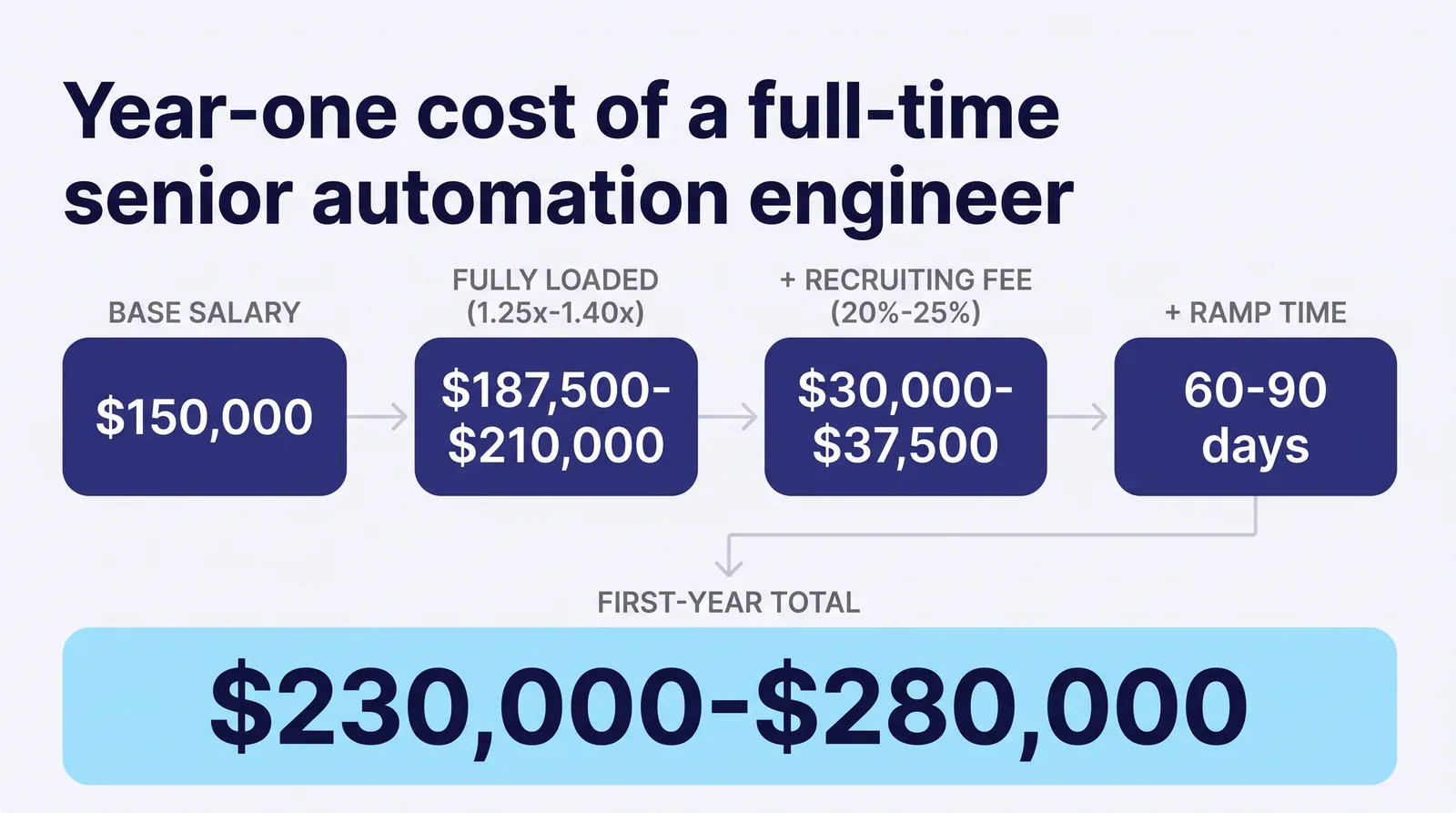
- Fully loaded: 1.25x–1.40x the base salary, or $187,500–$210,000 on a $150,000 salary.
- First-year total with recruiting and ramp: $230,000–$280,000.
- Fractional: $150–$275 per hour, for 121–250 hours per equipment installation.
- Fractional cost per installation: $21,175–$56,250 at $175–$225 per hour; two installations a year: $42,350–$112,500.
Most IVD and consumable diagnostic manufacturers don’t need a full-time automation engineer. They need someone deeply qualified for 3–5 months during equipment procurement and validation — then they don’t need them at all until the next capital project.
That mismatch is exactly what the fractional model solves. But “fractional” covers a wide range, and the cost math is rarely explained clearly. This post breaks it down.
For background on what this role actually does, read what an automation procurement specialist handles in medical device manufacturing.
What a Full-Time Automation Engineer Actually Costs
The base salary is only the start.
Per KORE1’s 2026 Automation Engineer Salary Guide, automation engineer salaries run roughly $72,000 to $162,000 annually, and regulated scope (pharma, biotech, and medical device work under GAMP 5 and 21 CFR Part 11) adds roughly 12% to 20%. Senior specialists with GAMP and FDA validation experience land in the upper portion — $130,000 to $162,000 is typical for someone who can own a capital equipment project from URS through IQ/OQ/PQ close-out.
That’s the W-2 number. The fully loaded number is different.
Per the Bureau of Labor Statistics Employer Costs for Employee Compensation, June 2026, benefit costs account for 30.0% of total employer compensation costs for private industry workers. That figure already includes FICA, unemployment insurance, workers’ compensation, and employer retirement contributions, so 1.25x–1.40x the base salary is a realistic, if conservative, fully loaded cost.
On a $150,000 base salary, that’s $187,500–$210,000 per year in total cost to your business.
Then add recruiting. A specialized hire — senior automation engineer with life sciences experience, GAMP knowledge, and IVD background — takes 3–6 months to fill. Recruiters charge 20%–25% of first-year salary for specialized technical placements. That’s $30,000–$37,500 in one-time placement fees.
Then add ramp time. A new hire takes 60–90 days to reach full productivity in a regulated environment. You’re paying full cost while they learn your QMS, your document templates, and your product line.
The total first-year cost of a senior full-time automation engineer with life sciences experience: $230,000–$280,000, including loaded salary, benefits, recruiting, and ramp.
What a Fractional Automation Engineer Costs
The fractional model bills for active project time. No benefits, no ramp, no recruiting fee.
For medical device and life sciences work, fractional automation engineers typically charge $150–$275 per hour depending on specialization, experience level, and engagement structure. Per MedEnvoy’s analysis of medical device consulting rates, medical device consultants typically charge $150 to $500 per hour, from $150–$225 for junior specialists to $325–$500 for senior consultants with 10+ years of experience. The wide range reflects specialization — someone who can write a URS, attend a FAT overseas, and close out an IQ/OQ/PQ package commands the upper end of that range.
A typical capital equipment project engagement for an IVD manufacturer runs 3–5 months. Here’s what that looks like in hours:
| Phase | Hours |
|---|---|
| CRD + URS development | 20–40 |
| FRS/FDS review and challenge | 8–16 |
| FAT attendance and protocol execution | 16–40 (plus travel) |
| SAT protocol execution | 12–24 |
| IQ/OQ/PQ protocol development and execution | 40–80 |
| SOP development (3–5 documents) | 15–30 |
| Project coordination and QA interface | 10–20 |
| Total range | 121–250 hours per equipment installation |
At $175–$225 per hour (mid-range for a qualified fractional engineer), that’s $21,175–$56,250 per installation.
For a manufacturer doing two equipment installations per year, total fractional cost: $42,350–$112,500.
Compare that to $230,000–$280,000 for a full-time hire.
| Full-time senior automation engineer | Fractional automation engineer | |
|---|---|---|
| Pay | $130,000–$162,000 base salary | $150–$275 per hour, for active project time only |
| Benefits and overhead | 1.25x–1.40x the base salary, fully loaded | None |
| Recruiting | 20%–25% of first-year salary ($30,000–$37,500 on a $150,000 base) | None |
| Ramp | 60–90 days to full productivity | None |
| Year-one cost | $230,000–$280,000 | $42,350–$112,500 for two installations |
The fractional model costs roughly 40%–60% less — often more, depending on how many installations you’re running.
What You Give Up With Fractional
The cost comparison favors fractional, but fractional isn’t right for every situation.
A full-time hire makes sense when you’re running a continuous equipment program — multiple installations per year, ongoing process changes, sustaining engineering work, and a quality system that needs an engineer embedded in it daily. At that volume, the per-project cost of fractional can approach or exceed full-time.
Fractional also introduces handoff risk. If the project is poorly managed, knowledge lives with the fractional engineer and doesn’t transfer cleanly when the engagement ends. This is why the process documentation matters — the URS, FRS, and qualification reports aren’t just regulatory artifacts, they’re the knowledge transfer mechanism.
Reza’s 8-step GAMP process produces a complete documentation package specifically so the manufacturer owns the knowledge at close-out. The documents don’t belong to the engineer.
A third factor is institutional knowledge. A full-time automation engineer builds familiarity with your product, your production team, and your quality culture over years. A fractional engineer brings deep expertise for the project at hand. Both are valuable. They’re different.
The Hidden Cost Nobody Accounts For: The Wrong Hire
Most cost comparisons miss this.
If you hire a full-time automation engineer without deep GAMP and IVD experience, you pay for the learning curve. If they write a weak URS, vendors quote to assumptions. Change orders follow. If the FAT documentation is thin and the equipment passes anyway, you discover the gap during an FDA inspection — at which point the cost of remediation dwarfs anything you saved on documentation.
Reza’s 96+ completed project track record in IVD and consumable diagnostic equipment exists because this specialization is narrow. Most general automation engineers don’t have FDA 21 CFR Part 820 and ISO 13485 experience. Most validation consultants don’t have equipment engineering experience. The combination — equipment procurement plus GAMP documentation — is what makes the role work.
Read about how the equipment engineer and automation engineer roles differ in medical device manufacturing to understand why the combination matters.
When Fractional Wins the Math
Run the numbers for your situation.
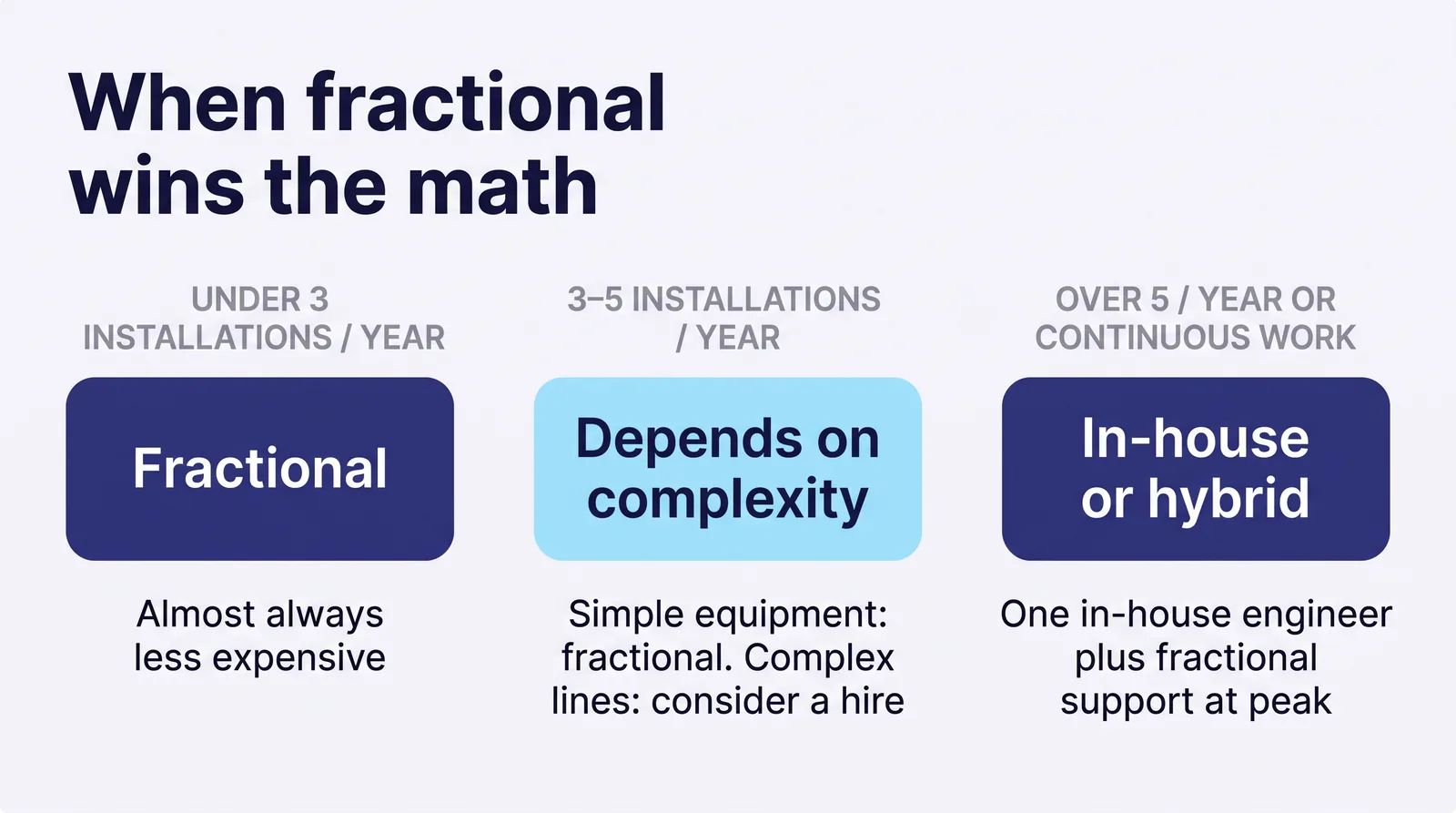
Under 3 equipment installations per year: fractional is almost always less expensive and produces better results, because you’re getting a specialist who does this work full-time rather than someone for whom it’s one part of a broader engineering role.
3–5 installations per year: it depends on complexity. Simple benchtop instruments with limited qualification scope may justify continuing with fractional. Complex fill lines, automated assembly systems, or highly customized equipment where the URS needs extensive engineering support may make a part-time or full-time hire worth considering.
Over 5 installations per year or continuous sustaining work: a dedicated in-house engineer or a hybrid model (one in-house engineer plus fractional support during peak) makes sense.
The variable nobody talks about: the fractional model scales. A manufacturer doing two installations this year and four next year doesn’t need to hire, onboard, and eventually downsize. The engagement expands and contracts with the workload.
What to Look For in a Fractional Automation Engineer
Not all fractional engineers are equivalent. For medical device and IVD manufacturers specifically:
- Direct experience with FDA 21 CFR Part 820, ISO 13485, and GAMP documentation for physical equipment (not just CSV)
- Background on the manufacturer’s side — not a vendor rep, not someone whose experience is primarily selling equipment or integration services
- Documented project history with IVD manufacturers, consumable diagnostic companies, or CDMOs
- Ability to own the full sequence: CRD through SOP, not just the validation protocols
A fractional engineer who’s done 10 equipment qualifications for pharmaceutical packaging companies but has never worked with an IVD manufacturer will have a learning curve. The equipment categories, the regulatory submissions, and the QMS context are different.
Learn more about hiring a fractional automation engineer for your IVD or diagnostic manufacturing operation.
Common Questions on Fractional Automation Engineering Cost
How much does a fractional automation engineer cost per project?
A fractional automation engineer typically costs $21,175–$56,250 per capital equipment installation, depending on equipment complexity and the scope of documentation required. That range assumes 121–250 hours of work at $175–$225 per hour, the middle of the $150–$275 market rate. Projects with simple equipment and an existing quality system land at the lower end. Complex multi-axis systems with extensive IQ/OQ/PQ execution land higher.
Is fractional cheaper than hiring full-time?
For manufacturers doing fewer than 3 capital equipment installations per year, fractional is almost always less expensive. A full-time senior automation engineer in life sciences costs $230,000–$280,000 in year one including base salary, benefits, recruiting, and ramp time. Two fractional engagements per year typically run $42,350–$112,500. The math favors fractional when the work is project-based, not continuous.
What’s the difference between a fractional automation engineer and a validation consultant?
A validation consultant specializes in documentation — protocols, reports, and quality system compliance. A fractional automation engineer covers equipment selection and procurement as well: writing the URS before the vendor is selected, attending the FAT, and reviewing the FRS for technical accuracy. For capital equipment projects, you need both functions. A fractional automation engineer combines them. A validation consultant does not.
How long does a fractional automation engineer engagement typically last?
Most capital equipment engagements run 3–5 months from CRD development through IQ/OQ/PQ close-out. The active work isn’t continuous — there are natural gaps during vendor manufacturing, shipping, and installation. Total active hours over that period typically fall between 121 and 250, depending on equipment complexity and how complete your existing quality system is.
Can one fractional engineer handle multiple projects at once?
Yes, and this is one reason the fractional model works. The gaps in a capital equipment project — vendor manufacturing lead time, shipping, installation delays — create natural windows for the engineer to work on other engagements. For manufacturers, this means the engineer you’re working with has active IVD project experience, not just your project. That breadth typically improves documentation quality and audit readiness.
The Bottom Line
If you run fewer than three capital equipment installations a year, a fractional automation engineer will almost always cost less than a full-time hire, and you get a specialist who does this work full-time.
Budget $21,175–$56,250 per equipment installation for fractional support, against $230,000–$280,000 in first-year cost for a senior full-time engineer. Above five installations a year, or with continuous sustaining work, an in-house engineer or a hybrid model makes more sense.
Reza Bashar at MEPSCo GAMP works with IVD and medical device manufacturers on equipment procurement and GAMP qualification. To see what fractional support would look like for your next capital project, reach out directly.