Equipment Engineer vs. Automation Engineer: Which Role Does a Medical Device Manufacturer Actually Need?
An equipment engineer in medical device manufacturing manages equipment selection, specification, and FDA qualification. An automation engineer designs and integrates control systems. The roles overlap but solve different problems — and most IVD manufacturers need both functions covered before a capital equipment purchase can pass audit.
- These two titles get used interchangeably, but they describe different skill sets aimed at different problems.
- An automation engineer builds and integrates control systems.
- An equipment engineer manages the procurement, specification, and qualification of production equipment — especially in regulated environments.
- If you’re buying automation for an FDA-regulated medical device operation, you probably need both, but most companies don’t know that’s what’s missing.
The job postings make it confusing. One company posts “Equipment Engineer — Mechatronics/Automation.” Another posts “Automation Engineer — Equipment Validation.” A third just posts “Manufacturing Engineer” and lists everything in the requirements.
If you’re trying to figure out which role to hire for a medical device manufacturing scale-up, the title confusion isn’t helping you. What matters is the function, not the label.
This post breaks down what each role actually covers in a regulated medical device environment, where they overlap, where they diverge, and which one you’re more likely missing if your equipment procurement has been painful.
What an Automation Engineer Actually Does
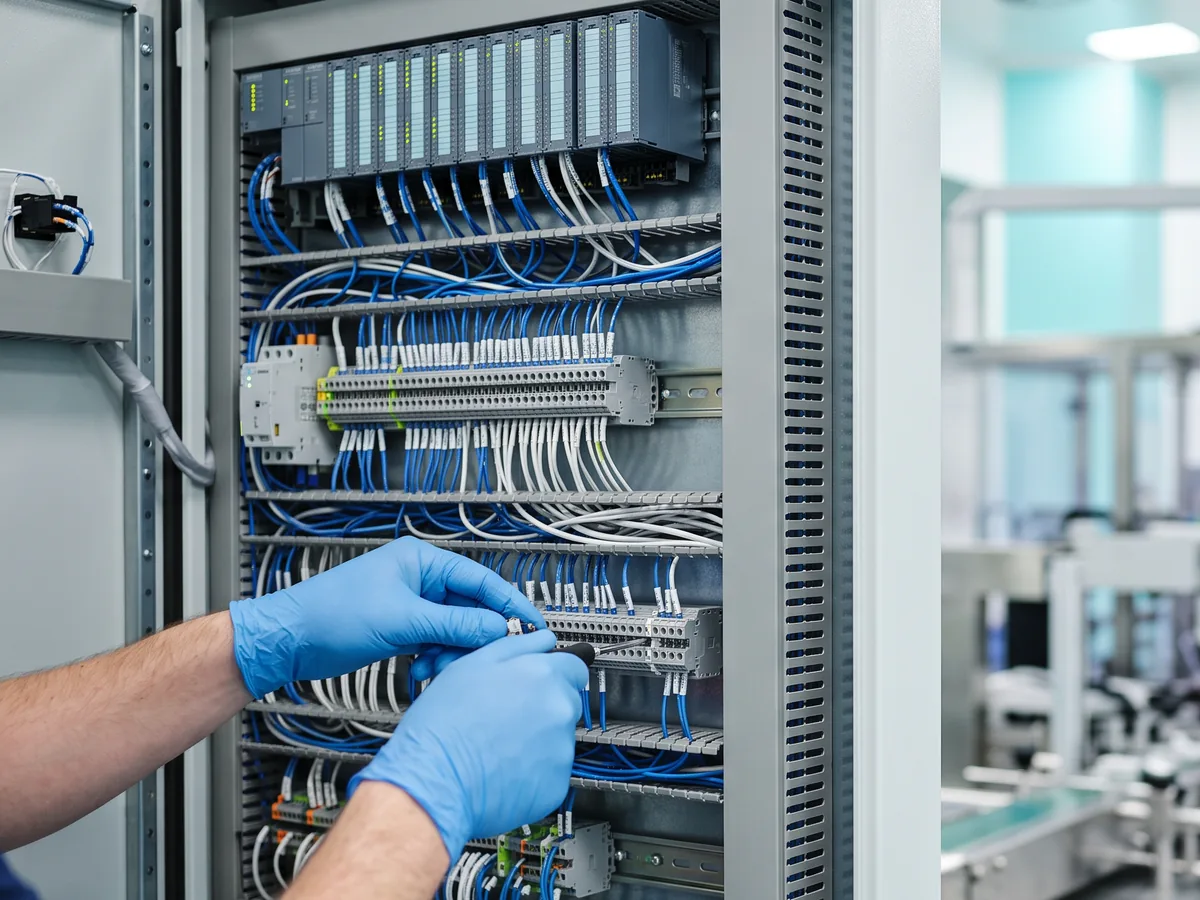
Automation engineers design, build, and integrate automated systems. In a medical device manufacturing context, that means controls architecture, PLC programming, machine vision systems, robotics integration, and the software that connects all of it.
The core skill set is technical depth in automation systems. These engineers understand how to build a machine that does what it’s supposed to do reliably. They work heavily on controls and systems integration — the hardware/software interface that makes automation run.
What they typically don’t own: the regulatory documentation trail that proves the equipment is qualified to run in a medical device facility. That’s a different skill set.
Most automation engineers can contribute to IQ/OQ/PQ documentation. Fewer have the GAMP background to lead it. And even fewer have the procurement experience to write a URS before a vendor is selected, evaluate proposals against regulatory requirements, and negotiate FAT acceptance criteria that protect the manufacturer rather than the vendor.
Salary range for experienced automation engineers in life sciences and medical device contexts: KORE1’s 2026 automation engineer salary guide puts senior engineers (7 to 12 years) at $118,000 to $148,000 base and notes that regulated scope such as pharma, biotech and medical device adds roughly 12% to 20%, so senior engineers in pharmaceutical and medical device work command the upper end. Posted salaries in the same guide top out near $162,000.
What an Equipment Engineer Does (and Why It’s Different)
In a regulated manufacturing environment, the equipment engineer role is more specifically focused on the lifecycle of production equipment from acquisition through qualification and ongoing maintenance.
That includes writing the URS, managing vendor selection, running FAT and SAT, leading IQ/OQ/PQ validation, and producing the documentation that a quality system needs to prove the equipment is fit for its intended use.
Think of it this way. An automation engineer is focused on the system working correctly from an engineering standpoint. An equipment engineer is focused on proving the system works correctly from a regulatory standpoint. Those two things require different expertise and different documents.
In medical device manufacturing, the FDA’s Quality Management System Regulation (QMSR) — which updated 21 CFR Part 820 — requires manufacturers to have procedures that ensure production equipment is adequate for its intended use, properly installed, and appropriately maintained. The equipment engineer owns that documentation trail.
Most job descriptions don’t separate these cleanly. When a company posts an “Equipment Engineer — Mechatronics/Automation” role, they’re often hoping to find one person who can do both. Sometimes they find that person. More often, they hire someone strong on one side and weak on the other.
Where the Roles Overlap
The honest answer is: a lot.
Both roles need to understand the equipment being deployed. Both need to communicate with vendors. Both participate in acceptance testing. Both contribute to validation documentation.
In a well-resourced company with a mature equipment function, you’d have specialists on both sides. An automation engineering team handling systems design and integration, and an equipment engineering or validation function handling qualification documentation and regulatory compliance.
Most IVD manufacturers and consumable diagnostics companies aren’t at that scale. They’re buying production automation episodically — maybe once every 18 months, maybe as part of a scale-up from pilot to commercial production. Maintaining both functions in-house full-time doesn’t make sense financially.
That’s why the distinction matters even when you can’t hire for both. You need to know which piece is already covered internally and which piece needs to come from somewhere else.
| Equipment engineer | Automation engineer | |
|---|---|---|
| Focus | Proving the system works correctly from a regulatory standpoint | The system working correctly from an engineering standpoint |
| Core work | URS, vendor selection, FAT and SAT, IQ/OQ/PQ validation | Controls architecture, PLC programming, machine vision, robotics integration, software |
| Deliverable | The documentation a quality system needs to prove the equipment is fit for its intended use | A machine that does what it’s supposed to do reliably |
| Regulatory documentation | Owns the documentation trail the QMSR requires | Can contribute to IQ/OQ/PQ; fewer can lead it |
| Bring in when | Buying, specifying and qualifying capital equipment for a regulated line | Designing, integrating or troubleshooting automated systems |
The One That Gets Skipped Most Often
Equipment engineering. Specifically, the procurement and qualification side.
Here’s why. Automation engineers are visible. Their work produces something you can watch run. Controls systems, robots, conveyors — you can see them. The documentation that proves the equipment is qualified for FDA purposes is less visible. It lives in a binder. Or a quality management system. Or, in a lot of cases, it’s incomplete or missing because nobody was assigned to own it.
Qualifying medical lab equipment without engineering overhead is the gap IVD manufacturers hit most often. They buy the right equipment and then struggle through qualification because the documentation work wasn’t staffed.
The automation vendor isn’t going to fill that gap for you. Vendors produce FAT protocols that validate their equipment. They don’t produce the IQ/OQ/PQ documentation that validates your use of that equipment in your specific facility, for your specific process, under your quality system.
That distinction — between validating the equipment and validating your use of the equipment — is where the equipment engineer function matters most.
When You Need an Automation Engineer
Your need is primarily for an automation engineer when:
- You’re designing a new automated line from scratch and need controls architecture decisions made early.
- You’re integrating multiple pieces of equipment from different vendors into a unified production system.
- You have existing automation that’s underperforming and needs controls-level troubleshooting.
- Your production requires machine vision, robotics, or custom software integration that goes beyond standard equipment configuration.
In all of these cases, the technical depth of an automation engineer is what moves the project. The procurement and qualification documentation can often be handled by a validation engineer or a quality function with GAMP experience — assuming those resources exist internally.
When You Need an Equipment Engineer (or the Equivalent)
Your need is primarily for equipment engineering when:
- You’re buying capital equipment from an external vendor for a regulated production line.
- Nobody internally has written a URS for production automation before.
- Your last equipment purchase generated change orders after the contract was signed.
- You have a qualification package from a previous project that you’re not confident would hold up under FDA scrutiny.
- You’re a CDMO bringing on a new product that requires new equipment, and you need the qualification documentation to be defensible for multiple clients.
This is the role that’s almost always understaffed. And it’s the one that generates 483 observations when it’s not done correctly.
The Quick Decision Framework
Don’t want to read a full comparison? Here it is in three questions:
- Is my main problem getting the equipment to work? Automation engineer.
- Is my main problem getting the equipment qualified and documented for FDA purposes? Equipment engineer or fractional GAMP specialist.
- Is my main problem buying the right equipment in the first place — spec, vendor, price, and risk? Equipment procurement specialist. That’s a more specific version of the equipment engineer role, focused on the front end of the procurement cycle before qualification begins.
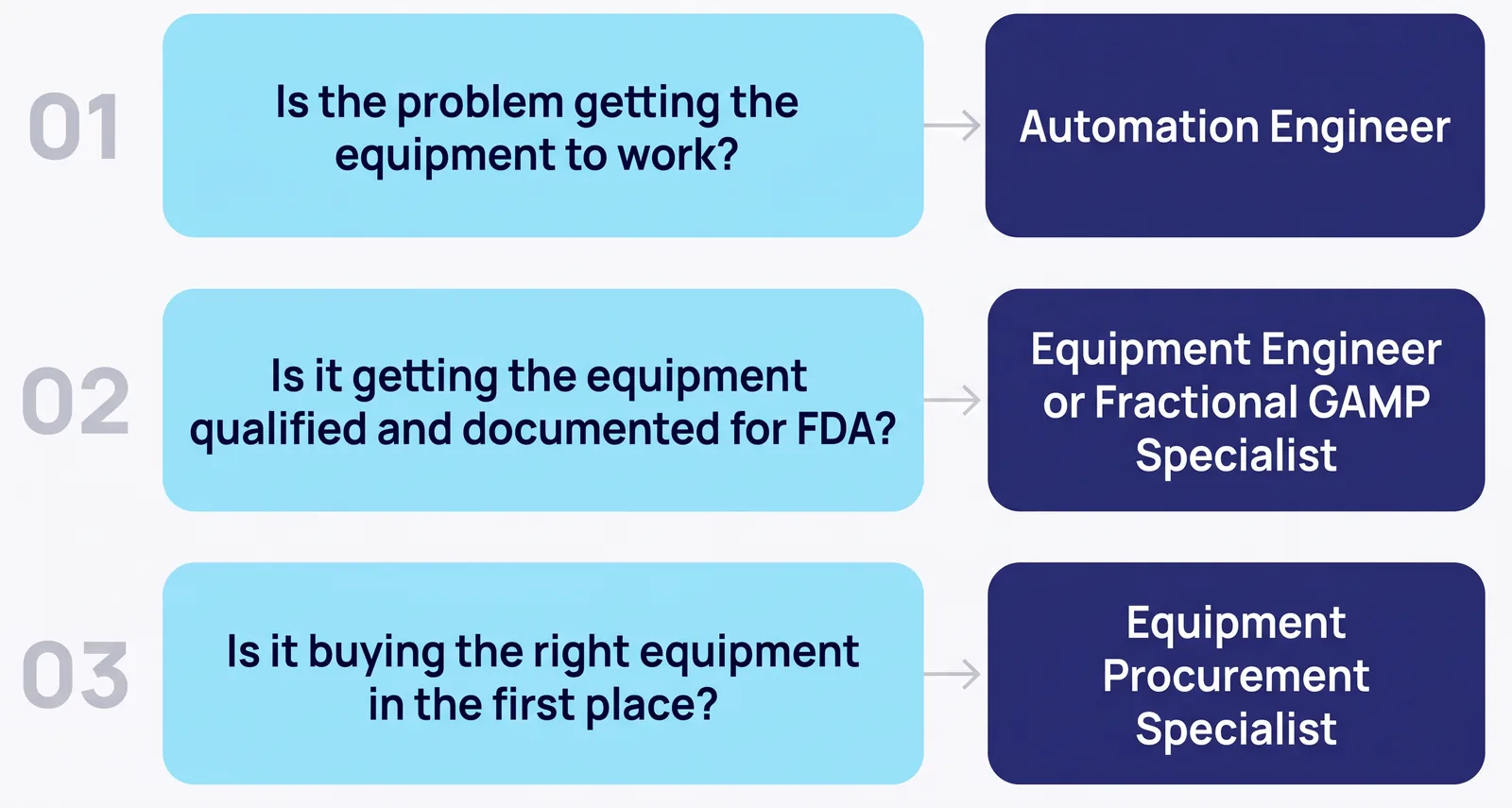
If the answer is #2 or #3, the automation engineer — however skilled — is not the right primary resource for that problem.
How These Roles Show Up in IVD and Consumable Diagnostics Manufacturing
IVD manufacturing has specific regulatory nuances. The EU IVD Regulation (IVDR) and FDA’s IVD framework apply different controls than general medical device regulations. Production equipment for IVD reagent filling, lateral flow assembly, microfluidic component manufacturing, or diagnostic cartridge assembly has specific process requirements.
An automation engineer from general medical device or pharma manufacturing can often apply their controls skills in an IVD context. The regulatory documentation layer, though, has nuances specific to IVD that a generalist equipment engineer may not have encountered.
That’s one reason why fractional specialists with specific IVD and consumable diagnostics experience tend to be more useful than generalist hires for this specific segment. The equipment types are often non-standard — non-standard fill volumes, proprietary reagent handling, custom assay manufacturing. A specialist who has done this before brings documentation templates and vendor knowledge that a generalist builds from scratch.
Reza Bashar at MEPSCo GAMP has completed 96+ projects specifically in medical device manufacturing, including IVD and consumable diagnostics producers. The GAMP process he runs covers both procurement and qualification — the equipment engineer function, specifically. If you’re trying to figure out which role your operation is missing, it’s worth a conversation before your next capital equipment cycle starts.
What People Ask About These Two Roles
Which title should I put on a job posting — equipment engineer or automation engineer?
Depends what you need. If you’re buying capital equipment and need someone to own procurement, vendor management, and GAMP qualification — post for a Validation Engineer or Equipment Engineer with GAMP experience, and make sure the job description emphasizes regulatory documentation over controls. If you need someone to design and integrate systems, post for Automation Engineer with relevant equipment experience. Posting for one person to do both usually means getting partial coverage of both.
Can an automation engineer learn the GAMP qualification side on the job?
Some can, given time and the right mentorship. The challenge in a regulated environment is that learning on the job has compliance costs. If the equipment gets qualified incorrectly while the engineer is developing their GAMP skills, you’re looking at corrective actions or revalidation. In most cases it’s faster and safer to bring in someone who already has the qualification experience.
Can our quality team handle the equipment qualification piece?
Depends on your quality team’s bandwidth and background. If they have prior experience with equipment qualification specifically — not just software validation or process validation, but capital equipment IQ/OQ/PQ — and if they have capacity, that can work. If equipment qualification is being added on top of a full existing workload, the documentation quality tends to suffer. Quality managers will often tell you they can handle it right up until qualification fails.
What does automation engineer work actually cost vs. equipment engineer work?
Based on 2026 salary data, senior automation engineers earn roughly $120,000 to $150,000 in base pay, and regulated pharmaceutical and medical device roles sit at the upper end. Equipment engineers with deep GAMP and qualification experience are in a similar range. The real cost comparison is between full-time headcount for episodic work versus fractional engagement for project-based cycles. Most IVD companies with fewer than three capital equipment purchases per year find fractional significantly more cost-effective.
Is there one title that covers both automation engineering and equipment qualification?
Senior automation engineers with GAMP experience exist and are genuinely hard to find. When you do find one, they command the top of that range or above. The more common reality is that companies hire an automation engineer who’s strong on controls and weak on documentation, then discover the qualification gap mid-project. Planning for that gap in advance is cheaper than discovering it during FAT.
The Practical Takeaway
These roles aren’t interchangeable. They require different experience, produce different deliverables, and solve different problems.
If you’re planning a capital equipment purchase for a medical device production line — especially for IVDs, consumable diagnostics, or lab components — figure out which function is actually covered internally before you sign a vendor contract. The automation can work perfectly and still fail qualification because nobody owned the documentation side.
If you want to understand how the equipment engineering function specifically works in an IVD or consumable diagnostics context, MEPSCo GAMP handles exactly that. Reza Bashar’s work is exclusively on the manufacturer’s side — procurement through qualification, GAMP documentation, and the full validation package. Worth a call before your next project kicks off.