Small Fill for Bottle With Foamy Reagent
Not the Project I Planned For
When I started MEPSCo, the plan was straightforward: focus on GAMP documentation for the manufacturing automation procurement space. That’s the gap I saw in the market. That’s the service I built the business to deliver.
Then I got a call.
A contract manufacturing organization in Carlsbad, California needed to fill an odd-shaped bottle with a foamy reagent. They needed two units. In less than two months.
That’s a tight scope, a difficult material, and a short timeline. I knew immediately that most automation companies wouldn’t take it — either because of the timeline or because the project was too small to be worth their time. I took it.
The Challenge
Foamy reagents are difficult to fill. The challenge isn’t the fill volume — it’s the foam. If the fill process agitates the reagent, foam forms at the surface and the fill volume becomes unreliable. Standard fill nozzles and processes aren’t designed for this. The nozzle geometry, fill speed, and head pressure all have to be considered together.
The bottle shape added another constraint. Odd-shaped containers affect how reagent flows during fill, how foam develops, and how the bottle seats on the fill station. A standard fill setup wouldn’t fit.
The Solution
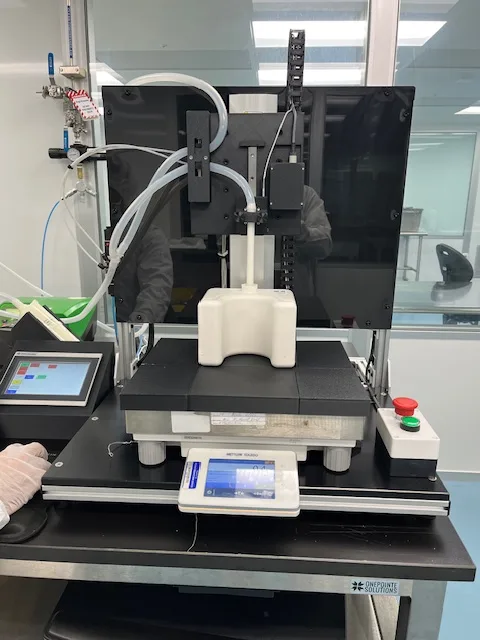
Working in partnership with another engineer I’d met at a symposium a few months earlier, we designed a custom fill process and nozzle for this specific reagent and bottle combination. The nozzle geometry controlled foam formation. The fill process managed head pressure and fill speed to keep the reagent stable during the fill cycle.
Both units were designed, built, and delivered to the CMO within the two-month deadline.
They worked better than requested. Using the custom process and nozzle, we filled just over a liter of foamy reagent in under the required 60 minutes — improving on the CMO’s original lab setup.
designed and built
delivered within it
filled
60-minute requirement
What This Project Shows
MEPSCo doesn’t have a minimum project size.
The same engineering discipline that went into the DOD pandemic project — proper scoping, custom process design, a solution built for the specific material and container — goes into a two-unit build for a CMO. The scale is different. The approach isn’t.
When the challenge shows up, you rise to it.
About This Project
Does MEPSCo take on small projects?
Yes. There’s no minimum project size. The same engineering discipline — proper scoping, custom process design, a solution built for the specific material and container — applies to a two-unit CMO build as it does to a large-scale validated production line.
Why is foamy reagent fill difficult?
Foam forms when the reagent is agitated during filling. Standard fill nozzles and processes aren’t designed to control foam formation, which makes fill volume unreliable. The nozzle geometry, fill speed, and head pressure all have to be managed together. Odd-shaped containers add another layer of complexity because they affect how the reagent flows and how foam develops during the fill cycle.
Can MEPSCo work with CDMOs and contract manufacturers?
Yes. CDMOs and CMOs are part of the primary ICP. The regulatory environment is the same — FDA-regulated manufacturing requires the same GAMP documentation standards regardless of whether the manufacturer owns the product or produces it under contract.
How quickly can MEPSCo start a project?
On this project, two custom fill units were designed, built, and delivered in under two months. Start time depends on project scope and Reza’s current capacity — he typically runs 3–4 concurrent projects. A Manufacturing Automation Assessment call is the right starting point to discuss timeline and fit.
Book a Manufacturing Automation Assessment
Or download the GAMP Roadmap to see the full 8-step process.