Validating a Retrofitted Off-the-Shelf Filling Machine
The Decision
There’s no such thing as cheap fill equipment in medical device manufacturing.
An engineer at a previous company purchased an inexpensive industrial filling machine designed for mainstream applications — the kind built for filling bottles of glass cleaner. The assumption was that fill equipment wouldn’t require validation and that cleaning would be simple.
Both assumptions were wrong.
What Quality Asked
When the Quality team reviewed the equipment, they had five questions. None of them had satisfactory answers.
- How do we validate this machine?
- How do we prove lot-to-lot contamination can be tested and controlled?
- How do we verify that fill volume is within spec?
- What requirements are we validating against?
- How do we document and defend this when FDA shows up?
These aren’t unexpected questions in medical device manufacturing. They’re mandatory. Skipping the GAMP process didn’t make them go away. It just meant there were no answers ready when they arrived.
The issues escalated from engineering to management. Deadlines compressed. The old adage proved true again: you can have it cheap, fast, and good. Pick two.
The Retrofit
I was brought in to construct a process that would enable validation of the filling machine and release it to manufacturing.
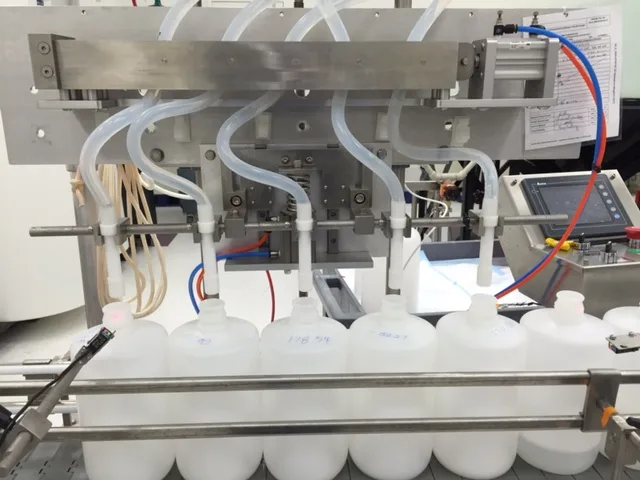
The first step was addressing all product contact components. The existing fill pathways weren’t designed for a regulated manufacturing environment. I designed and built a novel 5-channel pinch valve with an E-Stop feature, along with special nozzles and processes to restrict foaming during the fill cycle.
After the contact components were resolved, the HMI and controls were reprogrammed to operate reliably and repeatably within spec. This wasn’t a small change — reprogramming the controls to meet validation requirements on equipment that was never intended for a regulated environment required rebuilding the operational logic from the ground up.
none with satisfactory answers
designed and built
manufacturing
The Outcome
The machine was validated and released to manufacturing.
It wasn’t easy, inexpensive, or fast. Retrofitting off-the-shelf equipment to operate within a validated process never is. But it was successful — and more importantly, it was preventable.
Every question the Quality team asked in that meeting would have been answered before procurement if a GAMP process had been followed from the start. The URS would have defined the validation requirements. The vendor selection process would have identified whether an off-the-shelf industrial machine was appropriate for this application. The answer would have been no.
The retrofit cost more than getting it right the first time would have.
About This Project
Can off-the-shelf industrial equipment be used in medical device manufacturing?
In some cases, yes — but only if the equipment can be validated to meet GAMP and cGMP requirements. The problem on this project wasn’t the equipment category, it was the assumption that validation wouldn’t be required. In a regulated manufacturing environment, every piece of equipment that touches the product or the process needs to be validated. Off-the-shelf industrial equipment built for unregulated applications usually can’t meet that standard without significant modification.
What is a 5-channel pinch valve and why was it needed?
A pinch valve controls flow by compressing flexible tubing — no metal parts contact the fluid, which is important for product contact surfaces in a regulated environment. The 5-channel design allowed multiple fill lanes to be controlled independently with a single valve assembly. The E-Stop feature allowed the system to halt immediately if a fault condition was detected. This component didn’t exist in the original equipment and had to be designed and built for this application.
What does it cost to retrofit equipment that should have been specified correctly from the start?
More than doing it right the first time. The retrofit on this project required designing and fabricating custom product contact components, reprogramming the HMI and controls from the ground up, and executing a full validation protocol on equipment that wasn’t built for the purpose. The GAMP process — specifically, a proper URS and vendor qualification — would have identified upfront that this equipment wasn’t appropriate for the application. The cost of the URS is a fraction of the cost of a retrofit.
What FDA regulations apply to filling equipment in medical device manufacturing?
21 CFR Part 820 (Quality System Regulation) governs manufacturing equipment in medical device manufacturing. 21 CFR Part 11 governs electronic records and electronic signatures, which applies to HMI and data capture systems. Equipment validation — IQ, OQ, and PQ — is required to demonstrate that the equipment is installed correctly, operates within spec, and consistently produces output that meets requirements.
Book a Manufacturing Automation Assessment
Or download the GAMP Roadmap to see the full 8-step process.