From Disney Imagineering to Mag-Particle Fill Process
The Problem
Few operators wanted to go into the fill room.
The process required hours of pre-weighing every bottle, carefully segregating them into weight ranges, then setting up the mag-particle fill process and keeping the mixture churning during filling. After each fill, the operator would weigh the bottle and hope it came in within spec. If it didn’t, that fill was wasted.
It was inefficient, frustrating, and produced more waste than it should have. They asked me to design a better solution.
An Unusual Starting Point
I also have a business called Creative Water Sights. I design and build water sculptures — copper sheetmetal kinetic wall units, custom installations for private clients. Water has been and still is my passion. I understand how it moves, how it behaves under pressure, how it manages flow.
That background followed me to Walt Disney Imagineering, where I designed and installed special effects for Disney parks. Water in motion, under controlled conditions, producing a specific result on a reliable schedule. That’s the engineering challenge whether you’re running a waterfall at Grizzly Rapids or a fill process in a regulated manufacturing environment.
When I looked at the mag-particle suspension problem, I wasn’t thinking about fill equipment. I was thinking about fluid behavior.
The Solution
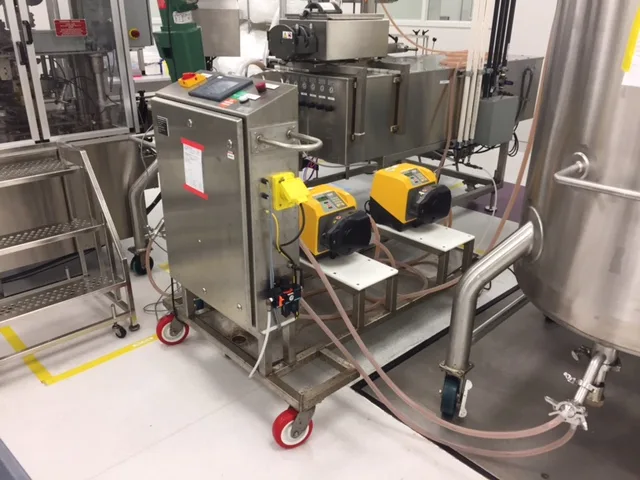
I designed and developed a custom continuous suspension mixing and filling process. The system included a pump and valve skid, tanks, a mixer, and a flow-through reservoir that kept the suspension in continuous motion throughout the fill cycle.
By keeping the suspension moving, the process eliminated the need to pre-weigh bottles before filling. Sampling was reduced by over 95%. The fill crew no longer spent hours in the prep room before a production run. The process ran cleaner, faster, and with far less waste.
The cost savings were significant. The operator experience improved substantially. Both came directly from solving the fluid behavior problem correctly instead of throwing more labor at a broken process.
before filling
room before a production run
The Lesson
Engineering problems don’t always get solved by engineering knowledge.
Sometimes they get solved by knowing how liquids behave. Or how a waterfall needs to behave for millions of park guests who don’t know it’s engineered. Or what happens when you design something that has to work correctly, every single day, without someone adjusting it by hand.
The skills that come from completely different industries and personal passions enable outside-the-box thinking. That’s not a marketing line. It’s what happened on this project.
About This Project
What is a mag-particle suspension fill process?
Magnetic particle (mag-particle) suspension filling involves keeping a mixture of magnetic particles suspended in a liquid reagent during the fill process. The challenge is that the suspension settles if it’s not kept in continuous motion, which makes consistent fill volumes and weights difficult to achieve without constant operator intervention.
How much did the new process reduce sampling?
Sampling was reduced by over 95%. The pre-weighing step was eliminated entirely. Both results came from designing a continuous suspension mixing system that kept the fill process consistent without requiring manual checks between every bottle.
What equipment was designed for this project?
A custom pump and valve skid, tanks, a mixer, and a flow-through reservoir that maintained continuous suspension motion throughout the fill cycle. The system was designed from fluid behavior principles rather than from existing fill equipment configurations.
Does MEPSCo handle process development work, not just documentation?
Yes. Process development — including Proof of Principle, Proof of Concept, and custom process design — is part of MEPSCo’s service offering. Equipment procurement and GAMP documentation work best when the process is defined correctly first. This project is an example of what happens when the process gets solved before the equipment is specified.
Book a Manufacturing Automation Assessment
Or download the GAMP Roadmap to see the full 8-step process.