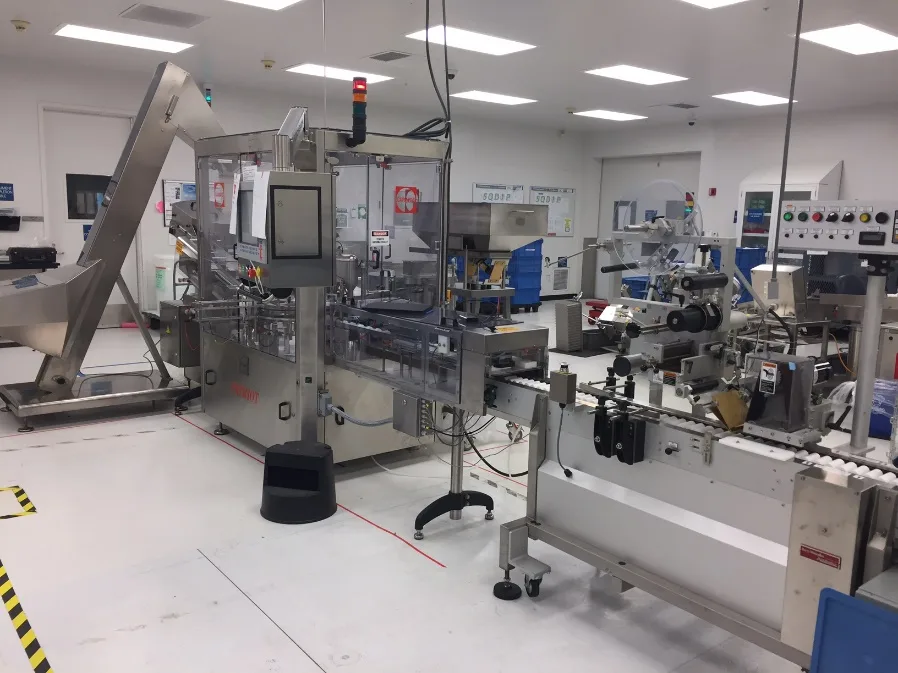
Continuous Labeling Solution for High PPM Production Line
Labeling Is Not an Afterthought
Across many automation projects, labeling gets treated as the last item on the list. The directive is usually some version of “we just need a labeler to put these labels on.”
That’s not a requirements document. That’s a setup for problems.
Pretty much every product needs a label. They have to be designed, produced, placed on a roll with an appropriate backing and inner core for the intended environment. They might be 100% pre-printed, partially printed, or fully printed on the line. The ink type has to be tested to confirm it withstands shipping and process conditions. The bottle design, material, machine speed, type of inspection — all of it factors into the labeling system specification.
None of that gets figured out during FAT. Or during validation. It gets figured out during the URS.
What Happens When Labeling Is an Afterthought
On a 70 PPM intermittent machine, a brief stoppage to replace the label roll has minimal impact on the production run. The calculus changes completely on a 200 PPM continuous line.
A standard label roll holds roughly 8,000 labels. On a 200 PPM continuous line, replacing the roll and removing the backing material takes about 5 minutes. That’s 10,000 parts of lost production in an 8-hour shift — every time the roll runs out.
That’s not a maintenance issue. That’s a design issue. And it’s entirely preventable if labeling is included in the URS from the beginning.
The Solution: Tandem Roll Replacement and Backer Chopping
I worked with my labeler supplier to design and implement a tandem label roll replacement system. Instead of stopping the line to replace an empty roll, the tandem system loads a fresh roll before the active roll runs out. The transition is seamless. The line doesn’t stop.
We also designed and implemented a backer chopping system to handle the backing material as it’s removed, eliminating the manual step of collecting and disposing of backing during the production run.
Combined, these two modifications eliminated labeling-related stoppages on the 200 PPM line entirely.
The Static Problem
This labeling application had an additional complication: the labels required a plastic backing. Plastic creates static. Static causes labels to misalign, misfeed, or stick where they shouldn’t.
The system was designed to mitigate static while maintaining continuous operation at speed. Additional challenges included printing Lot and UDI information on partially printed labels, then using OCR/OCV to inspect for features across several different colored labels. Each colored label background required separate inspection calibration.
None of it was trivial. None of it could have been addressed adequately during FAT.
production line
standard label roll
in an 8-hour shift
on the 200 PPM line
The Lesson
Plan for labeling the same way you plan for fill, assembly, or any other critical process step. The URS is where label design, material, ink type, inspection method, roll configuration, backing disposal, and OEE impact all get defined. Not at FAT. Not during validation. Not when you’re explaining an expensive change order to management.
About This Project
Why does labeling need to be in the URS?
Labeling involves more decisions than most teams realize: label design, material, ink type, roll configuration, backing disposal, inspection method, and OEE impact. On a 200 PPM continuous line, a labeling stoppage to replace a roll can cost 10,000 parts per shift. Every one of those decisions has to be made before the equipment is specified — not during FAT or validation.
What is a tandem roll replacement system?
A tandem system loads a fresh label roll before the active roll runs out, allowing the line to continue running without stopping for a roll change. On a 200 PPM continuous line, eliminating even one planned stoppage per shift recovers thousands of units of production capacity.
What is OCR/OCV inspection in labeling?
OCR (Optical Character Recognition) reads printed text on a label — lot numbers, UDI codes, expiration dates — and verifies that the correct information is present. OCV (Optical Character Verification) checks that the characters are legible and correctly formed. On this project, OCR/OCV inspection ran across multiple colored label backgrounds, each requiring separate calibration.
How does static affect labeling in a production environment?
Static causes labels to misalign during application, misfeed from the roll, or adhere to surfaces they shouldn’t. Plastic label backings are a common source of static in high-speed production environments. Mitigation requires designing the static control into the labeling system from the start — ionizers, grounding, shielding — not adding them after the fact when problems appear during startup.
Book a Manufacturing Automation Assessment
Or download the GAMP Roadmap to see the full 8-step process.