High Throughput Lyophilized Bead Manufacturing Process
The Starting Point
The lyo-bead project had been tried before.
Large, cumbersome equipment. An expensive and dangerous process. The old equipment was put in storage and the project was shelved. But the product still needed to be manufactured, and R&D and the Process Transfer group eventually came back to it. They asked me to engineer a higher-output, safer production process.
That’s the kind of problem I take seriously. Not because it’s easy, but because getting it right requires starting from first principles rather than trying to fix what was already proven to not work.
Phase 1: Proving the Process
I started with R&D scientists dropping enzyme reagents into a bead sieve in a liquid nitrogen bath using a pipette. That was the baseline. The first improvement was straightforward: set up a positive displacement pump to replace the manual pipette. Consistent pressure, consistent drop size, consistent results.
That alone was a significant improvement.
From there, I designed the first rotary 4-channel unit and worked with one of my automation vendors to build it. Four channels running simultaneously, controlled drop formation into the LN2 bath, consistent bead geometry. The process worked.
Phase 2: Scaling for Production
A second unit was ordered for the Process Transfer group to begin manufacturing. Additional equipment was designed to lyophilize the frozen beads and fill the 2×6 cartridges.
The bead was extremely delicate. Figuring out the handling process — how to move a frozen bead from the LN2 bath through the lyophilizer and into the cartridge without compromising it — was a significant engineering challenge. Every step of the handling sequence had to be designed around the bead’s fragility.
When management saw the results, they moved to full production. More copy units were ordered with modifications for quick changeovers, and a complete manufacturing suite was designed and built, including a dry room.
Phase 3: High-Throughput System
Production demand increased. Management asked for higher throughput.
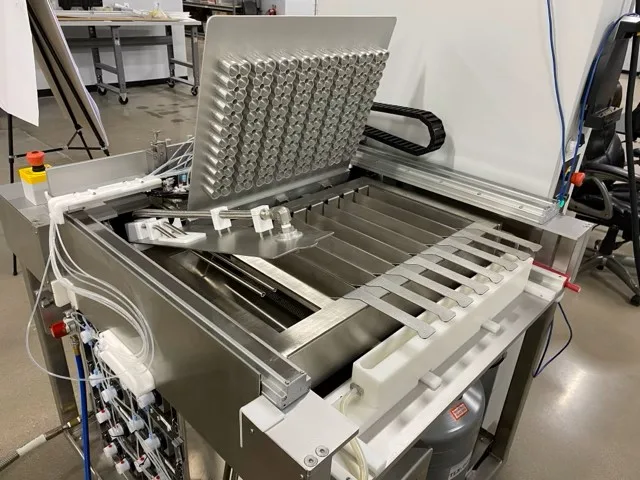
I wrote the URS for an 8-channel system with separated chambers and a quick changeover feature. The LN2 supply required a different approach at this scale — tanks in the material hallway needed frequent exchange, which disrupted production. I contracted a cryo-vendor to design, build, and install the piping and controls for an automatic tank transfer system. I also worked with the automation vendor to design an open-tank LN2 level control for the machine.
The 8-channel high-throughput system was validated and moved to production. A manual bead transfer tooling was also designed to fill the 4-up 2×6-cartridge tooling.
Two patents were secured on this project.
Phase 1
system, validated
on this project
transfer tooling
The Lesson
Abandoned equipment in storage isn’t always a dead end. Sometimes it’s a requirements problem — the original approach was wrong, not the product concept. Starting from the science (how does a bead form consistently in an LN2 bath?) rather than from the failed equipment produced a process that scaled from a lab pipette to a validated 8-channel production system.
The documentation made scaling possible. Each phase had a defined URS. Each phase’s qualification documents fed into the next. By the time the 8-channel system went through validation, the process was already understood. The documentation wasn’t catching up to the engineering. It was leading it.
About This Project
What is lyophilized bead manufacturing?
Lyophilized bead manufacturing produces small, freeze-dried beads containing enzyme reagents used in diagnostic assays. Beads are formed by dropping reagent into a liquid nitrogen bath, then lyophilized (freeze-dried) to remove moisture. The beads are extremely delicate and require precise handling throughout the manufacturing process.
Why was the original lyo-bead process abandoned?
The original process used large, cumbersome equipment and was both expensive and dangerous to operate. It couldn’t be scaled reliably or safely. Rather than trying to fix the existing equipment, Reza started from the science of bead formation and designed a new process from first principles.
How many patents came from this project?
Two patents were secured. Both arose from novel engineering solutions developed during active project work — a consistent pattern across Reza’s most technically complex projects.
How does MEPSCo approach scaling from a small pilot process to full production?
Each phase has a defined URS before procurement begins. Phase 1 URS covers the pilot system. Phase 2 URS covers the scale-up requirements. Each phase’s qualification documentation feeds into the next. By the time the high-throughput system goes through validation, the process is already understood from prior phases. The documentation leads the engineering, it doesn’t chase it.
Book a Manufacturing Automation Assessment
Or download the GAMP Roadmap to see the full 8-step process.