How to Evaluate Automation Vendor Quotes for Medical Device Manufacturing
Evaluating automation vendor quotes for medical device manufacturing requires comparing bids against a complete User Requirements Specification — not against each other. When quotes aren’t scoped to the same requirements, the lowest bid is rarely the lowest final cost. A structured vendor scoring methodology that evaluates capability, GAMP documentation support, track record, and technical fit produces better outcomes than price comparison alone.
Three quotes come back for the same piece of equipment.
The Director of Manufacturing takes them to leadership. Leadership asks which one to pick. Nobody in the room can answer the question — because the quotes aren’t scoped to the same thing. The $380k vendor left out vision inspection because the URS didn’t specify it. The $1.1M vendor added $200k in contingency for requirements that weren’t defined clearly enough to quote against confidently. The $690k vendor is somewhere in between, but nobody knows where.
This is the most common and most avoidable problem in medical device manufacturing automation procurement. It doesn’t come from bad vendors. It comes from a URS that wasn’t complete enough to produce comparable quotes — and from a selection process that was designed to compare prices instead of compare capability.
MEPSCo has run the Equipment Procurement & Vendor Management process across 96+ medical device automation projects. On two occasions in Reza’s career, management selected the lowest bid against his recommendation. Both projects came in late, over budget, and underperforming.
Vendor selection is not a price decision.
Why Vendor Quotes Aren’t Comparable
Before evaluating quotes, it’s worth understanding why quotes for the same piece of equipment come back at such different numbers.
The URS gap
When the URS doesn’t define a requirement specifically, every vendor makes a different assumption about what’s included. One assumes a basic HMI. Another quotes a full data acquisition system with 21 CFR Part 11 compliant audit trail. One assumes manual changeover. Another quotes quick-release tooling. The price difference between these assumptions can easily run $100k on a mid-size machine.
Contingency loading
Vendors add contingency for undefined requirements. The less defined the URS, the more contingency gets built into the quote. A $200k contingency line on an undefined requirement isn’t padding — it’s the vendor protecting themselves from scope creep on a vague scope. A properly written URS eliminates the contingency because there’s nothing undefined to protect against.
Core competency differences
Not all automation vendors are equally capable of everything. A vendor who excels at filling lines may not have the same depth in vision inspection integration. A vendor who’s built assembly machines for 20 years may not have experience with the specific reagent type the product requires. Quotes that reflect capability gaps don’t look like capability gaps — they look like low prices.
GAMP documentation assumptions
Vendors vary significantly in how they handle GAMP documentation. Some include a basic IQ/OQ/PQ package. Some assume the manufacturer handles documentation. Some include documentation that looks complete but isn’t built from the URS or isn’t in a format the manufacturer’s quality team can use. The documentation cost is either in the quote or it’s a problem to be solved later.
The Kepner-Tregoe Approach to Vendor Scoring
Price is one input into vendor selection. It’s not the deciding factor.
MEPSCo uses a Kepner-Tregoe (KT) analysis — a structured decision-making methodology that scores each vendor against a weighted set of criteria. Every vendor is evaluated on the same criteria, against the same weights, producing a defensible selection decision that doesn’t depend on who made the most compelling presentation.
The criteria:
Technical capability. Can this vendor actually build what the URS specifies? Not what they say they can build. What they’ve built before, for whom, on projects of similar complexity. References and project history matter here — not vendor claims.
GAMP documentation support. Does the vendor have a dedicated GAMP documentation capability? Who writes the documentation? Is it a dedicated documentation team or engineers filling out templates as a secondary responsibility? What’s the vendor’s documentation staff turnover? Validation happens six or more months after delivery — the person who understood the build needs to still be there.
Track record on similar projects. Has this vendor delivered similar equipment, on similar timelines, for manufacturers in FDA-regulated environments? Delivery track record matters. Schedule slippage on a vendor’s prior projects predicts schedule slippage on this one.
Financial stability. A vendor who goes out of business during the build — or whose key staff leave mid-project — is a serious risk on a 12–18 month automation project. Financial stability isn’t exciting to assess. It’s essential.
Responsiveness during the quote process. How a vendor behaves during quoting is how they’ll behave during the build. A vendor who takes three weeks to respond to a technical question during the quote process will take three weeks to respond to a punch list item during FAT. Speed and quality of communication during quoting is a leading indicator.
Change order history. Ask vendors for references on prior projects. Ask those references specifically about change orders — whether change orders occurred, what drove them, and how the vendor handled them. A vendor with a pattern of change orders on similar projects will generate change orders on this one.
The KT analysis produces a weighted score for each vendor. The vendor with the highest score is the recommended selection. That recommendation goes to management with the scoring methodology and the data behind it — not just a name.
What to Do When Quotes Aren’t Comparable
It happens. Even with a complete URS, vendors interpret requirements differently. Quotes come back on different assumptions.
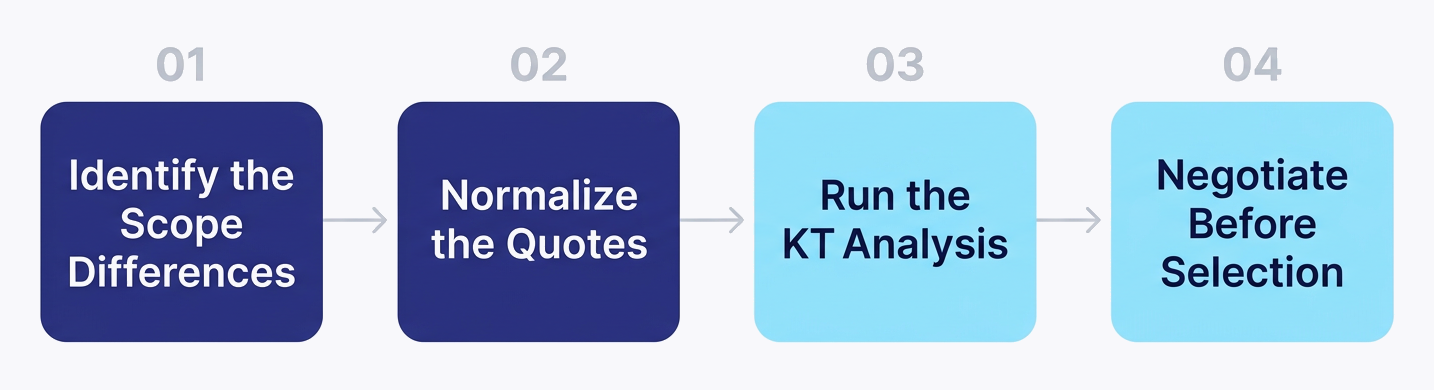
Step 1: Identify the Scope Differences
Before evaluating prices, identify what each vendor included and excluded. This requires reading the quote documentation carefully and asking specific questions. “Your quote doesn’t include vision inspection — is that excluded or is it in another line item?” “Your quote includes a GAMP documentation package — what documents are included and who writes them?”
Most scope differences can be identified and clarified through a structured quote review. What can’t be identified and clarified through the review process is a red flag — a vendor who can’t clearly explain what’s in their quote can’t clearly explain what’s in the contract.
Step 2: Normalize the Quotes
Once scope differences are identified, the quotes can be normalized to the same scope. Add the cost of excluded items to the low bid. Remove the contingency from the high bid for requirements that are now clearly defined. The result is a set of quotes that are actually comparing the same thing.
Step 3: Run the KT Analysis
With normalized quotes, price is one input alongside capability, documentation, track record, and responsiveness. The KT analysis produces the recommendation.
Step 4: Negotiate Before Selection
The vendor who scores highest isn’t necessarily the vendor who gets the contract at their quoted price. After the KT analysis identifies the preferred vendor, there’s room to negotiate on scope, on deliverables, on timeline, and on price — with the full understanding of what the URS requires and what the vendor is capable of delivering.
This is where the manufacturer needs their own engineer at the table. Negotiation with a vendor who’s selling equipment is not the same as negotiation with an independent engineer who understands both the URS and the vendor’s capabilities.
The Two Management Override Stories
On two occasions in Reza’s career, the KT analysis identified a vendor who was not the lowest bid. Management overrode the recommendation both times and selected the lowest bid.
Both projects came in late. Both came in over budget. Both produced equipment that underperformed against specification. Both required significant additional engineering time and cost to recover — more, in both cases, than the price difference between the recommended vendor and the lowest bid.
The pattern is consistent across 96+ projects. Vendor selection based on price alone, without a structured qualification process, produces predictable outcomes. The manufacturers who avoid those outcomes are the ones who make vendor selection a qualification decision.
What the Vendor Selection Decision Affects Downstream
Vendor selection isn’t just a procurement decision. It determines what the rest of the project looks like.
| A vendor selected for capability and track record, against a complete URS, with a documented selection process: | A vendor selected by lowest price, against an incomplete URS: |
|---|---|
| Quotes more accurately because the requirements are defined | Quotes against their assumptions, which differ from the manufacturer’s requirements |
| Builds to specification because the requirements are clear | Builds to their interpretation, which generates change orders when requirements clarify |
| Issues fewer change orders because there’s less ambiguity to exploit | Issues change orders for everything that wasn’t defined up front |
| Produces better FAT results because they understood the requirements before the build | Produces FAT punch lists that are longer than they should be |
| Delivers better IQ/OQ/PQ documentation because they were selected for GAMP capability | Delivers documentation that may not meet the manufacturer’s quality standards |
The selection decision made at the beginning of the project follows every subsequent step.
Proof
AGR, Kinematic Automation, CAID, Cozzoli, Cyth, Invio, ATS, Jerit, BioDot, Capmatic, Oden, Resina, PVA TePla
On the DOD pandemic project, vendors chose to support Hologic’s equipment orders over work from larger companies. Not because of contract size. Because of the documentation and the relationships built through proper process and professionalism over 20 years.
“Reza’s deep knowledge and understanding of automation and GAMP guidelines is also a significant benefit that he brings to the process.”
DAVE CARLBERG · COFOUNDER, KINEMATIC AUTOMATION
“Reza has done a great job in ensuring equipment requirements are well-defined by the end user so that vendors are successful in providing equipment solutions that are thorough and complete.”
JIM NEAL · SR. DIRECTOR OF OPERATIONS, HOLOGIC

“We have an approved vendor list. We just pick from that.”
Approved vendor lists narrow the field. They don’t select the right vendor for a specific project. A vendor who’s on the approved list and has delivered acceptable equipment on prior projects may not have the capability or GAMP documentation depth for this project. The KT analysis runs against whoever is on the shortlist — it’s not a replacement for the approved vendor list, it’s the methodology used to select from it.
“The lowest bid went through legal review and the contract protects us.”
Contracts protect against the vendor’s failure to deliver what the contract specifies. They don’t protect against a vendor who delivers exactly what the contract specifies — which may not be what the manufacturer actually needs, if the URS wasn’t complete when the contract was written. Change orders are contractually valid. That’s the problem. The protection against change orders isn’t legal language — it’s a complete URS and a vendor selection process that identifies which vendor will actually build to it.
Common Questions
Why do automation vendor quotes vary so much for the same equipment?
Quote variance traces almost entirely to URS completeness. When requirements aren’t fully defined, every vendor makes different assumptions about what’s included and adds contingency for everything undefined. A $380k quote and a $1.1M quote for the same machine usually means the requirements weren’t specific enough to produce comparable quotes — not that one vendor is dramatically more efficient than the other.
What is Kepner-Tregoe analysis and how does it apply to vendor selection?
Kepner-Tregoe is a structured decision-making methodology that scores options against weighted criteria. Applied to vendor selection, it evaluates each vendor on technical capability, GAMP documentation support, track record, financial stability, responsiveness, and change order history — producing a weighted score for each vendor that’s documented and defensible. Price is one criterion, not the deciding factor. The KT analysis produces a recommendation management can stand behind.
Should we ask vendors for references before selecting?
Yes. And ask those references specific questions — not “was the project successful?” but “did you receive change orders, what drove them, and how did the vendor handle them?” and “how was the vendor’s GAMP documentation?” and “was the equipment delivered on time and within budget?” References who can answer those questions specifically are more useful than references who provide general endorsements.
What’s included in a vendor’s GAMP documentation package?
It varies significantly. Some vendors include a basic IQ/OQ/PQ template package. Some include documentation written by their engineering team. Some include documentation written by a subcontracted documentation firm. Before accepting a vendor’s documentation package as part of the contract scope, ask who writes it, what their GAMP documentation experience is, and whether the documentation will be written from the URS or from the machine’s design spec. Documentation written from the machine’s design spec may not reflect the manufacturer’s requirements.
How does MEPSCo handle vendor selection when the manufacturer has existing vendor relationships?
The KT analysis runs against whoever is on the shortlist — existing vendor relationships included. If a preferred vendor scores highest on the KT analysis, the recommendation confirms the existing relationship. If a preferred vendor scores lower than an alternative, the recommendation identifies the gap — and management can make an informed decision about whether the relationship outweighs the capability difference. The KT analysis doesn’t eliminate relationships. It makes the tradeoff explicit.
At what stage should vendor selection happen?
After the Budgetary URS is developed and management has approved the budget — not before. Getting vendor quotes without a URS produces incomparable quotes and an uninformed selection decision. Getting vendor quotes with a Budgetary URS produces comparable quotes and a selection process that can actually distinguish between vendors on capability rather than on price.
Vendor selection made by price alone is one of the most reliable predictors of change orders, schedule slippage, and underperforming equipment on a medical device automation project.
The KT analysis is how that outcome gets prevented. If your team is approaching vendor selection on an automation project — or has quotes in hand that don’t make sense — the assessment call is the right starting point.
Not ready to talk? Download the GAMP Roadmap to see where vendor selection fits in the full procurement process.