IQ/OQ/PQ Qualification for Medical Device Manufacturing Equipment
IQ/OQ/PQ — Installation Qualification, Operational Qualification, and Performance Qualification — is the formal validation sequence that demonstrates manufacturing equipment was installed correctly, operates within specification, and consistently produces output that meets requirements. In medical device manufacturing, IQ/OQ/PQ documentation must be traceable to the URS and defensible under FDA audit. Equipment that fails qualification or has documentation gaps doesn’t get released to manufacturing.
IQ/OQ/PQ is the end of the procurement process. It’s also where everything that went wrong earlier shows up at once.
A requirement that wasn’t in the URS. A test at FAT that was marked pass but wasn’t fully documented. A vendor claim about machine performance that doesn’t hold up when the process runs under production conditions. A trace matrix with gaps that the quality team didn’t catch until the IQ/OQ/PQ protocol exposed them.
None of those problems started at IQ/OQ/PQ. They started earlier — at the URS, at FAT, at vendor selection. But they end up at IQ/OQ/PQ. And by the time they surface there, the equipment is installed, the vendor has moved on to the next project, and the manufacturer is carrying the cost.
MEPSCo has executed IQ/OQ/PQ across 96+ medical device equipment procurement projects. The GAMP Documentation Services process was built specifically to prevent IQ/OQ/PQ failures by doing everything upstream correctly — URS, vendor selection, FAT, SAT — so that by the time qualification starts, there are no surprises. But MEPSCo also steps in at the IQ/OQ/PQ stage when earlier steps didn’t go as planned.
Failure to validate processes under 21 CFR Part 820 — now the Quality Management System Regulation (QMSR), effective February 2026, harmonized with ISO 13485:2016 — remains one of the most frequently cited Form 483 observations in FDA inspections of medical device manufacturers. The documentation chain that prevents those observations runs from the URS through IQ/OQ/PQ without gaps.
What IQ, OQ, and PQ Each Do
These aren’t interchangeable. Each has a specific scope and a specific documentation requirement. Running them out of order or combining them without documentation discipline creates the exact gaps that produce 483 observations.
IQ — Installation Qualification
IQ documents that the equipment was installed correctly and in accordance with the manufacturer’s specifications and the vendor’s requirements. It’s not about whether the machine runs. It’s about whether it was installed the way it was designed to be installed.
IQ covers:
- Verification that equipment components match the purchase order and URS specifications
- Confirmation that utilities are connected correctly and meet the machine’s requirements
- Verification of safety systems, interlocks, and E-stop functionality
- Documentation that the installation environment meets the machine’s environmental requirements
- Confirmation that calibrated instrumentation is in place and documented
IQ closes with documented evidence that the equipment was installed to specification. No IQ = no starting point for OQ.
OQ — Operational Qualification
OQ demonstrates that the equipment operates within its specified operating parameters across the full range of the process. Not just at the center of the operating window. At the edges.
OQ tests the machine’s performance at worst-case conditions — the boundaries of the operating parameters where the process is most likely to fail. If the machine can’t maintain specification at the limits of the operating range, that’s an OQ failure. Better to know at OQ than at PQ or, worse, after the product is in the field.
OQ covers:
- Testing at worst-case high and low operating parameters
- Verification that alarms and interlocks function at the parameter boundaries
- Confirmation that the HMI and control system operate correctly across the operating range
- Documentation that all OQ test results meet the acceptance criteria defined in the URS
OQ closes with documented evidence that the equipment operates correctly across its full operating range. No OQ = no starting point for PQ.
PQ — Performance Qualification
PQ demonstrates that the equipment consistently produces output meeting specifications under actual production conditions. Not under controlled test conditions. Under production conditions — with real operators, real materials, real process parameters, and real production variability.
PQ runs the process. Multiple lots. Multiple operators. Across the full statistical range needed to demonstrate process capability. The data from PQ is what quality teams stand behind when FDA shows up.
PQ covers:
- Multiple production runs using actual production materials
- Statistical analysis of output data to demonstrate process capability
- Documentation that process parameters were within specification throughout each run
- Confirmation that the process produces output meeting quality specifications consistently
PQ closes with documented evidence that the process is validated and the equipment is released to manufacturing. This is the document that lets production start.
Where IQ/OQ/PQ Fails — and Why
Most IQ/OQ/PQ failures don’t start at IQ/OQ/PQ. They start earlier.
Trace matrix gaps.
If the URS requirements weren’t fully defined, the trace matrix can’t link requirements to design elements to FAT/SAT tests to qualification steps. A trace matrix with gaps is a 483 observation. The IQ/OQ/PQ protocol can’t close a gap that doesn’t exist in the trace matrix — it can only reveal it.
Acceptance criteria not defined in the URS.
OQ and PQ require acceptance criteria against which test results are evaluated. If the URS didn’t define those criteria specifically — fill volume to within X%, capping torque to within Y in-lb, vision inspection at Z% accuracy — the qualification team has to define them during IQ/OQ/PQ. That’s backwards. Acceptance criteria defined during qualification instead of during URS development are acceptance criteria that haven’t been reviewed by the vendor, agreed to by management, or traced through the documentation chain. They’re also the most common 483 target.
FAT and SAT documentation gaps.
IQ/OQ/PQ builds on the FAT and SAT documentation. If FAT was executed but not fully documented — punch list items closed informally, trace matrix not updated, test results not recorded against acceptance criteria — the IQ/OQ/PQ qualification starts from an incomplete baseline. The gaps have to be addressed during qualification, which extends the timeline.
Process not fully defined before procurement.
When a product transfers from R&D to engineering before the manufacturing process is fully defined, IQ/OQ/PQ has to qualify a process that’s still being figured out. PQ runs fail. The process is adjusted. PQ runs again. The timeline stretches. This is the most expensive version of the problem — not a documentation gap, but a fundamental process definition gap that plays out during qualification.
How MEPSCo Approaches IQ/OQ/PQ
From the URS forward, MEPSCo builds the IQ/OQ/PQ documentation set as part of the procurement process — not as a separate activity that happens after the machine is installed.
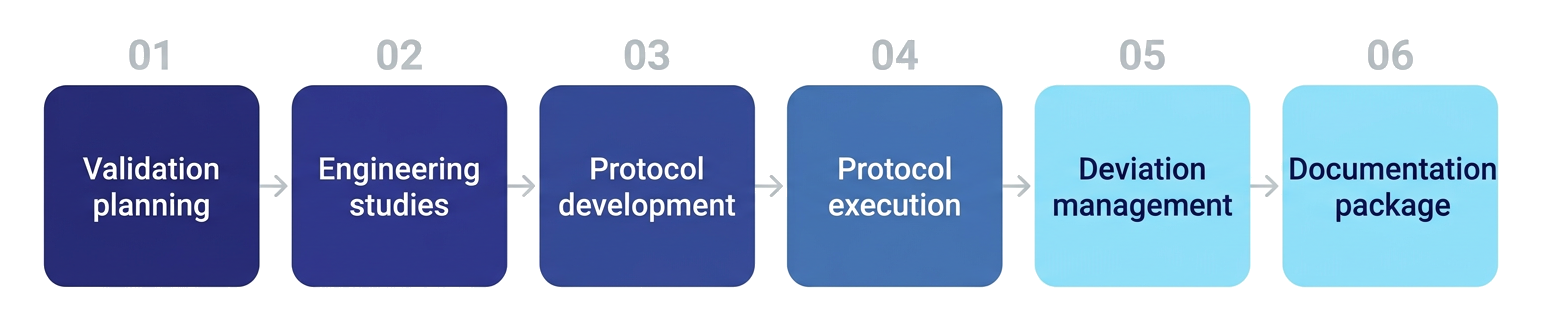
Validation planning starts at the URS.
Every requirement in the URS is written as a testable statement. That testability is what makes IQ/OQ/PQ work. When the URS says “fill volume shall be X mL ± Y% at Z PPM, verified by in-line vision inspection calibrated to [standard],” that requirement produces a specific IQ check, a specific OQ test at worst-case parameters, and a specific PQ acceptance criterion. The trace matrix builds itself from a properly written URS.
Engineering studies where needed.
Before IQ/OQ/PQ begins, engineering studies establish the operating parameter ranges — the boundaries within which the process runs correctly. OQ then tests at those boundaries. Engineering studies prevent OQ failures caused by parameter ranges that were defined too narrowly or too broadly without supporting data.
Protocol development tied to the URS.
IQ, OQ, and PQ protocols are developed against the URS and the trace matrix — not from generic validation templates adapted to this equipment. Every test in the protocol maps to a requirement. Every acceptance criterion traces back to a specification. Nothing is improvised during execution.
Protocol execution.
MEPSCo executes the protocols or provides execution oversight. Test results are documented as they occur — not reconstructed from notes afterward. Pass/fail determinations are made against the defined acceptance criteria in real time. Deviations are documented immediately and dispositioned correctly — not omitted from the record.
Deviation management.
Deviations happen. A test result that falls outside acceptance criteria, an instrument calibration that expired before a test was executed, a production material lot that doesn’t match the qualification lot. Deviations aren’t failures if they’re documented correctly and dispositioned with appropriate engineering judgment. Undocumented deviations are 483 observations.
IQ/OQ/PQ documentation package.
The complete documentation package — validation plan, IQ/OQ/PQ protocols with results, engineering studies, deviation reports, trace matrix update, and the final validation report — is what releases the equipment to manufacturing. Every document is complete before the package is submitted to quality.
Proof
On the DOD pandemic project, multiple 200 PPM filling lines were brought through IQ/OQ/PQ and released to manufacturing in record time. Three replicate machines required minimal engineering involvement during qualification because the original URS and GAMP documentation were complete enough that the qualification protocols could be executed by the team with minimal oversight from MEPSCo. The documentation was thorough enough to support remote qualification of the UK unit.
$150M in equipment qualified. No 483 observations on the documentation chain. On time.
“His proficiency in executing Factory Acceptance Tests, Site Acceptance Tests, Engineering Studies, IQ, OQ, and PQ has ensured that our systems meet and exceed regulatory standards, including FDA and GHTF process validation guidance.”
FRANK MAJDI · DIRECTOR OF QUALITY ENGINEERING, HOLOGIC
“He understands what to address and at what stage of the project to get the best results possible. He made it possible for us to see our way through the issues and properly getting to the validation stage.”
ERIC RHINE · DIRECTOR OF MANUFACTURING OPERATIONS, HOLOGIC

When MEPSCo Gets Involved
Ideal: from the URS forward. When MEPSCo writes the URS, manages vendor selection, executes FAT and SAT, and develops the IQ/OQ/PQ protocols as part of the same engagement, qualification runs from a complete, traceable documentation set. No gaps. No surprises.
But IQ/OQ/PQ support is also available as a standalone engagement.
If a manufacturer is approaching qualification with an existing vendor engagement and needs protocol development, execution oversight, and documentation package completion — MEPSCo can step in. The protocols are developed from whatever documentation exists, gaps are identified and addressed before execution begins, and the qualification is executed with the same documentation discipline.
Retroactive IQ/OQ/PQ — qualifying equipment that was installed and running without documentation — is the hardest version of this work. It requires reverse-engineering the installation and operational evidence, developing protocols against an incomplete documentation baseline, and running qualification on equipment that may have been modified since installation. Possible. More expensive. More time-consuming. And entirely preventable.
“Our internal team can handle IQ/OQ/PQ.”
They might. Ask how many IQ/OQ/PQ packages they’ve executed in medical device manufacturing. Pattern recognition matters here — knowing which acceptance criteria commonly get challenged during FDA inspection, which deviation types require engineering disposition vs. quality review, which trace matrix gaps produce 483 observations vs. which are acceptable documentation variations.
A junior engineer executing their first IQ/OQ/PQ package is learning on this project’s timeline and budget. That’s a real cost. And if the package has documentation gaps that produce a 483 observation, the cost compounds.
“We’ve already ordered the machine. Isn’t it too late?”
No. The machine being ordered doesn’t determine whether IQ/OQ/PQ goes well. The URS, FAT, and SAT documentation determine whether IQ/OQ/PQ goes well. If there’s time between the order and delivery to develop proper FAT and SAT protocols, and between delivery and qualification to develop IQ/OQ/PQ protocols tied to the URS, the qualification has a real chance of running cleanly.
The earlier MEPSCo is engaged after the order, the better. But it’s rarely too late to improve the documentation position before qualification begins.
Common Questions
What does IQ/OQ/PQ stand for in medical device manufacturing?
IQ stands for Installation Qualification — documentation that equipment was installed correctly. OQ stands for Operational Qualification — demonstration that equipment operates within specification across its full operating range. PQ stands for Performance Qualification — demonstration that the process consistently produces output meeting specifications under actual production conditions. Together they form the validation sequence required to release manufacturing equipment under FDA’s Quality Management System Regulation (21 CFR Part 820, updated as QMSR effective February 2026).
How long does IQ/OQ/PQ take for a medical device automation project?
Depends on equipment complexity and documentation completeness going in. A straightforward filling line with complete URS, FAT, and SAT documentation and well-defined acceptance criteria might run IQ/OQ/PQ in 4–8 weeks. More complex multi-function equipment, equipment with process definition gaps, or equipment with incomplete upstream documentation takes longer — 3–6 months is common for complex projects. The biggest variable isn’t the equipment complexity. It’s how complete the documentation is before qualification starts.
What is a trace matrix and why does it matter for IQ/OQ/PQ?
The trace matrix is the document that links every URS requirement to a design element, to a FAT or SAT test result, to a qualification step in IQ/OQ/PQ. It’s the chain of evidence that FDA inspectors use to verify the equipment was specified, built, tested, and qualified correctly. A trace matrix with gaps means some requirements can’t be traced through the qualification — which is either a 483 observation or a documentation remediation project before the qualification can close.
Can IQ/OQ/PQ be performed on equipment that skipped FAT and SAT?
Technically, yes. In practice, it’s significantly harder. Without FAT and SAT documentation, the trace matrix has gaps that have to be addressed during IQ/OQ/PQ. Equipment deficiencies that would have been caught at FAT show up during OQ or PQ — at the manufacturer’s site, on the manufacturer’s timeline, often requiring the vendor to return. The cost of skipping FAT and SAT is paid during IQ/OQ/PQ.
What is a deviation during IQ/OQ/PQ and how is it handled?
A deviation is a test result or observation that falls outside the acceptance criteria or protocol requirements. Deviations must be documented immediately when they occur, investigated to determine root cause, and dispositioned with appropriate engineering judgment and quality review. A deviation that’s documented and properly dispositioned is an acceptable part of the qualification record. An undocumented deviation — one that occurred but wasn’t captured in the protocol — is a 483 observation. The record must reflect what actually happened.
How does MEPSCo’s IQ/OQ/PQ approach differ from what a validation consulting firm would provide?
Two differences. First, MEPSCo’s IQ/OQ/PQ protocols are developed from the URS and trace matrix built at the beginning of the project — not adapted from generic pharmaceutical validation templates. The protocols reflect the actual equipment and the actual requirements. Second, MEPSCo executes the protocols or provides direct execution oversight — not a junior consultant assigned to the engagement after the senior partner sold it. 96+ IQ/OQ/PQ packages across medical device manufacturing automation is the pattern recognition behind the execution.
Related Pages
IQ/OQ/PQ failures don’t start at IQ/OQ/PQ. They start earlier. And they end with equipment that can’t be released to manufacturing, a vendor who’s already moved on to the next project, and a timeline that’s gone.
The time to address this is before the machine ships. If your team is approaching qualification on an automation project — or is already in the middle of one — the assessment call is where that conversation starts.
Not ready to talk? Download the GAMP Roadmap to see where IQ/OQ/PQ fits in the full procurement process.