URS Development for Medical Device Manufacturing Automation
A User Requirements Specification (URS) is the document that defines what manufacturing equipment must do before any vendor builds it. In medical device manufacturing, a properly written URS prevents change orders, produces comparable vendor quotes, and forms the traceable foundation for IQ/OQ/PQ validation. Without it, every subsequent step in the procurement process costs more than it should.
The URS is not a wish list.
That’s the most important thing to understand about User Requirements Specifications in medical device manufacturing automation. A wish list is what happens when a manufacturer asks for “a filling machine that fills bottles.” A URS is what happens when every stakeholder who touches that machine — the operator, the maintenance team, the validation engineer, the quality director, the process engineer — has been interviewed, their requirements collected, and every line item written in a form that’s specific, verifiable, and traceable through qualification.
One produces inflated vendor quotes and change orders. The other produces on-time, on-budget delivery with validated equipment. The difference between them is who writes the document and how.
MEPSCo has written URS documents across 96+ equipment procurement projects in medical device manufacturing. The GAMP documentation process built at Gen-Probe in 2001 started with this document. Everything downstream — vendor selection, FAT, SAT, IQ/OQ/PQ — builds on it. Get the URS wrong and the whole project pays.
What a Weak URS Actually Costs
Most manufacturers don’t realize a URS is weak until the vendor quotes come back.
Three quotes for the same piece of equipment.
No two are scoped to the same assumptions. The vendor at $400k left out the vision inspection system because the URS didn’t specify one. The vendor at $1.1M added $200k in contingency for requirements that weren’t defined clearly enough to quote confidently.
The manufacturer now has three quotes they can’t compare and a leadership team asking which one to pick.
That’s a URS problem. Not a vendor problem.
Failure to validate processes in accordance with FDA requirements under 21 CFR Part 820 (now updated as the Quality Management System Regulation, effective February 2026, harmonized with ISO 13485:2016) is one of the most frequently cited Form 483 observations FDA issues. The documentation chain that prevents those observations starts at the URS. Not at IQ/OQ/PQ. The URS.
What a Properly Written URS Does
Four things. Each one measurable.
Produces comparable vendor quotes. When every vendor receives the same complete, specific requirements, they quote to the same scope. No assumptions. No contingency for undefined items. The quotes come back comparable — which means the selection decision is based on capability, not on which vendor interpreted the gaps most favorably.
Prevents change orders. A change order is a requirement that wasn’t in the URS. Full stop. Every change order on an automation project traces back to something that wasn’t defined, wasn’t specific enough, or was defined by the vendor’s assumptions instead of the manufacturer’s requirements. A URS that eliminates ambiguity eliminates change orders at the source.
Provides the traceability foundation for validation. The trace matrix links every requirement in the URS to a corresponding design element, then to a test in the FAT or SAT, then to a qualification step in IQ/OQ/PQ. Without a complete URS, there’s nothing to trace. The trace matrix becomes a document that exists on paper but doesn’t reflect the actual equipment. That’s a 483 observation waiting to happen.
Serves as the vendor evaluation tool. A properly written URS isn’t just the document the vendor builds against. It’s the document used to evaluate whether a vendor is even capable of building the equipment. When a vendor declines to quote because the GAMP documentation requirements exceed their internal capability, that’s the URS working correctly. You want to know that before you sign a contract.
How MEPSCo Writes a URS
The process isn’t starting with a template and filling in blanks. Every URS starts with interviews.
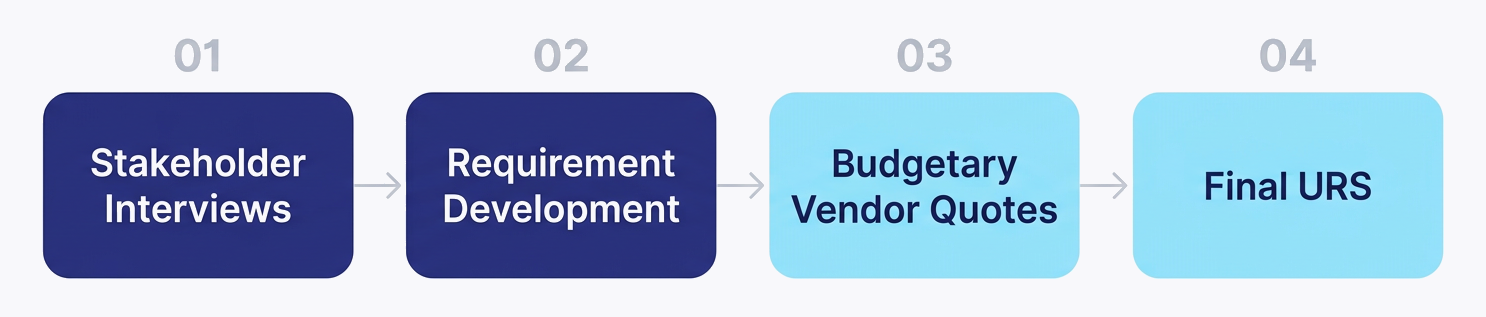
Step 1: Stakeholder Interviews
Before a single requirement is written, every person who touches the equipment is interviewed. Management needs a budget number and a timeline. The process engineer needs specific fill volume tolerances and throughput targets. The maintenance team needs access panels, consumable change-out intervals, and documentation they can actually use. The validation team needs testable requirements — every line item in the URS must be verifiable by a test method. The operator needs an interface that works in a real production environment, not in a vendor demonstration.
These are not the same requirements. A URS that captures only the process engineer’s view produces equipment the maintenance team can’t sustain. A URS that captures only what management approved in the budget misses the technical requirements the vendor needs to build to.
Step 2: Requirement Development
Requirements are written as specific, testable statements. Not “the machine shall fill bottles accurately” but “the machine shall fill bottles to a target volume of X mL ± Y%, at Z PPM, with 100% in-process vision inspection of fill volume, verified by [test method].” Every requirement has a number. Every requirement is testable. The URS becomes the contract between the manufacturer and the vendor.
Step 3: Budgetary Vendor Quotes
Before the final URS is locked, a Budgetary URS is used to get realistic quotes from multiple vendors. This step surfaces the difference between what the manufacturer wants and what the market will deliver at budget. It also identifies vendors who can’t support the GAMP documentation requirements early — before a contract is signed. Management gets a real number to approve.
Step 4: Final URS
After vendor quotes are in and management has approved the budget, the final URS is developed. It incorporates what the vendor selection process surfaced, resolves any requirements that needed clarification, and becomes the document the vendor builds against for the duration of the project.
Proof
The URS built at Gen-Probe in 2001 was complete enough to use as both a project baseline and a vendor quote evaluation tool. On the DOD pandemic project, a Hologic 200 PPM filling machine was specified, procured, and qualified using the MEPSCo URS process — no change orders, on time, during COVID-19. Three additional replicate machines were brought in, qualified, and released to manufacturing in record time because the original URS was thorough enough that the replicate builds required minimal additional engineering involvement.
$150M in equipment validated. One process. No change orders.
“Reza has done a great job in ensuring equipment requirements are well-defined by the end user so that vendors are successful in providing equipment solutions that are thorough and complete.”
JIM NEAL · SR. DIRECTOR OF OPERATIONS, HOLOGIC

When to Bring MEPSCo In
The right time to start the URS is before a vendor is contacted. Not after quotes come back. Not after a vendor has been selected. Not after the machine is being built and requirements are being negotiated in real time.
But MEPSCo can also step in at later stages.
If quotes have come back and they’re not comparable, a URS revision can get the project back on track before vendor selection. If a vendor is already engaged and scope creep is starting, a URS review and gap analysis identifies what’s missing and what needs to be added to the contract. If a piece of equipment was procured without a URS and now needs to be validated, MEPSCo can reverse-engineer the requirements from the equipment — harder, slower, more expensive than doing it right the first time, but possible.
The ideal is always before. The earlier the URS is written correctly, the less everything else costs.
“Our vendor said they’d handle the URS.”
They might. But ask who at the vendor is writing it and what experience they have with GAMP documentation in medical device manufacturing. Automation vendors build equipment. GAMP documentation — particularly URS development — is not their core competency. The documentation staff at vendors move around. Validation typically happens six or more months after machine delivery. The person who understood the build well enough to write a useful URS may not be there anymore.
More fundamentally: when the same organization writes the requirements and builds the equipment to those requirements, nobody is checking whether the requirements are right. That’s where change orders start. And that’s why the manufacturer needs their own engineer at the table.
“We have a junior engineer who can write the URS.”
Junior engineers can be trained to fill out URS templates. What they can’t substitute for is the pattern recognition that comes from 96+ projects — knowing which requirements get missed in a first draft, which vendor claims don’t hold up against specific requirement language, which maintenance requirements get overlooked until the machine is installed and the maintenance team can’t service it. A junior engineer on their first URS is learning on this project’s budget and timeline. That’s a real cost, even if it doesn’t show up as a line item.
Common Questions
What does URS stand for and why does it matter for equipment procurement?
URS stands for User Requirements Specification. It’s the document that defines what manufacturing equipment must do before any vendor builds it. In medical device manufacturing, it’s the foundation for vendor quotes, vendor selection, FAT and SAT testing, and IQ/OQ/PQ validation. A weak or incomplete URS produces incomparable quotes, change orders, and validation gaps. A properly written URS produces on-time, on-budget delivery with validated equipment.
How long does it take to write a URS for a medical device automation project?
Depends on equipment complexity and how well-defined the manufacturing process is. A URS for a straightforward filling line with a defined process might take 2–4 weeks. A URS for a more complex multi-function assembly machine with less defined process parameters takes longer — 4–8 weeks is common. The time spent writing the URS correctly is recovered many times over in prevented change orders and faster vendor quotes.
Should the URS be written before or after getting vendor quotes?
Before. The URS is what vendors quote against. Getting vendor quotes before the URS is written means every vendor quotes to different assumptions and adds contingency for everything undefined. The quotes can’t be compared, and the lowest quote is almost never the lowest final cost. A Budgetary URS — a requirements document complete enough to get realistic quotes without locking in every final specification — is the right first step before vendor contact.
How does the URS connect to IQ/OQ/PQ?
Every requirement in the URS feeds into the trace matrix. The trace matrix links each requirement to a design element in the FRS or FDS, then to a test in the FAT or SAT, then to a qualification step in IQ/OQ/PQ. Without a complete URS, the trace matrix has nothing to trace. Qualification becomes a document exercise rather than a verification of actual equipment performance. FDA’s updated QMSR (21 CFR Part 820, effective February 2026) maintains validation requirements under the harmonized ISO 13485:2016 standard — and incomplete traceability remains a common 483 observation.
Can MEPSCo write a URS for equipment that’s already been selected?
Yes, but it’s harder. When the vendor is already selected, the URS has to be negotiated against an existing relationship rather than used as a vendor evaluation tool. Requirements that the vendor’s equipment can’t meet without modification become change orders before the machine is even built. The earlier MEPSCo is engaged in the URS process, the less this situation occurs. But a URS can be written at any stage — the later it starts, the more expensive the gaps become.
What makes MEPSCo’s URS development different from a generic template?
The process starts with stakeholder interviews, not a template. Every requirement is written as a specific, testable statement — not a generic capability claim. The URS is reviewed against what comparable vendor equipment actually delivers, not just what the manufacturer wants. And the 96+ projects of pattern recognition behind the process means the requirements that commonly get missed — maintenance access, consumable change-out, vision inspection calibration, operator interface usability — are in the document before the first vendor quote is requested.
Missing requirements don’t show up in the URS. They show up in change orders.
Every week a project runs without a defined URS is a week of vendor assumptions building into a machine that may not meet spec. If your team is approaching an automation procurement project, the assessment call is where that stops.
Not ready to talk yet? Download the GAMP Roadmap to see how the URS fits into the full procurement process.